CME IMPACT BUT NO STORM (YET): A coronal mass ejection (CME) hit Earth's magnetic field today, Feb. 9th @ 2100 UT. So far the impact has not sparked a geomagnetic storm. However, it often takes hours or even more than a day for storms to develop as Earth glides through a CME's magnetized wake. Indeed, such a delayed storm was the cause of the Starlink Incident, described below. Stay tuned for updates. Auroras alerts: SMS Text.
GEOMAGNETIC STORM BRINGS DOWN STARLINK SATELLITES: As many as 40 Starlink satellites are currently falling out of the sky--the surprising result of a minor geomagnetic storm. SpaceX made the announcement yesterday:
"On Thursday, Feb. 3rd at 1:13 p.m. EST, Falcon 9 launched 49 Starlink satellites to low Earth orbit from Launch Complex 39A (LC-39A) at Kennedy Space Center in Florida. ... Unfortunately, the satellites deployed on Thursday were significantly impacted by a geomagnetic storm on Friday, [Feb. 4th]."
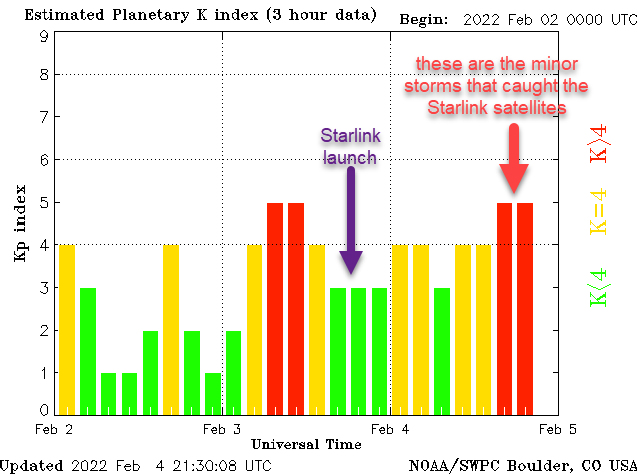
Two days before launch a CME hit Earth's magnetic field. It was not a major space weather event. In fact, the weak impact did not at first spark any remarkable geomagnetic activity. However, as Earth passed through the CME's wake, some sputtering G1-class geomagnetic storms developed. It was one of these minor storms that caught the Starlink satellites on Feb. 4th.

Geomagnetic storms heat Earth's upper atmosphere. Diaphanous tendrils of warming air literally reached up and grabbed the Starlink satellites. According to SpaceX, onboard GPS devices detected atmospheric drag increasing "up to 50 percent higher than during previous launches."
"The Starlink team commanded the satellites into a safe-mode where they would fly edge-on (like a sheet of paper) to minimize drag," says SpaceX. "Preliminary analysis show the increased drag at the low altitudes prevented the satellites from leaving safe-mode to begin orbit raising maneuvers, and up to 40 of the satellites will reenter or already have reentered the Earth’s atmosphere."
The Sociedad de Astronomia del Caribe apparently caught one of the reentries over Puerto Rico on Feb. 7th:
SpaceX says that the deorbiting satellites "pose zero collision risk with other satellites and by design demise upon atmospheric reentry—meaning no orbital debris is created and no satellite parts hit the ground."
Keep an eye on the night sky this week. You might catch a Starlink satellite burning up overhead. Solar flare alerts: SMS Text.
Realtime Space Weather Photo Gallery
Free: Spaceweather.com Newsletter
VALENTINE'S GIFTS FROM THE EDGE OF SPACE: Does your sweetheart love space? Their perfect Valentine's gift may be in the Earth to Sky Store. All items in the store have flown to the edge of space on board cosmic ray research balloons. From now until Feb. 14th, everything is 10% off:

Each purchase comes with a greeting card showing the item in flight and telling the story of its journey to the stratosphere and back again. Don't forget to enter the coupon code "ILOVESPACE" for your Valentine's discount!
Far Out Gifts: Earth to Sky Store
All sales support hands-on STEM education
SUNSPOT ARCHIPELAGO: An archipelago of sunspots is growing between the primary cores of AR2941. This movie from NASA's Solar Dynamics Observatory captures 48 hours of action:
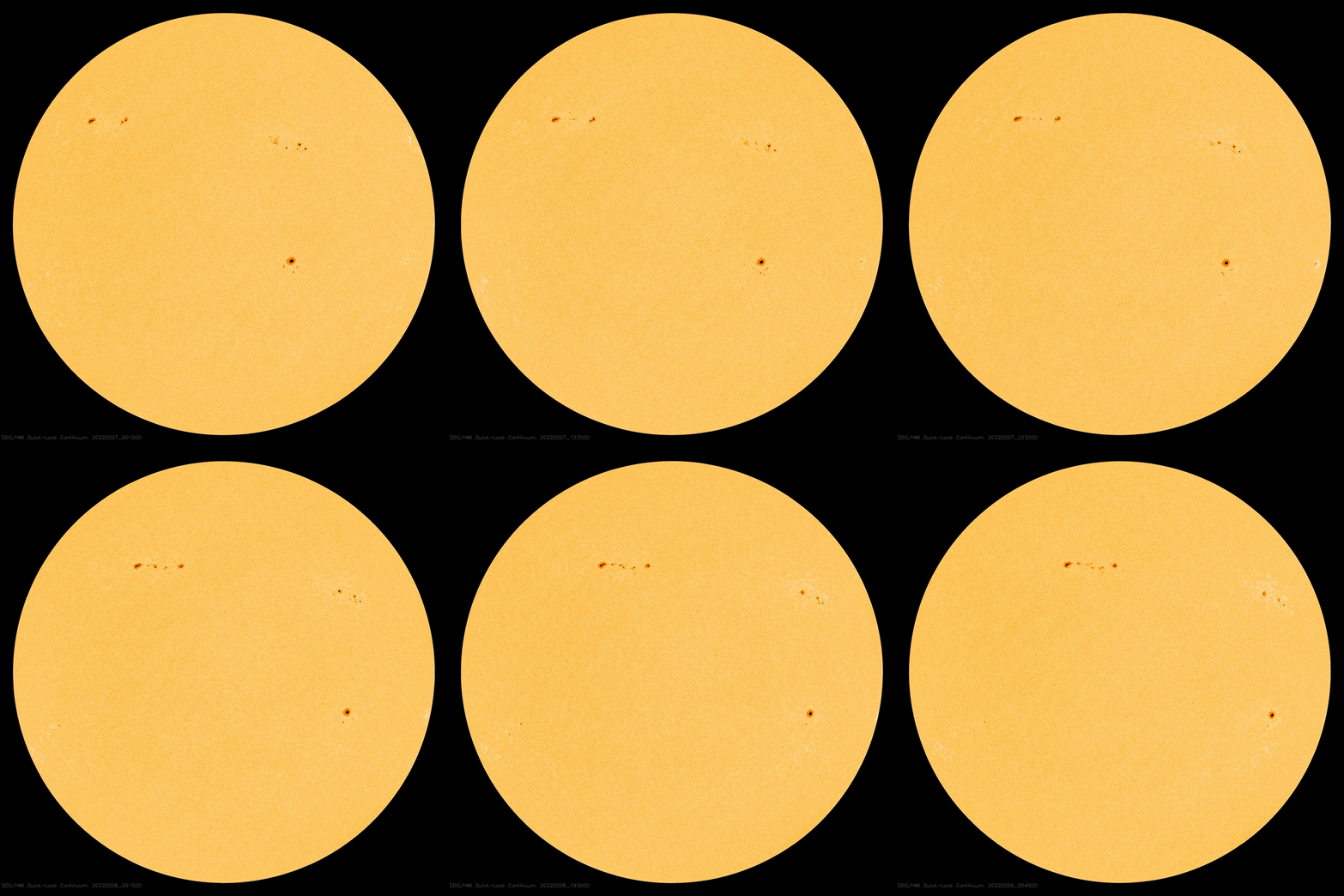
The magnetic island chain stretches nearly 200,000 km with more than a dozen moon-sized spots turning toward Earth. Altogether they have an unstable 'beta-gamma' magnetic field that harbors energy for M-class solar flares. Any eruptions today will be Earth-directed. Solar flare alerts: SMS Text.
Realtime Aurora Photo Gallery
Free: Spaceweather.com Newsletter