ANOTHER SOLAR FLARE: Departing sunspot AR2941 is crackling with M-class solar flares. The latest, a category M1.3 explosion on Feb. 15th at 1815 UT, caused a minor shortwave radio blackout over South America. This sunspot could produce an X-flare before it vanishes over the sun's western limb later this week. Solar flare alerts: SMS Text.
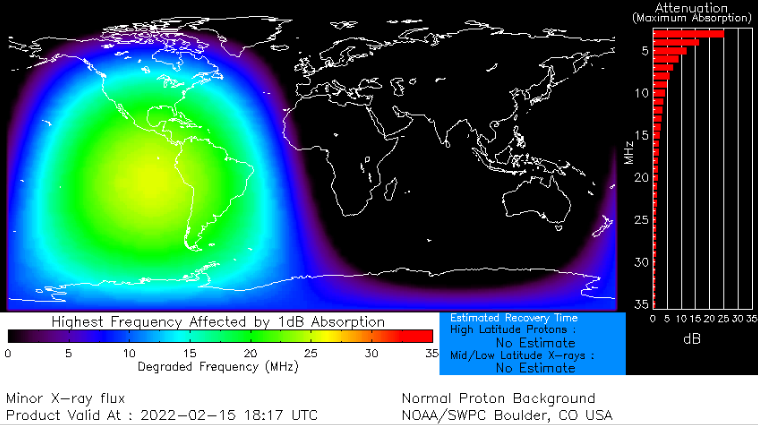
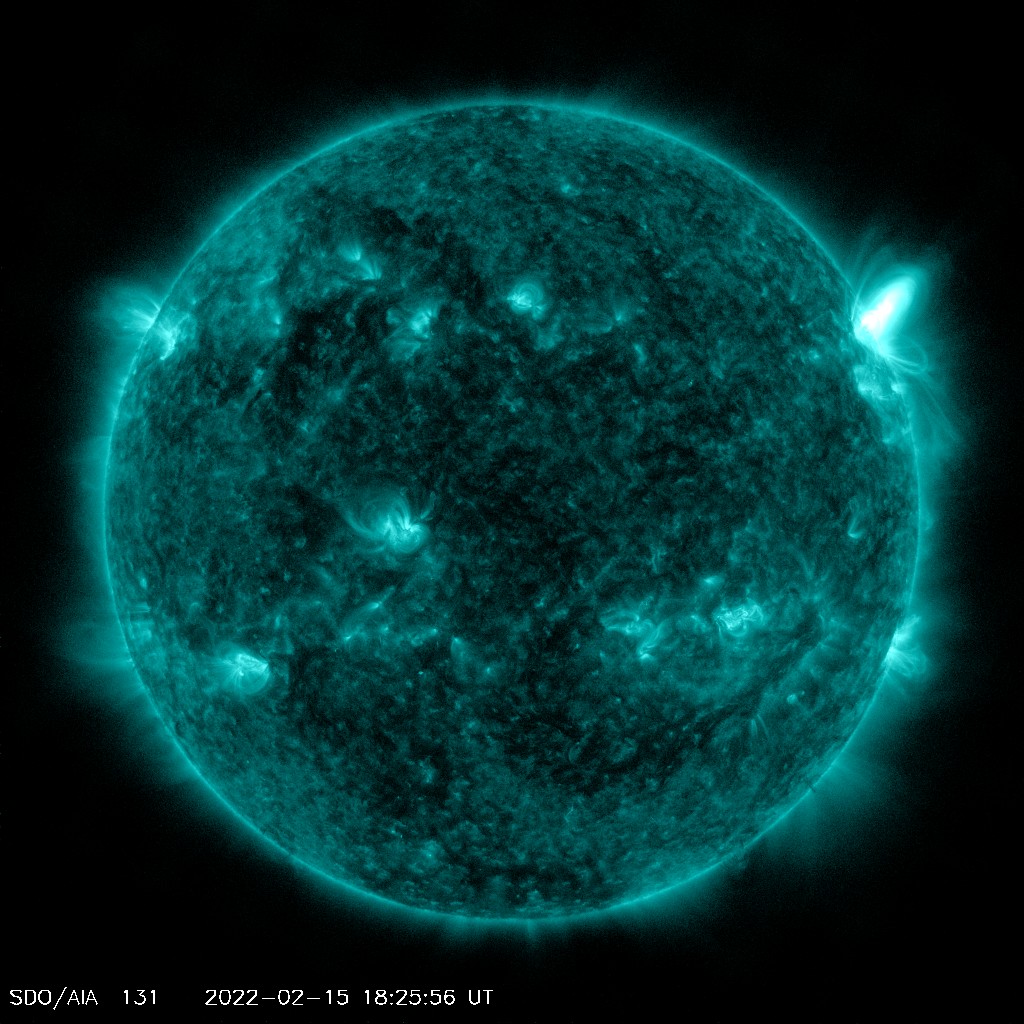
Above: An extreme ultraviolet image of the Feb. 15th M-flare. Credit: NASA/SDO
Realtime Aurora Photo Gallery
Free: Spaceweather.com Newsletter
A RARE BLUE FLASH FROM THE SUN: You've heard of the green flash, the emerald light that sometimes glints above the setting sun. Once thought to be a fable, the green flash was popularized by Jules Verne in his 1882 novel "Le Rayon Vert" (The Green Ray). Now we know it is real.
And what about the blue flash? Turns out, that's real too. Benji Barnes photographed one from Honolulu, Hawaii, on Feb. 12th:

"I've been trying for years to catch a blue flash," says Barnes. "Finally, I did it!"
Blue flashes are formed in the same way as green flashes. A mirage magnifies tiny differences in the atmospheric refraction of red, green and blue light. Blue flashes are harder to see than green flashes because blue flashes blend into the surrounding blue sky. When the air is exceptionally clear, however, the blue flash emerges.
Verne described the green flash as something "which no artist could ever obtain on his palette, a green of which neither the varied tints of vegetation nor the shades of the most limpid sea could ever produce the like! If there is a green in Paradise, it cannot be but of this shade, which most surely is the true green of Hope."
Ditto the blue.
Realtime Space Weather Photo Gallery
Free: Spaceweather.com Newsletter
A DRAGONFLY IN THE STRATOSPHERE: Are you looking for a far-out gift? Consider the Sterling Silver Space Dragonfly. On Jan 12th, this winged pendant flew 113,451 feet above the Sierra Nevada mountains of California, hitching a ride onboard an Earth to Sky Calculus cosmic ray balloon:
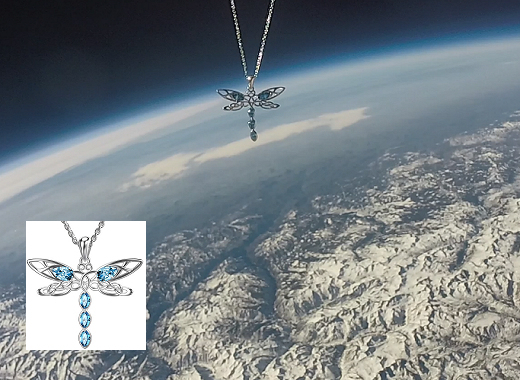
You can have it for $172.95. The dragonfly's heart is a Celtic love knot, and its wings are decorated with blue marquise crystals--all plated with 14k white gold. It's an exquisite ensemble for birthdays, anniversaries or any other romantic occasion.
The students are selling dragonfly pendants to support their cosmic ray ballooning program. Each one comes with a greeting card showing the pendant in flight and telling the story of its trip to the stratosphere and back again.
Far Out Gifts: Earth to Sky Store
All sales support hands-on STEM education