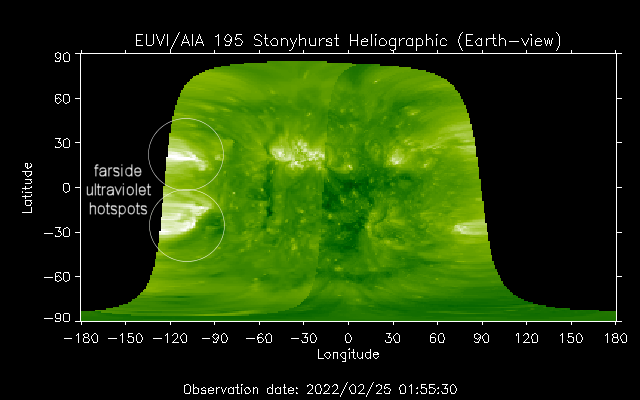
POSSIBLE FARSIDE SUNSPOTS: NASA's STEREO-A spacecraft is monitoring a pair of ultraviolet hotspots behind the sun's eastern limb. These may be active sunspots. We'll find out for sure this weekend when the sun's rotation turns them toward Earth. Solar flare alerts: SMS Text.
BE ALERT FOR ZODIACAL LIGHT: It's one of the most delicate and beautiful sights in the heavens, yet most people have never seen it. We're talking about the Zodiacal Light. "A good display is coming in just a few days," says astrophotographer Petr Horálek, who created this image to whet your appetite:
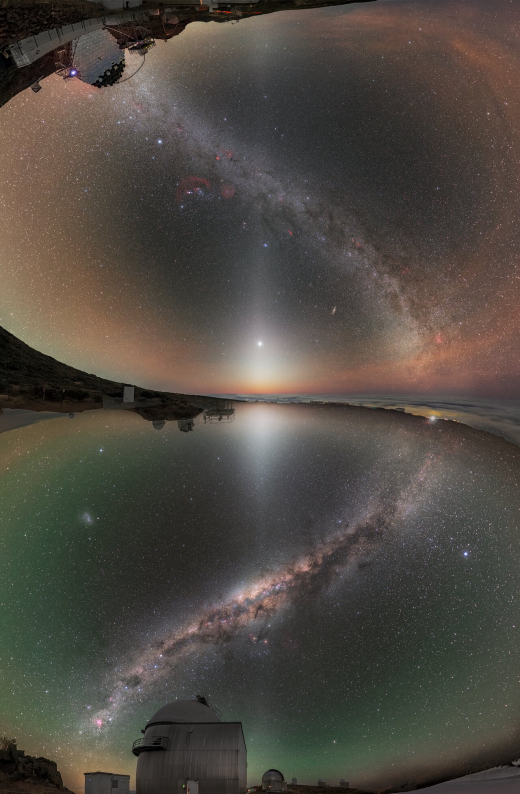
"This composite shows Zodiacal Light from both hemispheres," explains Horálek. "My friend, great TWAN photographer Juan Carlos Casado, took the northern photo from the IAC La Palma Observatory in Feb. 2020. I took the southern photo from ESO's La Silla Observatory in April 2016. Stitched together they show the entire night sky using Earth's horizon to block the bright sun."
See the pale triangles of light at the center? That is Zodiacal Light.
For centuries, astronomers puzzled over the light's origin. Now we know: Zodiacal Light comes from Mars. Giant dust storms on the Red Planet leak into space, filling the plane of the Solar System with tiny grains. We can actually see this dust with the naked eye because it scatters sunlight, producing the triangular glow in Horálek's photo.
February, March and April are good months to see Zodiacal Light because the plane of the Solar System juts over the horizon almost vertically, putting the triangle on full display. Dark skies are required. Zodiacal Light is faint and easily overwhelmed by light pollution.
"New Moon dates close to the equinox are when Zodiacal Light is best seen all around the world," says Horálek. "In the northern hemisphere, visibility is best in the evening after sunset (look west). In the southern hemisphere, visibility is best in the morning before sunrise (look east)."
The next New Moon: March 2nd. Mark your calendar and see the light!
Realtime Space Weather Photo Gallery
Free: Spaceweather.com Newsletter
THE CRESCENT VENUS PENDANT: Are you looking for a far-out gift? Consider the Crescent Venus Pendant. This one flew to the stratosphere onboard a cosmic ray research balloon on Jan. 8, 2022:
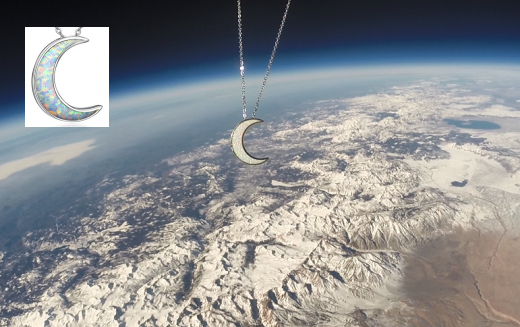
You can have it for $142.95. The opal crescent is framed by sterling silver with a matching hypoallergenic chain. It comes with a greeting card showing the pendant in flight and telling the story of its journey to the stratosphere.
Why is it a crescent? Because Venus itself was a crescent on the date of the flight. On Jan. 8, 2022, the second planet was at inferior conjunction with the sun. From Earth it looked like a slender crescent--the most beautiful phase of the Goddess of Love.
Far Out Gifts: Earth to Sky Store
All sales support hands-on STEM education
Realtime Aurora Photo Gallery
Free: Spaceweather.com Newsletter