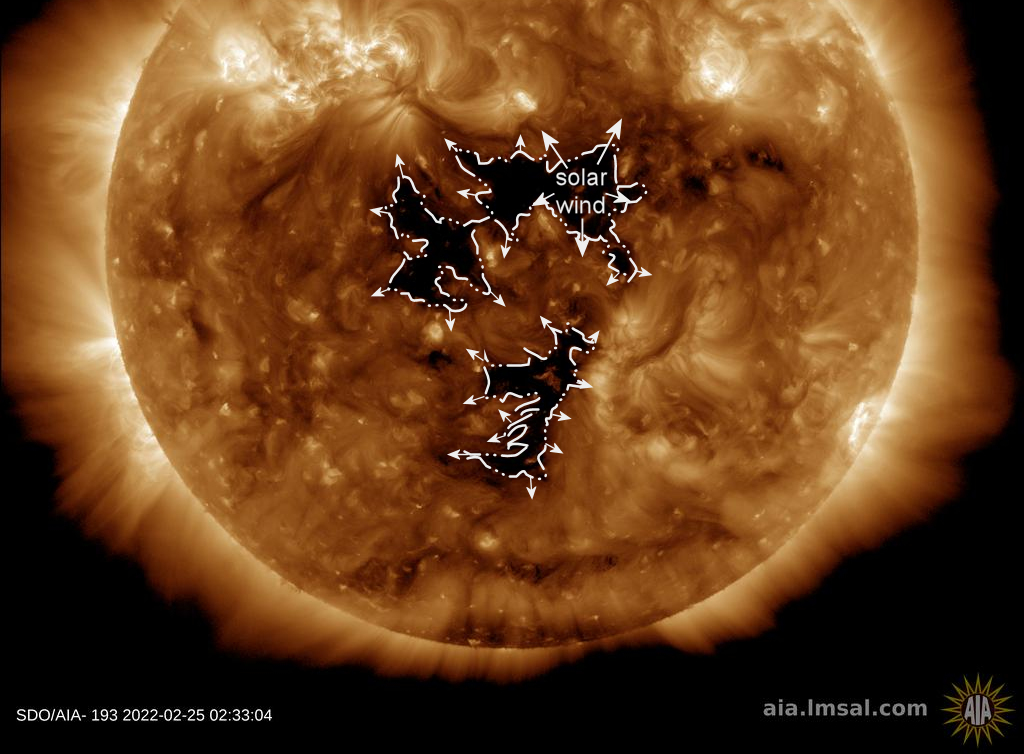
SOLAR WIND, INCOMING: A stream of solar wind is approaching Earth. Estimated time of arrival: Feb. 28th. The gaseous material is flowing from an irregular hole in the sun's atmosphere, and could spark Arctic auroras when it reaches our planet. Solar flare alerts: SMS Text.
STARLINKS OVER LONDON: Yesterday, SpaceX launched a new batch of Starlink satellites, replacing ones lost to a solar storm earlier this month. Twelve hours after launch, the satellites flew over London where amateur astronomer Szabolcs Nagy was waiting with a telescope and a camera:
"I photographed the train of satellites from my back garden," says Nagy. "They were very bright."
When Starlink satellites are first launched, they are in a low-altitude orbit, little more than 200 km high. (Later they ascend to a more distant operational altitude of 550 km.) The low altitude flyby of London allowed Nagy to target a single satellite and see details through his telescope.
"I inset an artist's rendering of a Starlink satellite into this animation of the real thing," says Nagy:
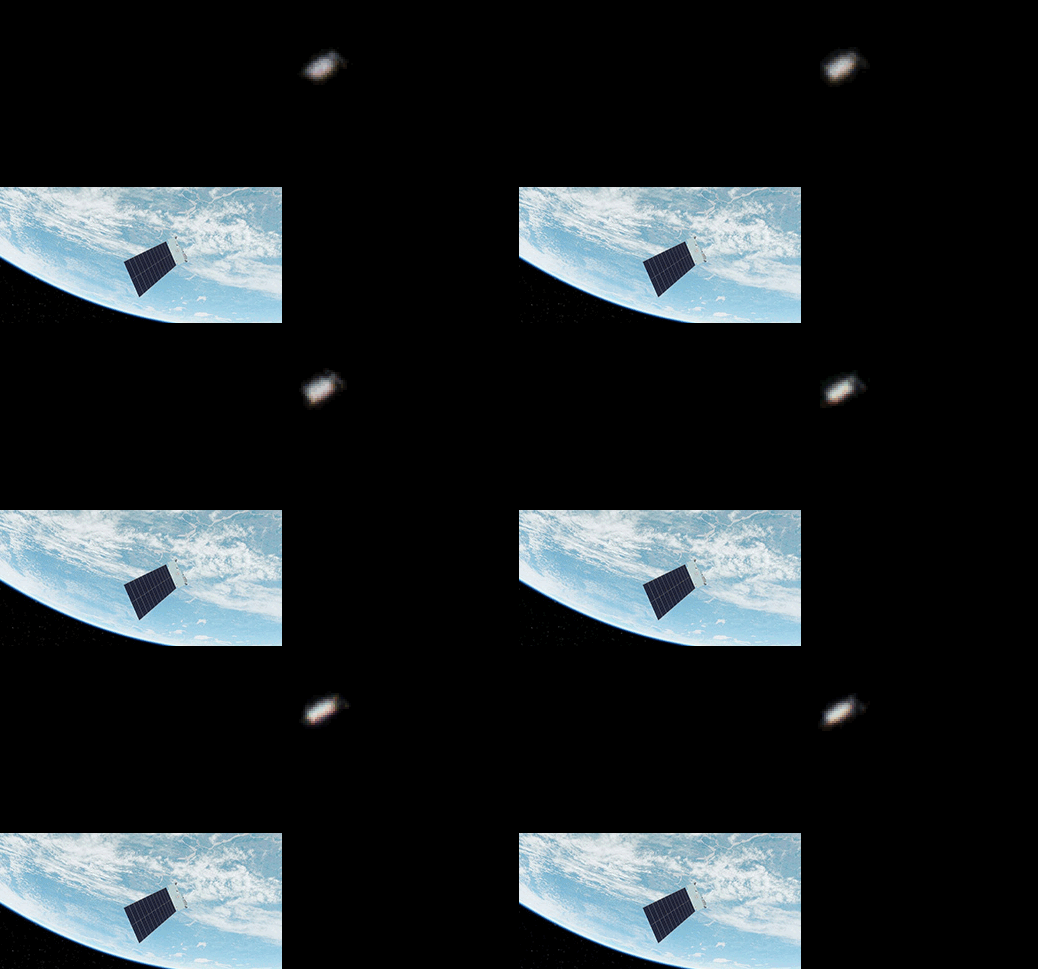
Nagy's video reveals what makes Starlink so bright. Sunlight is reflecting from the satellite's broad solar panels, which have a reflecting area greater than 30 square meters.
To reduce the brightness of Starlink satellites, which some astronomers have likened to light pollution, SpaceX has installed sunblocking visors, which are deployed at operational altitudes. Onboard software also tilts the solar arrays to reduce glinting. The jury's still out, however, on whether these measures are enough to protect astronomy.
Realtime Space Weather Photo Gallery
Free: Spaceweather.com Newsletter
THE CRESCENT VENUS PENDANT: Are you looking for a far-out gift? Consider the Crescent Venus Pendant. This one flew to the stratosphere onboard a cosmic ray research balloon on Jan. 8, 2022:
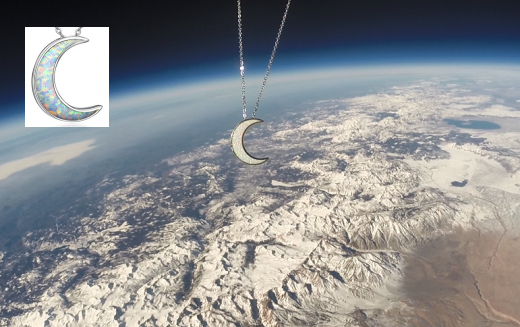
You can have it for $142.95. The opal crescent is framed by sterling silver with a matching hypoallergenic chain. It comes with a greeting card showing the pendant in flight and telling the story of its journey to the stratosphere.
Why is it a crescent? Because Venus itself was a crescent on the date of the flight. On Jan. 8, 2022, the second planet was at inferior conjunction with the sun. From Earth it looked like a slender crescent--the most beautiful phase of the Goddess of Love.
Far Out Gifts: Earth to Sky Store
All sales support hands-on STEM education
Realtime Aurora Photo Gallery
Free: Spaceweather.com Newsletter