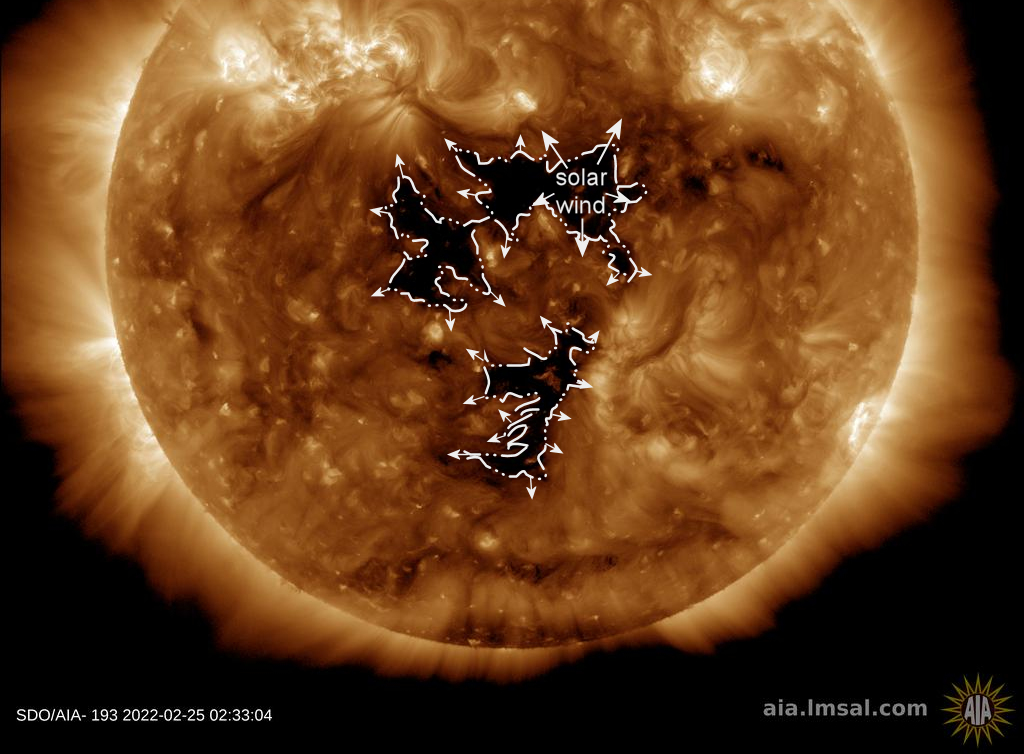
THE SOLAR WIND HAS ARRIVED: Earth is entering a stream of solar wind flowing from a loosely organized cluster of holes in the sun's atmosphere. Geomagnetic storms are not expected at this time. However, lesser geomagnetic unrest and bright auroras are possible inside the Arctic Circle. Aurora alerts: SMS Text.
TONGA VOLCANIC ERUPTION TOUCHED THE MESOSPHERE: When a volcano exploded out of the Pacific Ocean near Tonga on Jan. 15th, scientists immediately realized they were witnessing something special. Little did they know how special. A new analysis of images from Earth-orbiting satellites shows that the plume punched a hole in our atmosphere all the way up to the mesosphere.
"The intensity of this event far exceeds that of any storm cloud I have ever studied," said Kristopher Bedka, an atmospheric scientist at NASA Langley who specializes in studying extreme storms.
Bedka and colleagues combined images from two satellites: NOAA's GOES-17 and Japan's Himawari-8, both of which observed the eruption using similar infrared cameras from different points in geosynchronous orbit. Using the simple math of stereo geometry, the team calculated that the plume rose to 58 kilometers (36 miles) at its highest point.
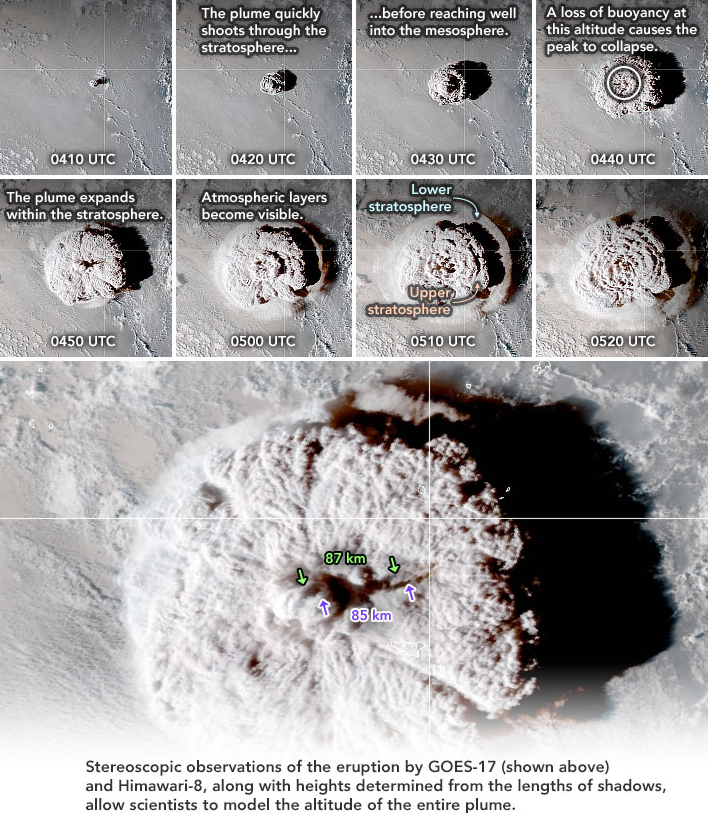
For comparison, the largest known volcanic plume in the satellite era before Tonga came from Mount Pinatubo, which spewed ash and aerosols up to 35 kilometers (22 miles) into the air above the Philippines in 1991. The Tonga plume was 1.5 times the height of Pinatubo.
The extreme height of the Tonga plume means it could affect space weather phenomena such as sprites, airglow, and noctilucent clouds, which also occur in the mesosphere. Tonga was truly out of this world.
Realtime Space Weather Photo Gallery
Free: Spaceweather.com Newsletter
'TONGA SUNSETS' CONTINUE: A month and a half after the Tonga volcano erupted, southern hemisphere sky watchers are still seeing unusual sunsets. Helio C. Vital took this picture from Rio de Janeiro, Brazil, on Feb. 26th:

"This spectacular sunset was possibly caused by the return of the plumes of aerosols launched into the high atmosphere by Tonga," says Vital, who has seen several episodes of colorful sunsets since the eruption. "Their timing is consistent with a 2-week circumnavigation period at Rio's latitude."
Aerosols from the volcano's plume have persisted in the stratosphere for more than a month after the eruption and could stay for a year or more, according to atmospheric scientist Ghassan Taha of the Goddard Space Flight Center.
More Tonga sunsets: from Cassiano Macedo of Sao Paulo, Brazil; from Peter Lowenstein of Mutare, Zimbabwe; from Daniele Gasparri of Atacama, Chile; from Ray Pickard of the Bathurst Observatory, NSW Australia; from Tara Williams of Pottsville NSW Australia
THE CRESCENT VENUS PENDANT: Are you looking for a far-out gift? Consider the Crescent Venus Pendant. This one flew to the stratosphere onboard a cosmic ray research balloon on Jan. 8, 2022:
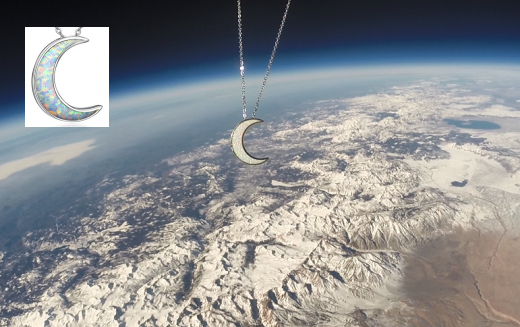
You can have it for $142.95. The opal crescent is framed by sterling silver with a matching hypoallergenic chain. It comes with a greeting card showing the pendant in flight and telling the story of its journey to the stratosphere.
Why is it a crescent? Because Venus itself was a crescent on the date of the flight. On Jan. 8, 2022, the second planet was at inferior conjunction with the sun. From Earth it looked like a slender crescent--the most beautiful phase of the Goddess of Love.
Far Out Gifts: Earth to Sky Store
All sales support hands-on STEM education
Realtime Aurora Photo Gallery
Free: Spaceweather.com Newsletter