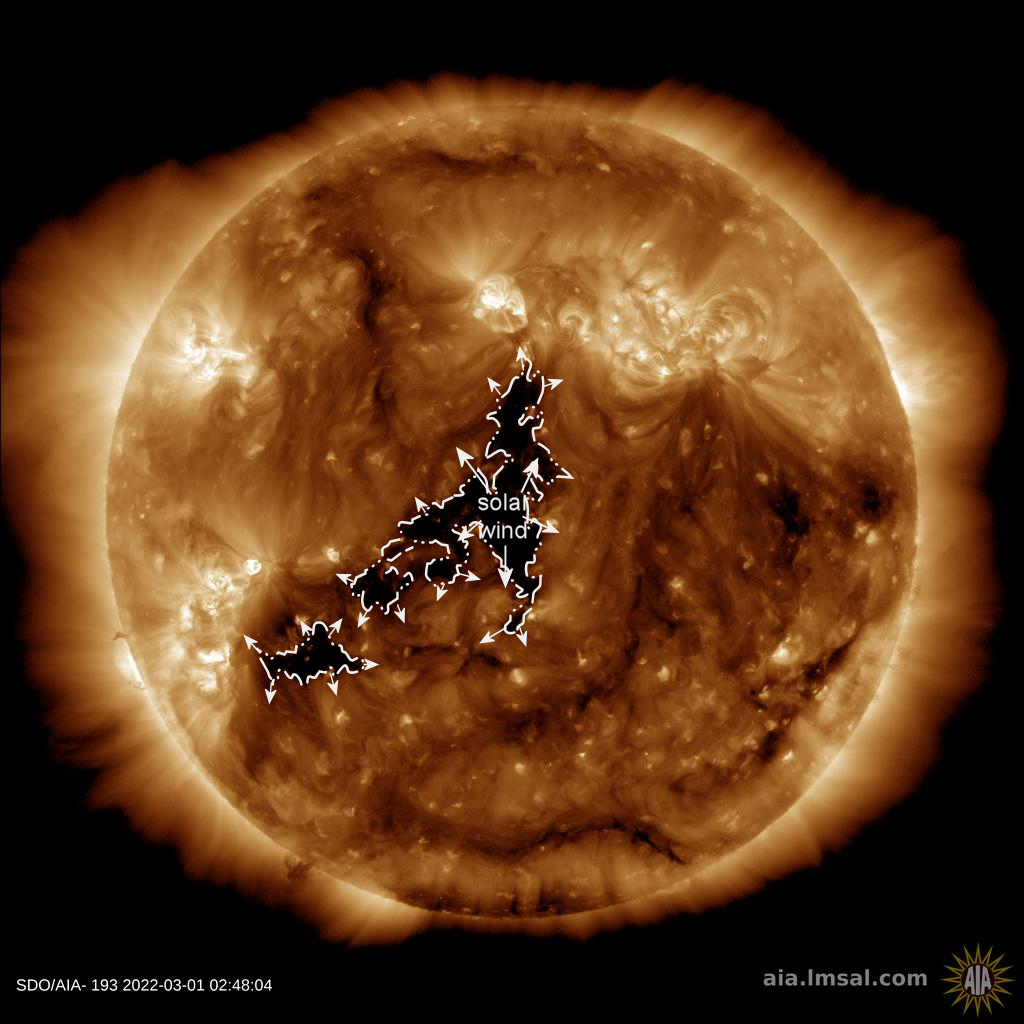
SOLAR WIND STREAM APPROACHES EARTH: A stream of solar wind is approaching Earth. Estimated time of arrival: March 5th. The gaseous material is flowing from an equatorial hole in the sun's atmosphere, and it could spark minor geomagnetic storms and Arctic auroras when it arrives. Solar flare alerts: SMS Text.
THE MYSTERY OF ORANGE AURORAS: A recent display of auroras over Canada has experts scratching their heads. The mystery? They were orange. Pilot Matt Melnyk was flying 36,000 feet over Canada on Feb. 23rd when he saw the strangely-colored lights from the cockpit window:
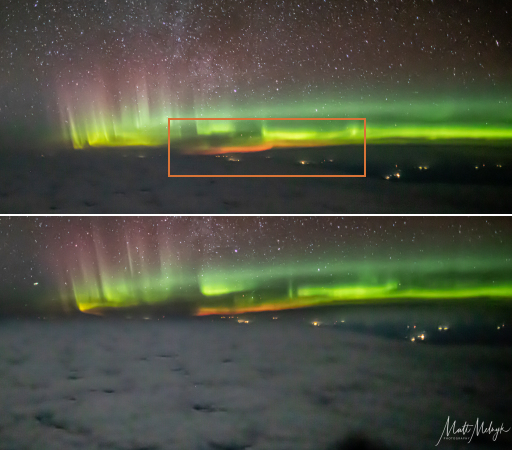
"I have been chasing and photographing auroras for more than 13 years (often from airplanes) and this is the first time I have ever seen orange," says Melnyk.
What's so strange about orange? Joe Minow of NASA's Marshall Space Flight Center explains: "Theoretically, nitrogen and oxygen (N2, N2+, and O2+) can produce emissions at orange wavelengths, but these are typically weak compared to stronger emissions from the same molecules at the red end of the spectrum. It is hard to understand how orange could dominate in an auroral display."
Even so, Melnyk says "these appeared to be real auroras." The orange fringe danced in sync with regular red and green auroras overhead. It did not appear to be an artifact of city lights or distant twilight. Moreover, Melnyk saw the orange color with his naked eye, and his camera recorded it, too.
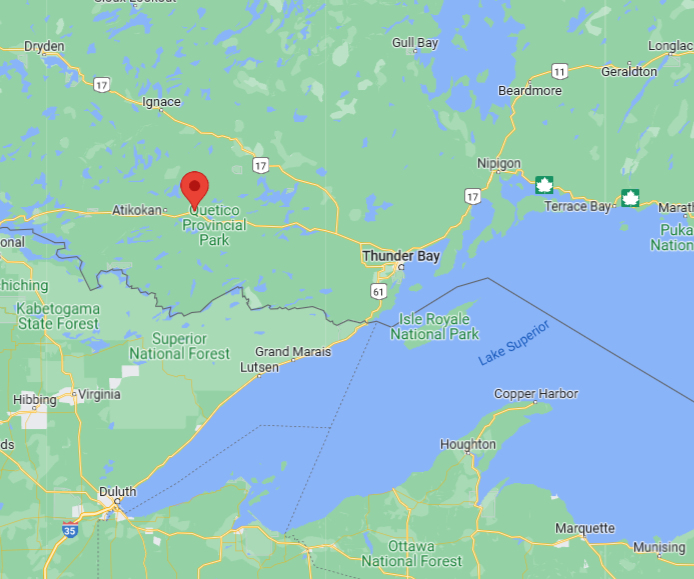
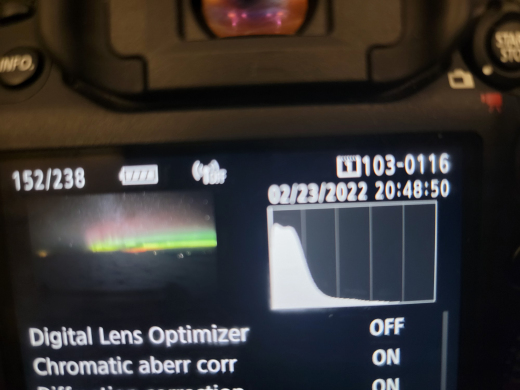
Above: The red pushpin marks the approximate location of the plane on Feb. 23rd (22:48 EST) when the orange auroras appeared. Inset is the camera's view.
Kjellmar Oksavik, a space physicist at the University Center in Svalbard (UNIS), has an idea: "Normally, auroras are produced by electrons with energies less than 10 keV. Raining down from space, they stop an an altitude of 100 km where the dominant color is green (caused by electrons hitting oxygen). During strong activity, however, electrons can reach energies of 20 keV and even higher. These electrons penetrate deeper, all the way down to 80-100 km. Here nitrogen molecules dominate, with multiple emission lines in blue, purple, orange, red and magenta."
"I think this is what is happening in the picture," says Oksavik. "On this particular day the precipitating electrons were so energized that they reached deeper into the atmosphere (probably 80-90 km) where nitrogen molecules emitted a wide range of colors, that combines into what looks like an orange glow."
Oksavik's colleague Fred Sigernes, chief of the UNIS Aurora Observatory, agrees with Oksavik, but also wonders "why have we never observed this up here with our cameras in Svalbard?" It's a mystery, indeed.
Have you observed orange auroras? Submit your photos here.
Realtime Space Weather Photo Gallery
Free: Spaceweather.com Newsletter
STERLING SILVER RAINBOW DRAGONFLY: Are you looking for a far out gift? Consider the Rainbow Dragonfly. On Jan 28th, this sterling silver pendant hitched a ride onboard an Earth to Sky Calculus cosmic ray research balloon:
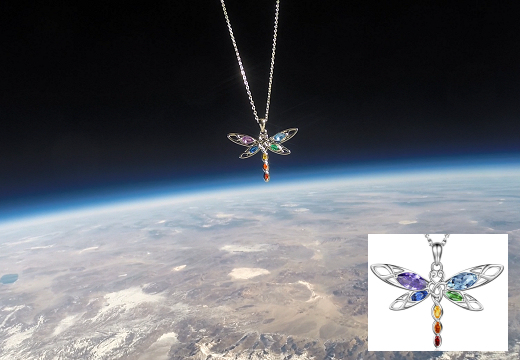
You can have it for $172.95. The dragonfly's heart is a Celtic love knot, and its wings are decorated with a spray of rainbow-colored crystals. This item is 100% 925 sterling silver, lead-free, nickel-free, cadmium-free, and totally hypoallergenic.
The students are selling dragonfly pendants to support their cosmic ray ballooning program. Each one comes with a greeting card showing the pendant in flight and telling the story of its trip to the stratosphere and back again.
Far Out Gifts: Earth to Sky Store
All sales support hands-on STEM education
Realtime Aurora Photo Gallery
Free: Spaceweather.com Newsletter