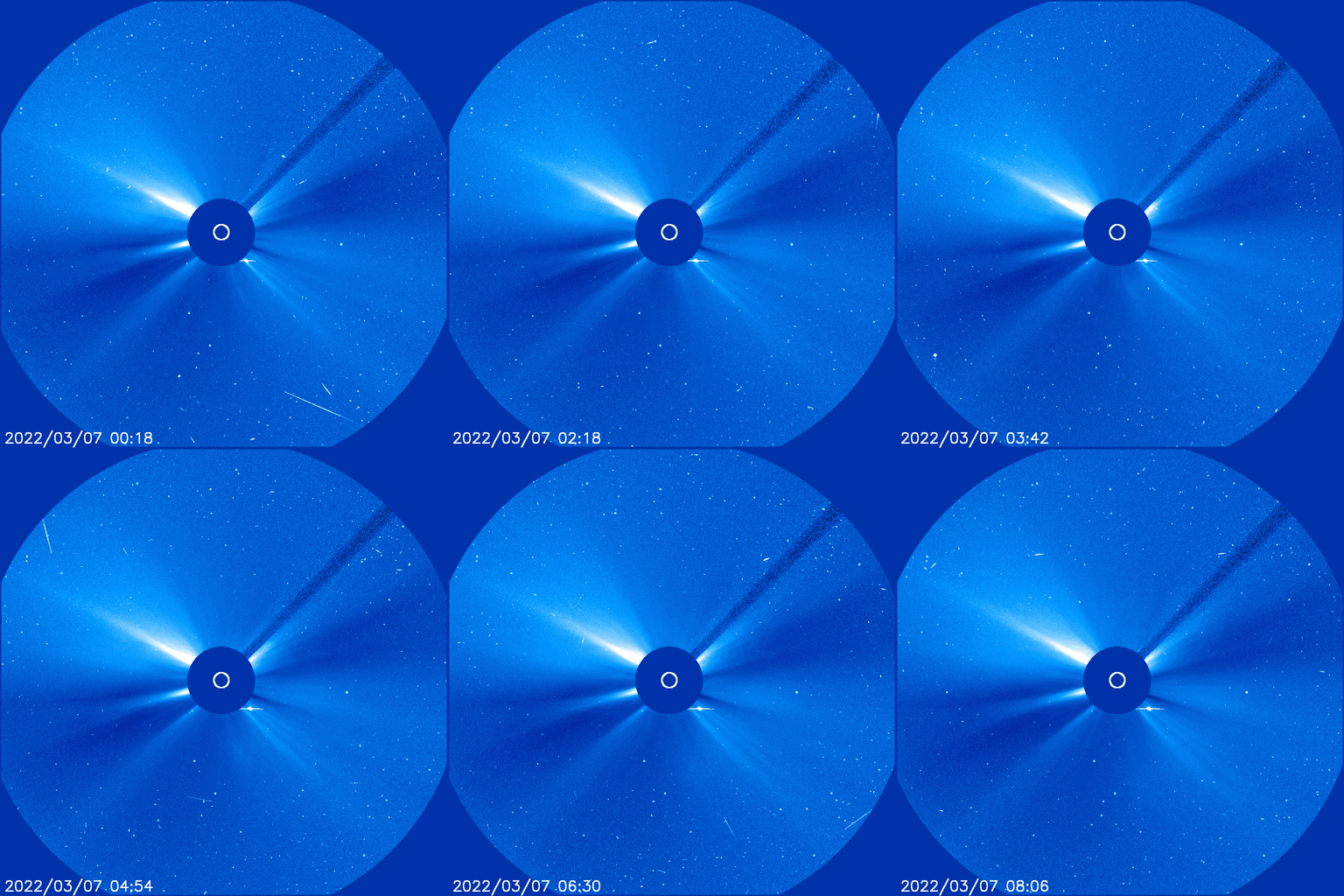
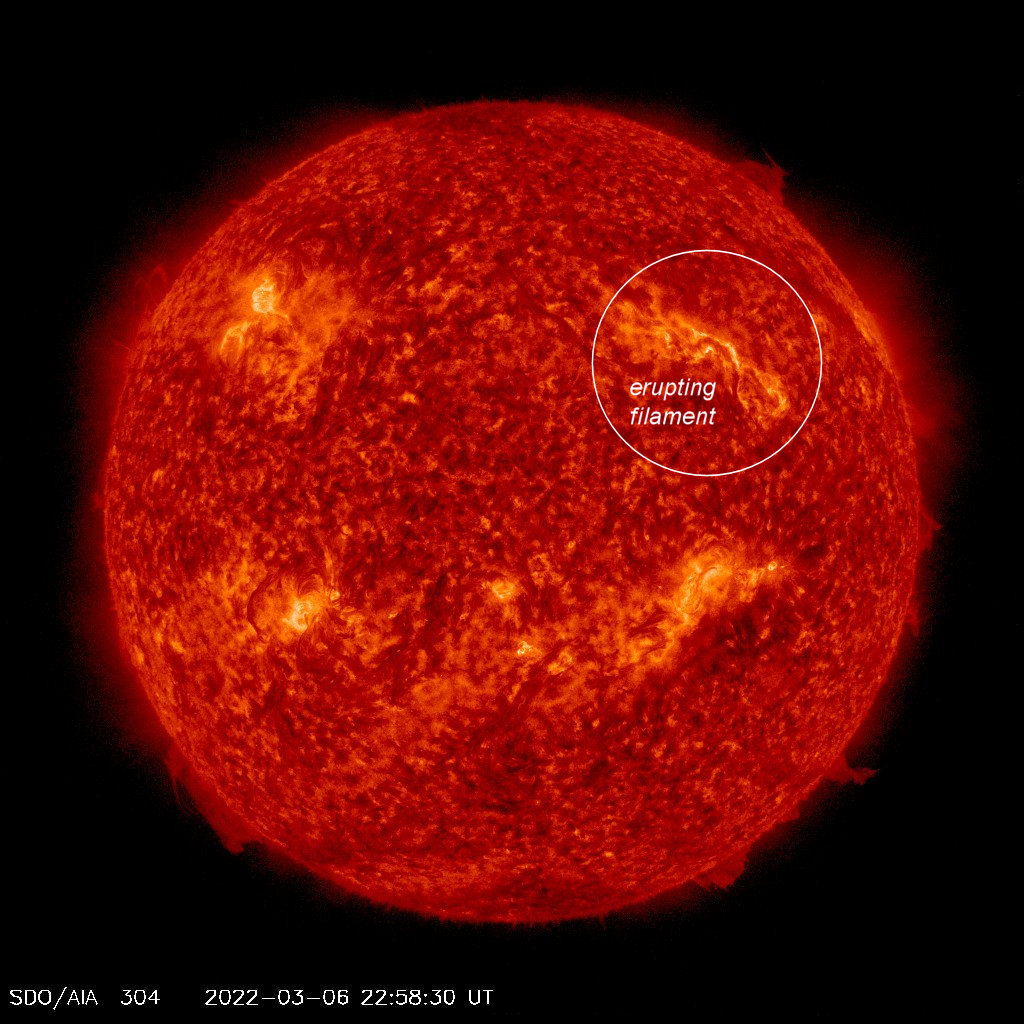
POSSIBLE CME IMPACT THIS WEEK: A faint CME (movie) might sideswipe Earth's magnetic field on March 10th. It left the sun on March 7th following the eruption of a magnetic filament; no sunspots were involved. The glancing blow could spark minor G1-class geomagnetic storms later this week. Aurora alerts: SMS Text.

ROCKET LAUNCH INTO PULSATING AURORAS: Sometimes, Arctic auroras do something strange and puzzling. They blink. Imagine a chess board where the squares strobe--green, black, green, black--in a mesmerizing rhythm every ~10 seconds. Researchers call them "pulsating auroras" and, over the weekend, NASA launched a rocket from Alaska to investigate.
"It was amazing," says aurora tour guide Marketa S. Murray, who witnessed the launch from the Poker Flat Research Range near Fairbanks. "The sky was strobing overhead when the two-stage Black Brant IX took off--straight into the mysterious pulsating auroras."
"The launch was highly successful," reports Alexa Halford of NASA's Goddard Space Flight Center, the experiment's lead investigator, who had been waiting since February for the pulsations to begin. "We couldn’t have asked for better conditions!"
Pulsating auroras are nothing new. Arctic people have been watching them for thousands of years. However, researchers have only recently figured out what powers them. In 2018, a team led by S. Kasahara of the University of Tokyo conclusively linked pulsating auroras to "chorus waves" in Earth's magnetosphere. Chorus waves are electromagnetic oscillations that sound heavenly when played through the loudspeaker of a low frequency radio. They scatter electrons from space down to Earth, an oscillating rain which produces exotic blinking Northern Lights.
But this only scratches the surface of the mystery. "We still have a lot to learn," says Halford. For instance, patches of light within pulsating auroras can maintain almost exactly the same shape from pulse to pulse. Why? No one knows. Also, the pulses flicker as often as 10 times a second, a rapidfire modulation that has no easy explanation.
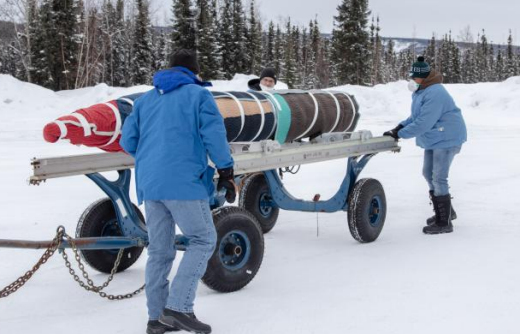
Above: LAMP rolling out to the launch pad for a pre-flight test.
Halford's rocket carried an experiment named "LAMP" directly into the pulsating auroras, sampling in situ magnetic fields and energetic particles that may offer clues to the mystery. The experiment is specifically designed to look for "microbursts" of energetic electrons--the space equivalent of raindrops in a thunderstorm--that might explain the puzzling flickers.
"After launching the rocket we need a break," says Halford, "but we are looking forward to analyzing all of the data we just got back." Stay tuned for updates.
Want to see some pulsating auroras? Watch this video from Ronn Murray, Marketa Murray's husband and fellow aurora chaser. It shows some pulsating auroras recorded on Feb. 25, 2022.
Realtime Aurora Photo Gallery
Free: Spaceweather.com Newsletter
STERLING SILVER CRYSTAL DOLPHIN: Dolphins from space? Believe it. On Feb. 28, 2022, this crystal dolphin pendant flew 111,101 feet above the Sierra Nevada mountains of Central California, hitching a ride onboard an Earth to Sky Calculus cosmic ray balloon:
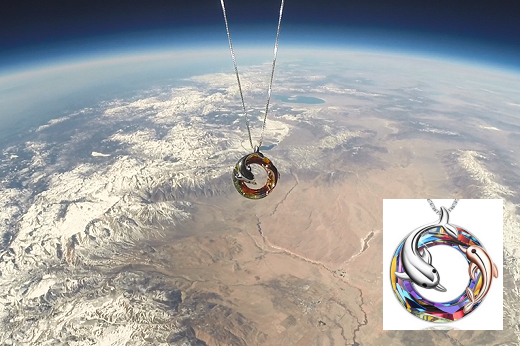
You can have it for $175.95. Swimming around a colorful crystal whirl, the playful dolphins are 100% 925 sterling silver with a matching 18-inch sterling silver chain. The entire pendant is lead-free, nickel-free, cadmium-free, and totally hypoallergenic.
Each pendant comes with a greeting card showing the dolphins in flight, and telling the story of their trip to the edge of space and back again. All sales support the student's cosmic ray research program.
Far Out Gifts: Earth to Sky Store
All sales support hands-on STEM education
Realtime Space Weather Photo Gallery
Free: Spaceweather.com Newsletter