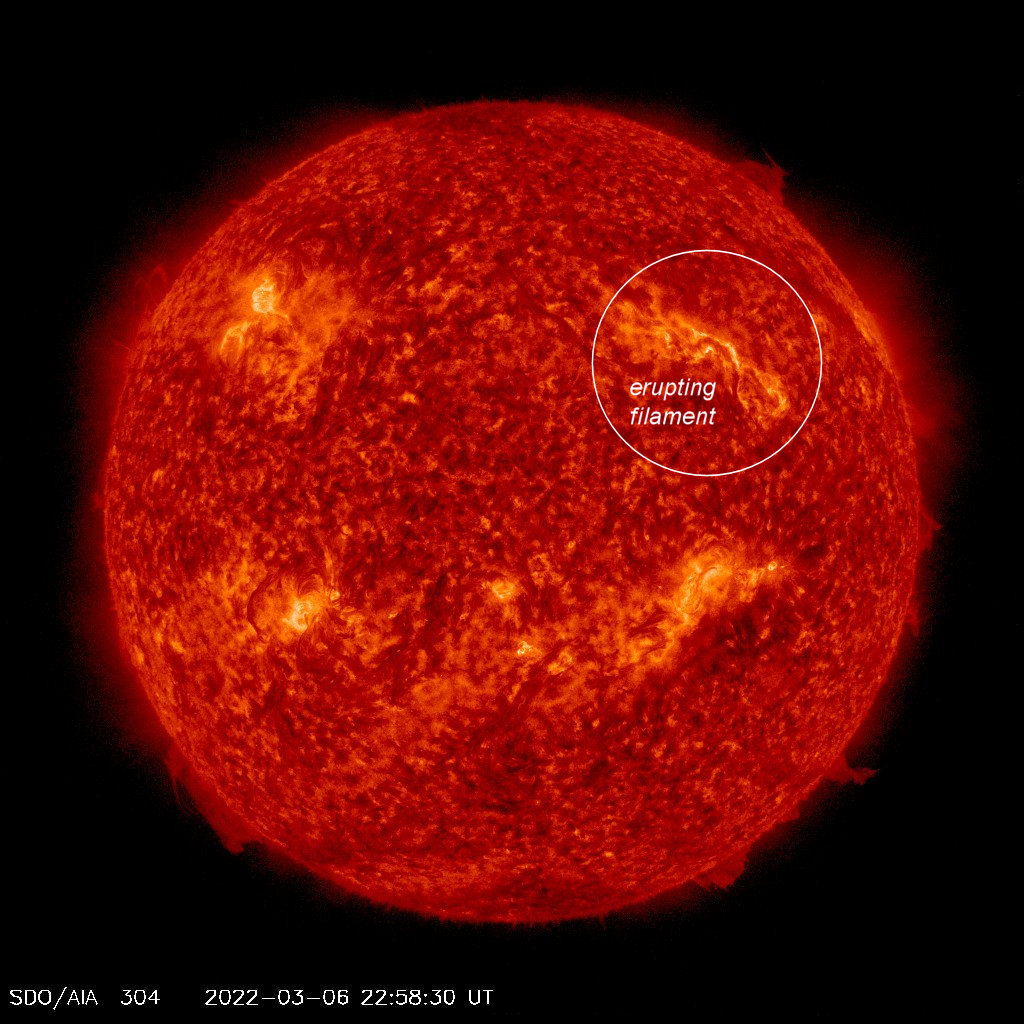
A CME IS IN THE NEIGHBORHOOD: Later today, March 10th, a coronal mass ejection (CME) will pass close to Earth and might deliver a glancing blow to our planet's magnetic field. The CME was hurled into space 3 days ago by an erupting filament of magnetism on the sun. Arctic sky watchers should be alert for a possible brightening of auroras when the CME arrives. Aurora alerts: SMS Text.
THIS RED ARC IS NOT AN AURORA: All day long on March 5th, a solar wind stream buffeted Earth's magnetic field. When night fell in Banff, Alberta, photographer Marybeth Kiczenski took her camera to the countryside to look for auroras. She found this instead:

"It also appears we captured an SAR," says Kiczenski, referring to the red arc cutting across the Milky Way.
SARs were discovered in 1956 at the beginning of the Space Age. Researchers didn’t know what they were and unwittingly gave them a misleading name: "Stable Auroral Red arcs" or SARs.
In fact, SARs are not auroras. Auroras appear when charged particles rain down from space, hitting the atmosphere and causing it to glow like the picture tube of an old color TV. SARs form differently. They are a sign of heat energy leaking into the upper atmosphere from Earth’s ring current system.
The ring current is a donut-shaped circuit carrying millions of amps around our planet. It skims the orbits of geosynchronous satellites and plays a huge role in determining the severity of geomagnetic storms. Earth is the only rocky planet that has one.
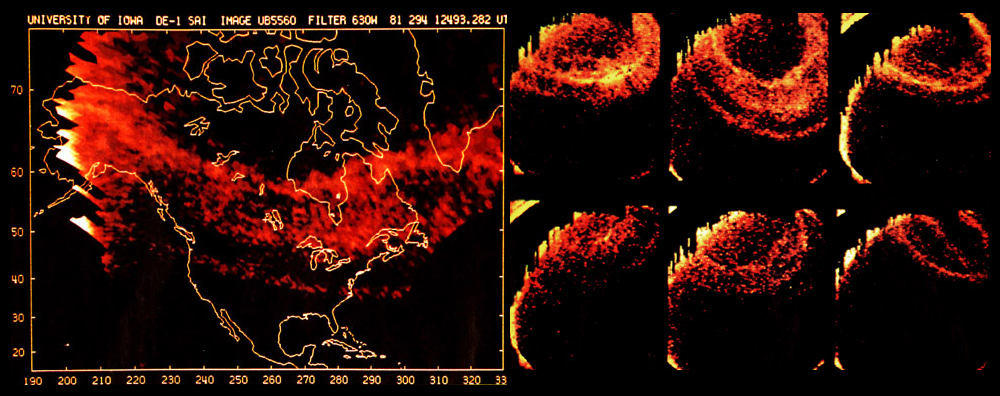
Above: SARs photographed by the Dynamics Explorer-1 satellite in 1982. More
If you want to photograph an SAR, you have to catch the ring current in the act of leaking. This happens during many geomagnetic storms. A G1-class storm was in progress when Kiczenski caught hers. The red arcs have been sighted as far south as Texas.

SARs are among the reddest things in the sky, with a monochromatic glow at 6300 Å that comes from atomic oxygen in the upper atmosphere. Unfortunately, the human eye is relatively insensitive to light at this wavelength. SARs are usually so faint that no one notices when they pass overhead. Cameras catch them easily, though. Pro tip for photographers: Use a 6300 Å filter.
Realtime Space Weather Photo Gallery
Free: Spaceweather.com Newsletter
STERLING SILVER DOLPHIN PENDANT: Dolphins from space? Believe it. On Feb. 28, 2022, this crystal dolphin pendant flew 111,101 feet above the Sierra Nevada mountains of Central California, hitching a ride onboard an Earth to Sky Calculus cosmic ray balloon:
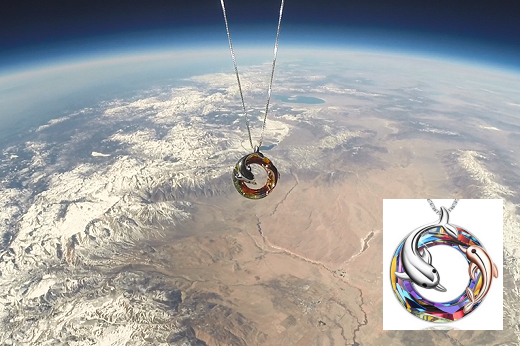
You can have it for $175.95. Swimming around a colorful crystal whirl, the playful dolphins are 100% 925 sterling silver with a matching 18-inch sterling silver chain. The entire pendant is lead-free, nickel-free, cadmium-free, and totally hypoallergenic.
Each pendant comes with a greeting card showing the dolphins in flight, and telling the story of their trip to the edge of space and back again. All sales support the student's cosmic ray research program.
Far Out Gifts: Earth to Sky Store
All sales support hands-on STEM education
Realtime Aurora Photo Gallery
Free: Spaceweather.com Newsletter