GEOMAGNETIC STORM WATCH: A CME was expected to pass near Earth on March 17th. However, solar wind data contain no evidence of a close encounter. It missed. Another CME is coming, and it could deliver a glancing blow to Earth's magnetic field on March 19th. Minor G1-class geomagnetic storms are possible if/when the CME arrives. Aurora alerts: SMS Text.

A SAHARA DUST STORM IN EUROPE: A few hundred million kilograms of desert dust just swirled across Europe. Jordi L. Coy photographed the scene from southern Spain on March 15th:
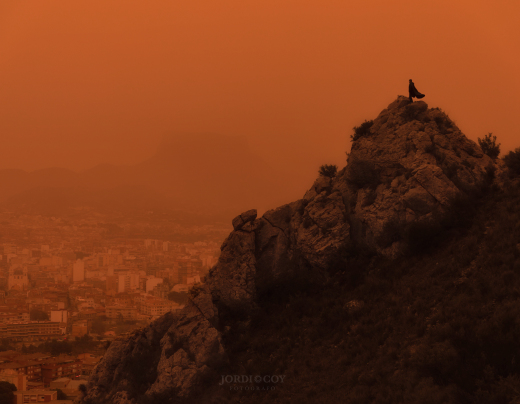
"It looks like the apocalypse," says Coy. "The atmospheric phenomenon will go down in history as the largest incursion into the Iberian Peninsula since record-keeping began. In the image, you can see the city of Elda under a dense blanket of sand, and on the crest of the mountain a person observing."
The gritty dust comes from the Sahara desert in Africa. This animation from Europe's Copernicus Atmosphere Monitoring Service shows a massive plume covering Spain on March 15th before dispersing into northern Europe:
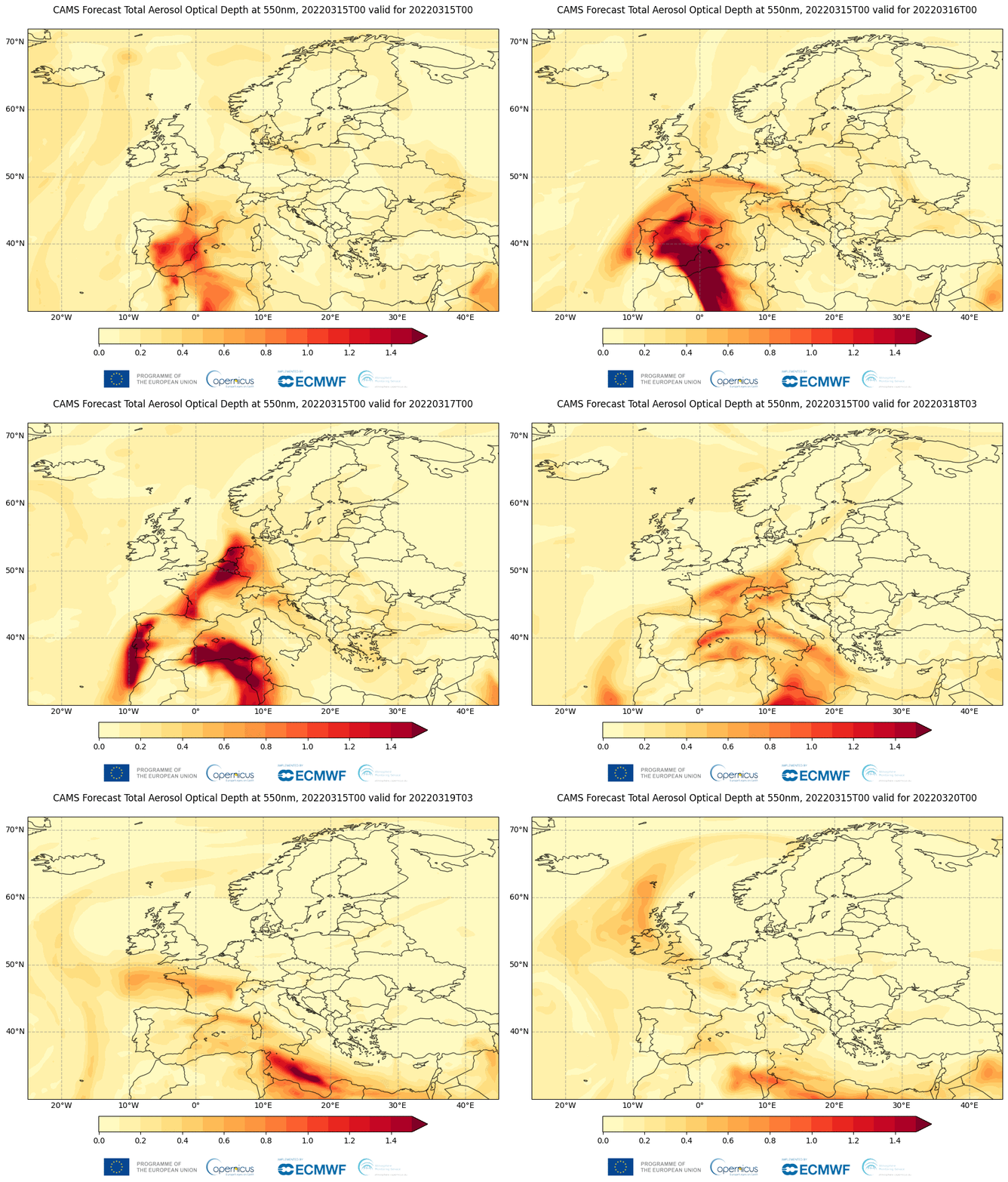
Plumes of Sahara dust drift over Europe multiple times each year. Researchers are calling this event "exceptional." Very high concentrations of coarse particulate matter (PM10) were recorded in the Iberian Peninsula. Dust has coated European ski slopes and glaciers, hastening seasonal melts. By the end of the week, hazy skies are expected as far north as Britain and Denmark.
more images: from Michael Karrer of Austria; from Erwin Jaklitsch of Oberwagenburg - Kloten, Switzerland; from Dorothea Grolig of Vienna Woods, Austria;
CME WIPES OUT COSMIC RAYS: The March 13th CME did more than spark bright auroras. It also wiped out a lot of cosmic rays. Neutron monitors at the Sodankyla Geophysical Observatory in Oulu, Finland, recorded a sharp drop in cosmic radiation just after the CME arrived:
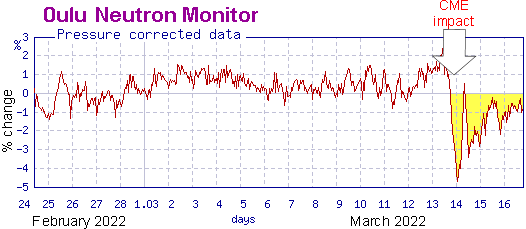
This is called a "Forbush decrease," named after American physicist Scott Forbush who studied cosmic rays in the early 20th century. It happens when a coronal mass ejection (CME) sweeps past Earth and pushes galactic cosmic rays away from our planet. Radiation from deep space that would normally pepper Earth's upper atmosphere is briefly wiped out.
There's something odd about this Forbush decrease. It's a double dip decrease. Cosmic rays dropped precipitously on March 13th--then they surged midday on March 14th--then they dropped precipitously again. The up-and-down may be a sign of structure inside the CME.
As Solar Cycle 25 intensifies, more and more CMEs will sweep past Earth. Forbush decreases will become increasingly common and may even begin to overlap. This will cause a persistent decline in cosmic rays around our planet.
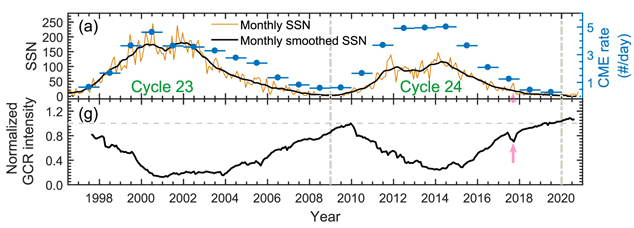
A recent paper in the Astrophysical Journal looked at the last two solar cycles and compared the daily rate of CMEs to the strength of cosmic rays. The plot, above, shows the results. At the peak of Solar Cycle 24, the sun was spitting out more than 5 CMEs per day; at the same time, galactic cosmic rays (GCRs) dropped more than 60%.
Evidence is mounting that new Solar Cycle 25 will be stronger than Solar Cycle 24. If so, CMEs will be more abundant and cosmic rays even more depressed--a welcome reduction for astronauts, air travelers, and even some mountain climbers.
Meanwhile, the March 13th Forbush decrease is still underway. Cosmic rays remain depressed 4 full days after the CME arrived.
Realtime Space Weather Photo Gallery
Free: Spaceweather.com Newsletter
STERLING SILVER DOLPHIN PENDANT: On Feb. 28, 2022, the students of Earth to Sky Calculus launched a cosmic ray research balloon. This sterling silver dolphin hitched a ride, flying 111,101 feet above the Sierra Nevada mountains of Central California:
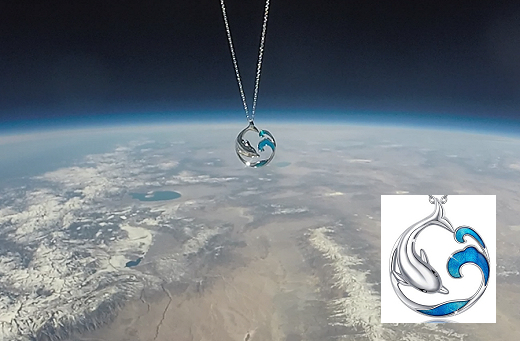
You can have it for $142.95. Leaping through blue crystal waves, the playful cetacean is 100% 925 sterling silver. It comes with a matching 18-inch sterling silver chain The entire pendant is lead-free, nickel-free, cadmium-free, and totally hypoallergenic.
Each pendant comes with a greeting card showing the dolphin in flight, and telling the story of its trip to the edge of space and back again. All sales support the student's cosmic ray research program.
Far Out Gifts: Earth to Sky Store
All sales support hands-on STEM education
Realtime Aurora Photo Gallery
Free: Spaceweather.com Newsletter