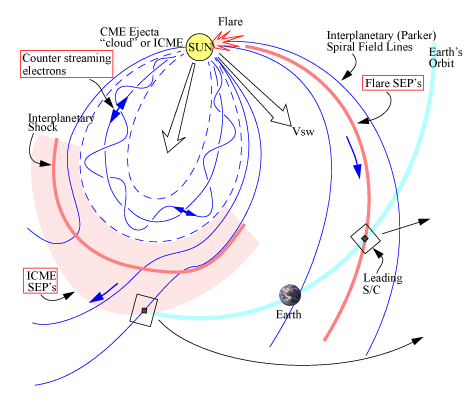
GRAZING CME IMPACT: A coronal mass ejection (CME) hit Earth on April 2nd @ 0100 UT. Weak discontinuities in solar wind data suggest a grazing impact. This appears to be the CME launched by an X1.3-class solar flare on March 30th (sunspot AR2975). The glancing blow sparked a minor G1-class geomagnetic storm, which is now subsiding. Aurora alerts: SMS Text.
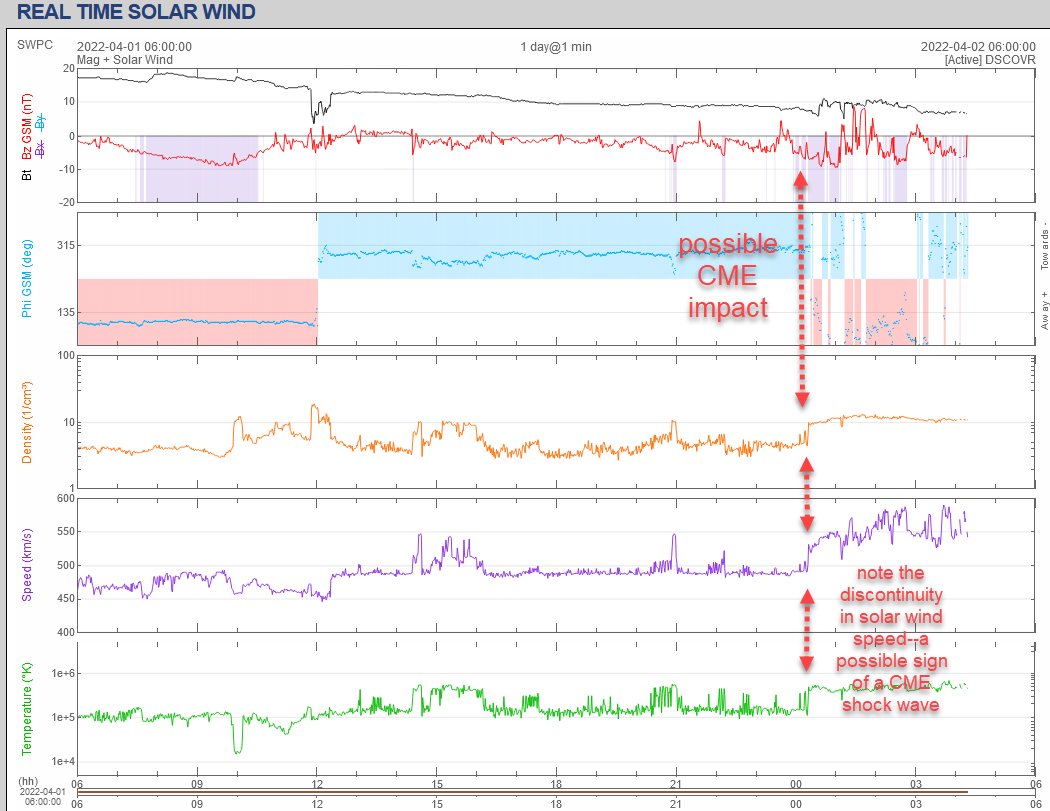

LONG DURATION SOLAR FLARE: Departing sunspot AR2975 exploded again today, April 2nd, producing a long-duration M4-class solar flare. NASA's Solar Dynamics Observatory recorded the blast:

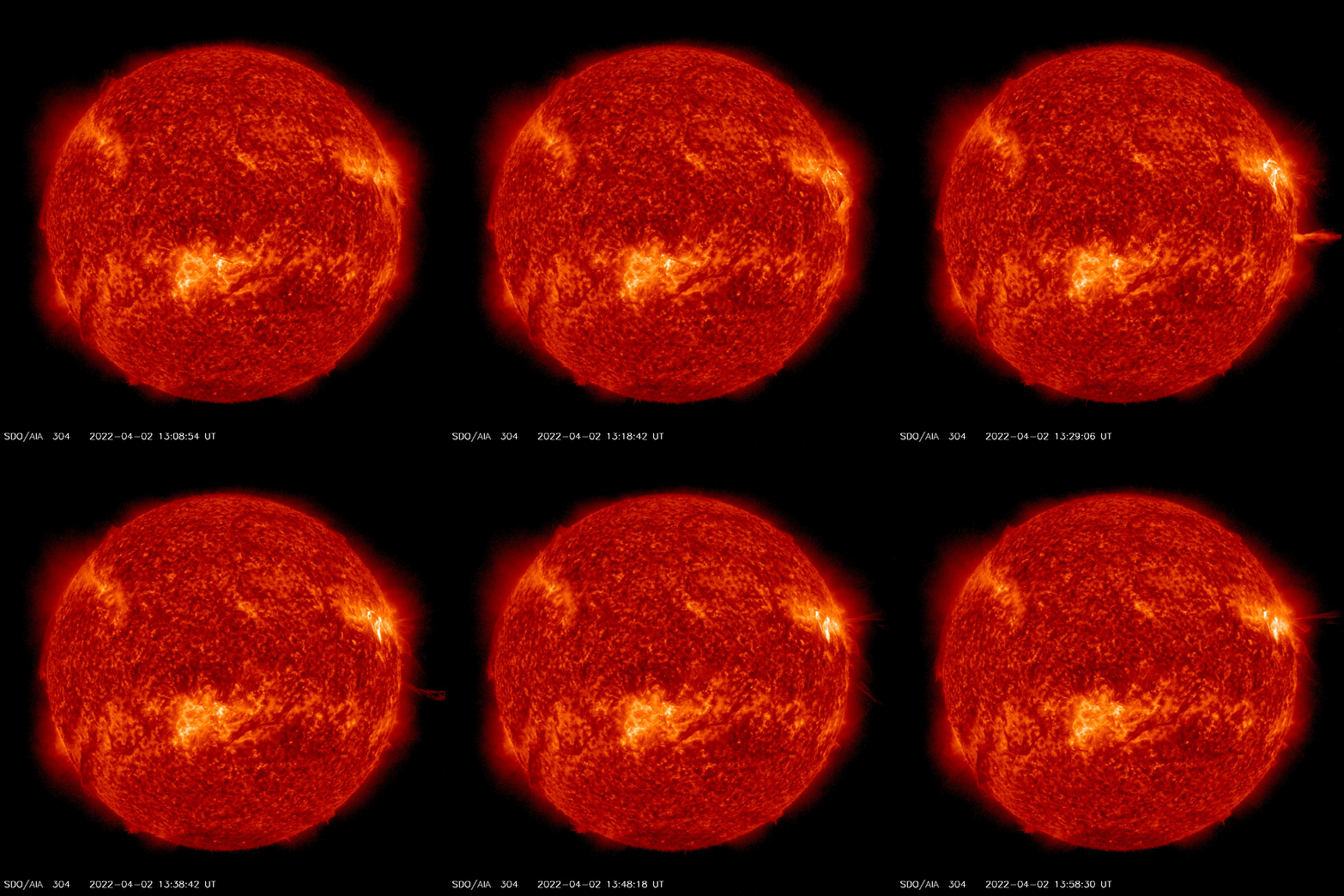
Energetic protons accelerated by the flare are now peppering the top of Earth's atmosphere. They were funneled in our direction by spiralling magnetic field lines, which connect the western limb of the sun to our planet. A polar cap absorption event is now underway as a result of the proton storm; this means shortwave radios won't work well in airplanes flying over Earth's poles.
Realtime Space Weather Photo Gallery
Free: Spaceweather.com Newsletter
SOLAR RADIO BURST AND RADIO BLACKOUT: Last Wednesday, March 30th, the sun did two seemingly contradictory things at once. It produced a loud radio burst and, at the same time, caused a deep radio blackout. Both were side-effects of an X1.3-class solar flare. First, let's listen to the radio burst:
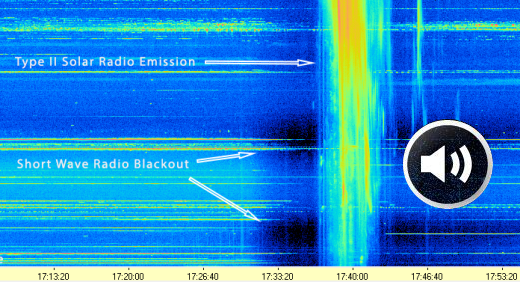
Click to listen to the radio burst or view the complete dynamic spectrum.
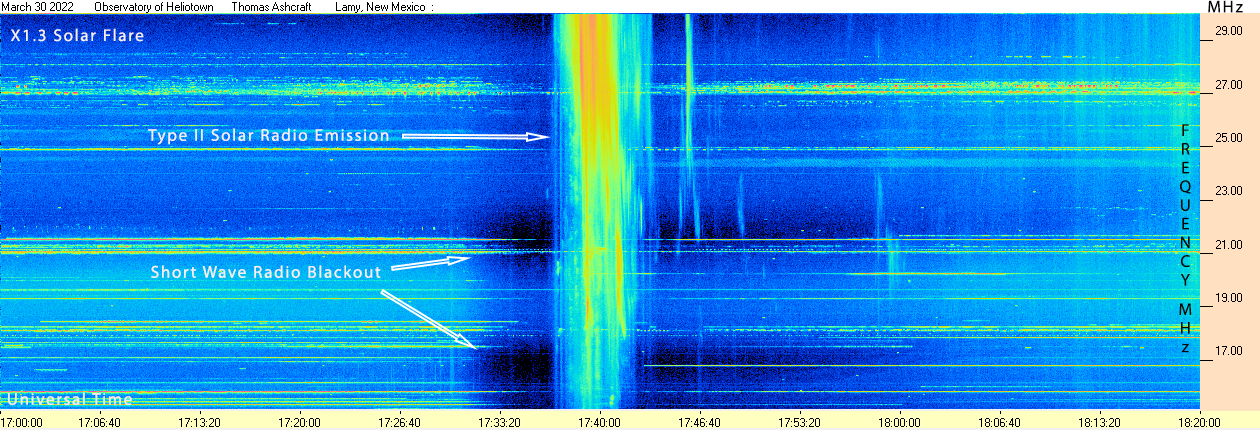
The gentle roar of static you just heard emerged from the loudspeaker of a shortwave radio receiver in New Mexico. Amateur astronomer Thomas Ashcraft recorded it. "The sun was well positioned in my radio antennas for the X1.3 solar flare," says Ashcraft. "The left channel of the audio file is 22.2 MHz, the right channel is 21.1 MHz."
This is a Type II solar radio burst. Shock waves from the flare rippled through the sun's atmosphere, creating plasma oscillations that emit shortwave static. Briefly, the sun turned itself into a natural radio transmitter.
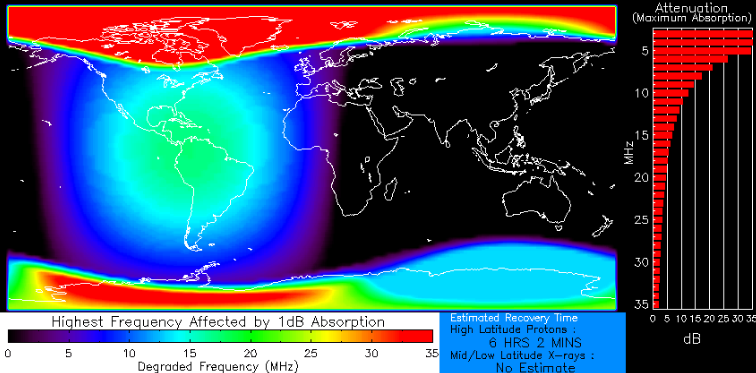
While the sun was busy creating radio waves, it was equally busy wiping them out. Radiation from the flare ionized the top of Earth's atmosphere, preventing terrestrial radio stations from bouncing their signals over the horizon as usual. This map shows where manmade signals suddenly faded:
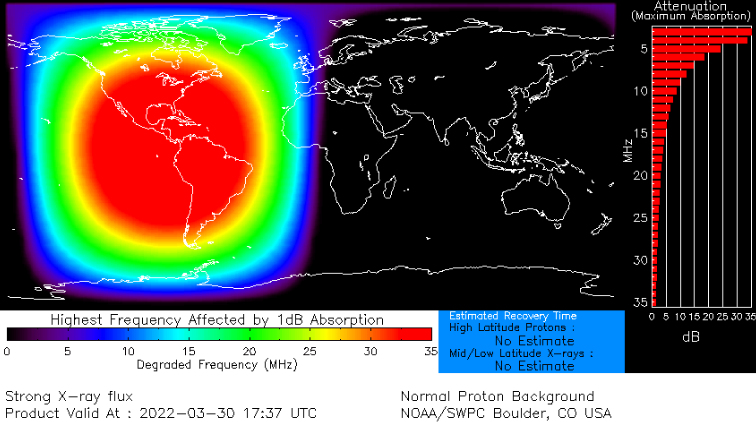
Ashcraft's observatory in New Mexico is located near the middle of the blackout zone. Take another look at his dynamic spectrum. Horizontal lines are terrestrial radio stations. They vanished for about 10 minutes around the time of the flare. The effect is strongest at frequencies below ~20 MHz.
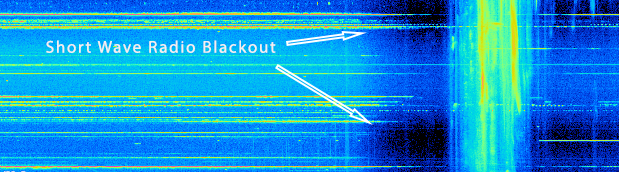
In Gainesville, Florida, radio astronomer Francisco Reyes recorded the blackout as well. "I used an array of 4 dipoles with an FSX-7 radio spectrograph (Radio JOVE)," he says.
Would you like to record an event like this? NASA's Radio JOVE program makes it easy. Off-the-shelf radio telescope kits allow even novices to monitor radio outbursts from the sun, which are becoming more frequent as Solar Cycle 25 intensifies.
Realtime Aurora Photo Gallery
Free: Spaceweather.com Newsletter
STERLING SILVER RAINBOW DRAGONFLY: Are you looking for a far-out gift? Nothing says "I love you" like a rainbow dragonfly from the edge of space. On Jan 28th, this sterling silver pendant hitched a ride onboard an Earth to Sky Calculus cosmic ray research balloon:
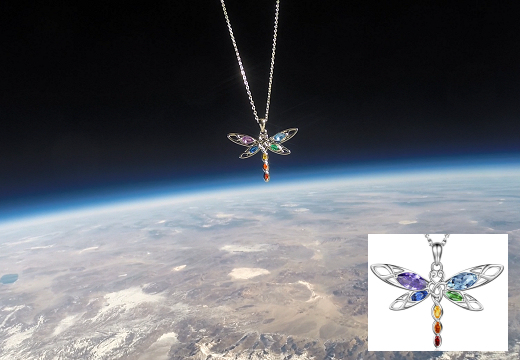
You can have it for $172.95. The dragonfly's heart is a Celtic love knot, and its wings are decorated with a spray of rainbow-colored crystals. This item is 100% 925 sterling silver, lead-free, nickel-free, cadmium-free, and totally hypoallergenic.
The students are selling dragonfly pendants to support their cosmic ray ballooning program. Each one comes with a greeting card showing the pendant in flight and telling the story of its trip to the stratosphere and back again.
Far Out Gifts: Earth to Sky Store
All sales support hands-on STEM education