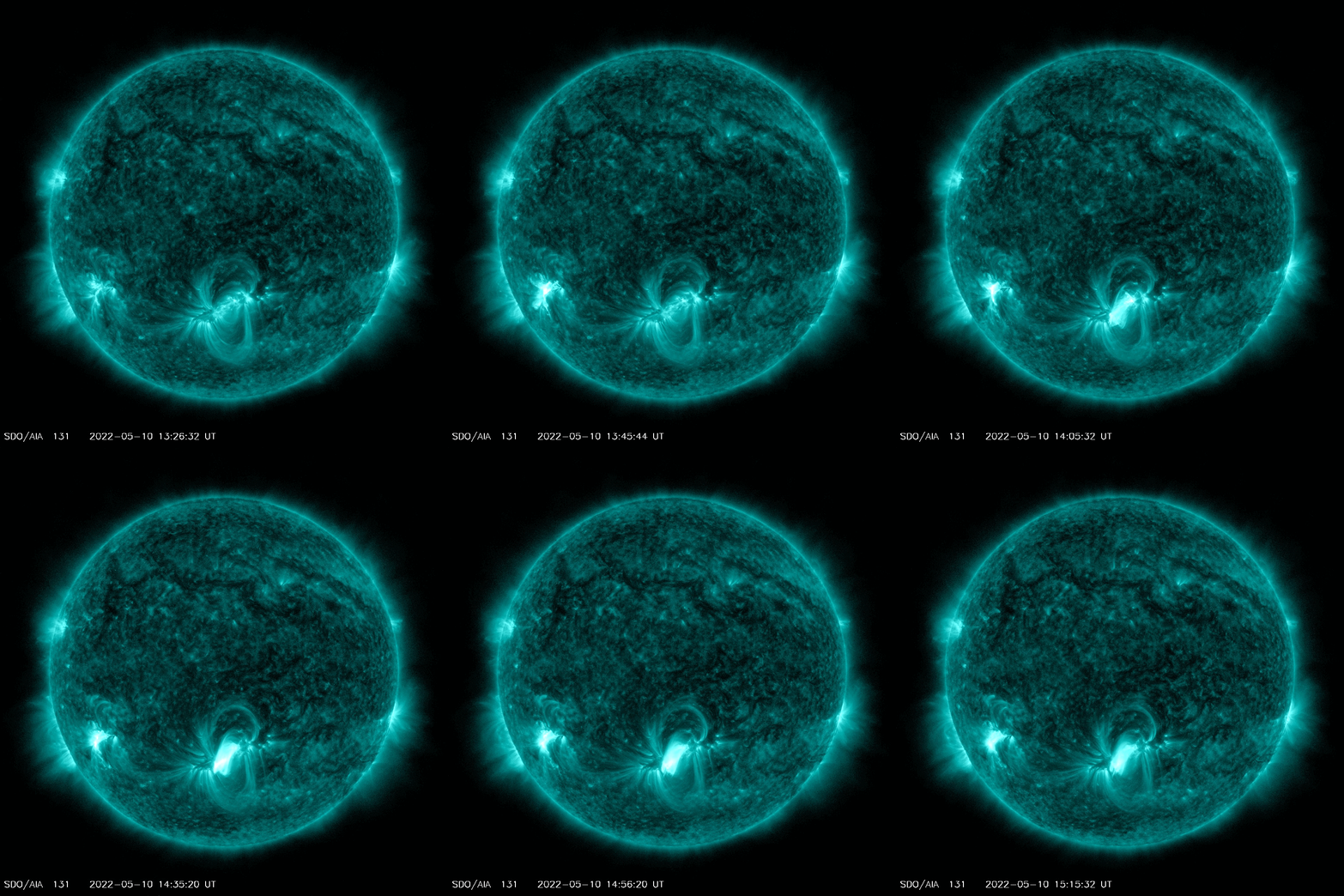
X-CLASS SOLAR FLARE: "Mixed-up" sunspot AR3006 (described below) exploded on May 10th (1355 UT), producing an intense X1.5-class solar flare. NASA's Solar Dynamics Observatory recorded the extreme ultraviolet flash:
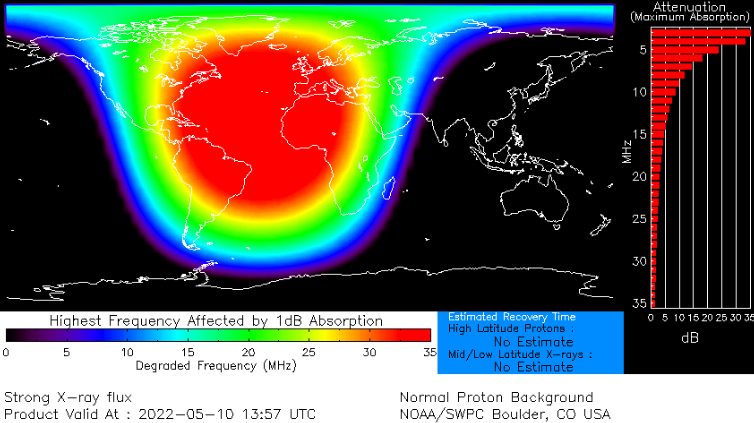
Radiation from the flare ionized the top of Earth's atmosphere, causing a shortwave radio blackout around the Atlantic Ocean: blackout map. Radio transmissions at frequencies below ~30 MHz were attenuated for more than an hour after the flare.
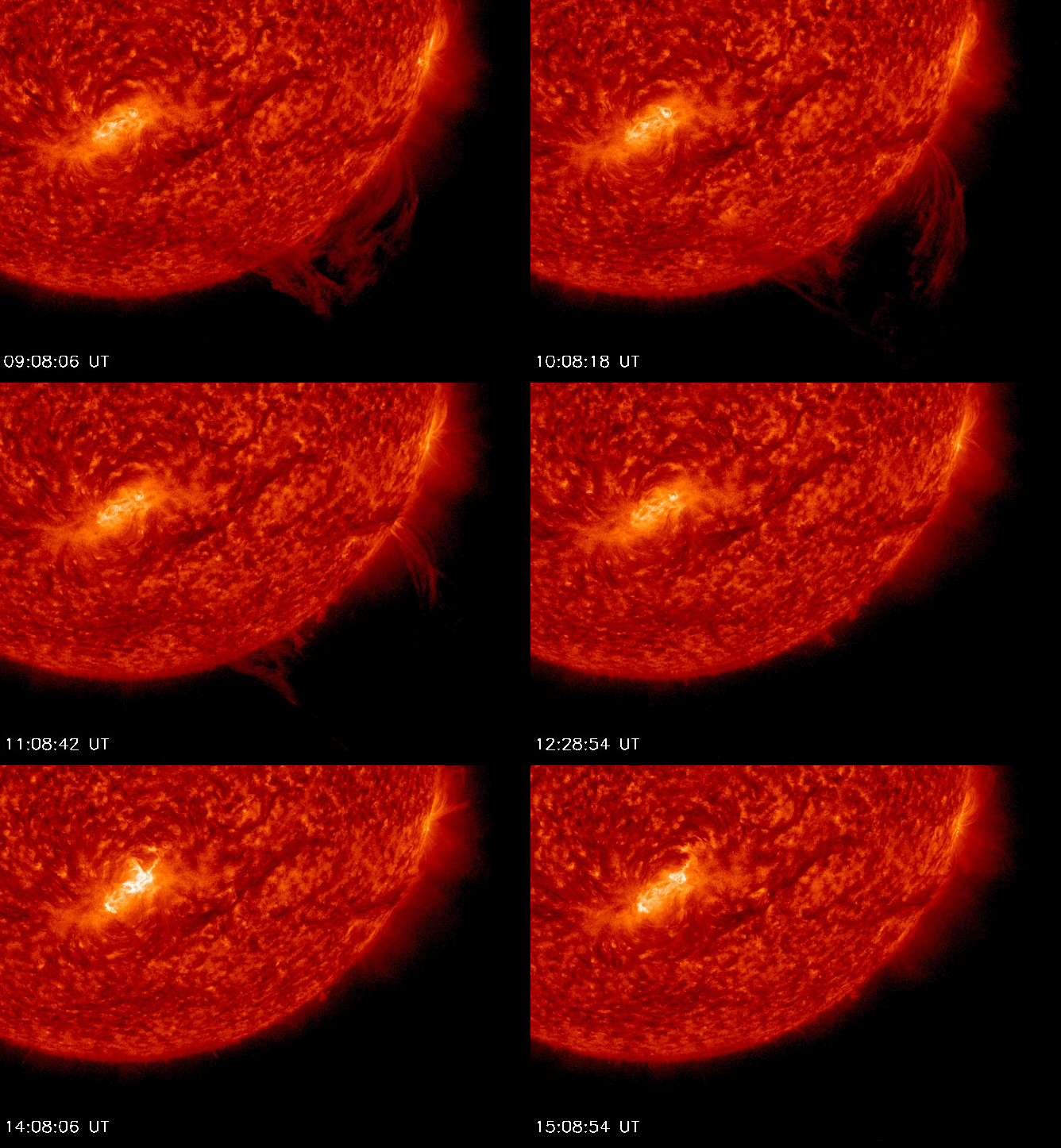
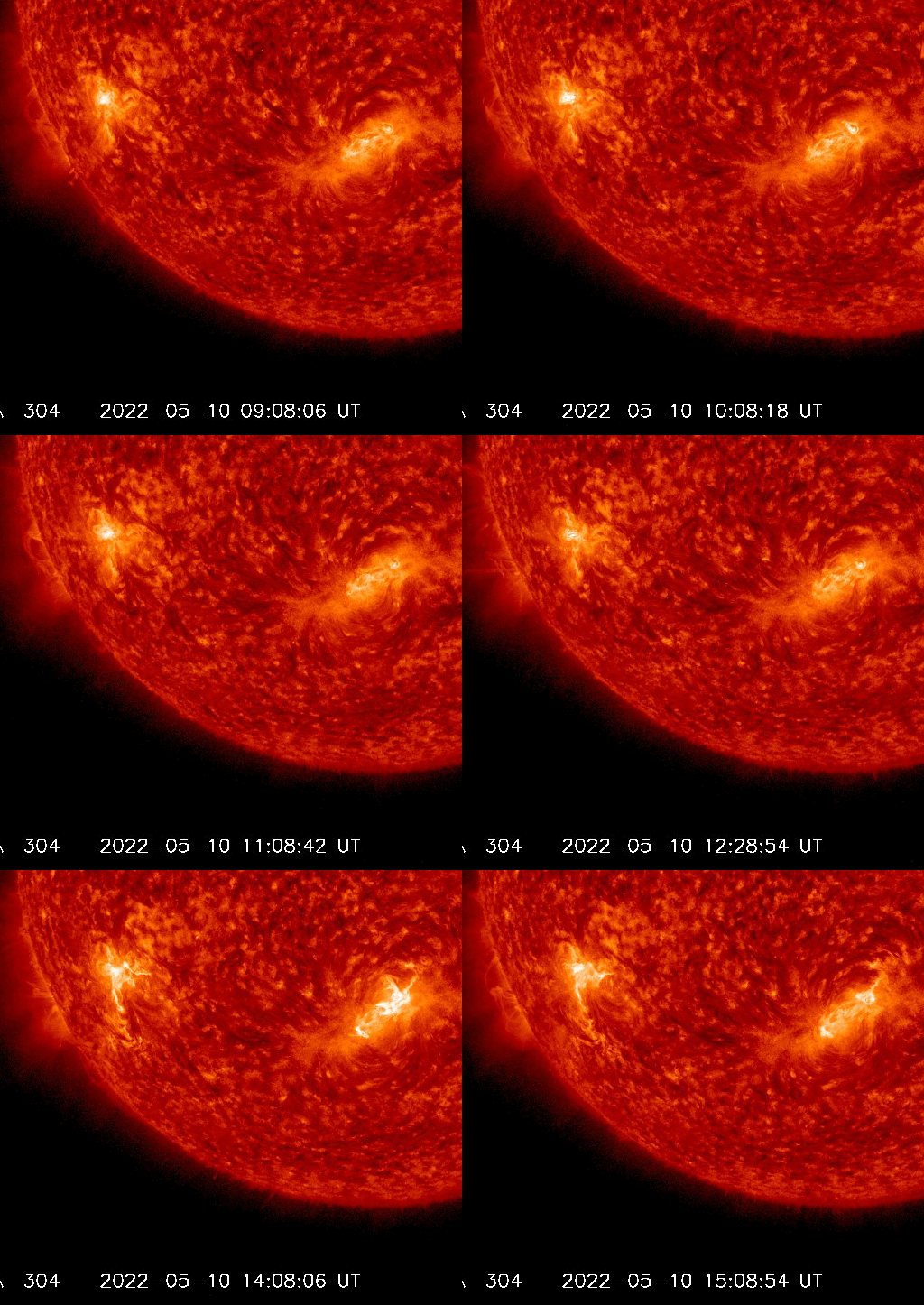
Since the flare occurred, a mish-mash of CMEs has billowed away from the sun's southern hemisphere. It is unclear if these CMEs are related to the X-flare or instead some other, lesser explosions that happened at almost the same time. There was a filament eruption to the right of the X-flare, and a C4-class solar flare in a different sunspot to the left. NOAA analysts are busy unraveling these events using computer models to determine if one of the CMEs might hit Earth. Stay tuned. Solar flare alerts: SMS Text
A MIXED-UP SUNSPOT: Sunspot AR3006 is having an identity crisis. It is supposed to have a +/- magnetic field. Mostly it does. But deep inside the sunspot's primary core, the polarity is opposite: -/+. Note the circled region in this magnetic map of the sunspot from NASA's Solar Dynamics Observatory:
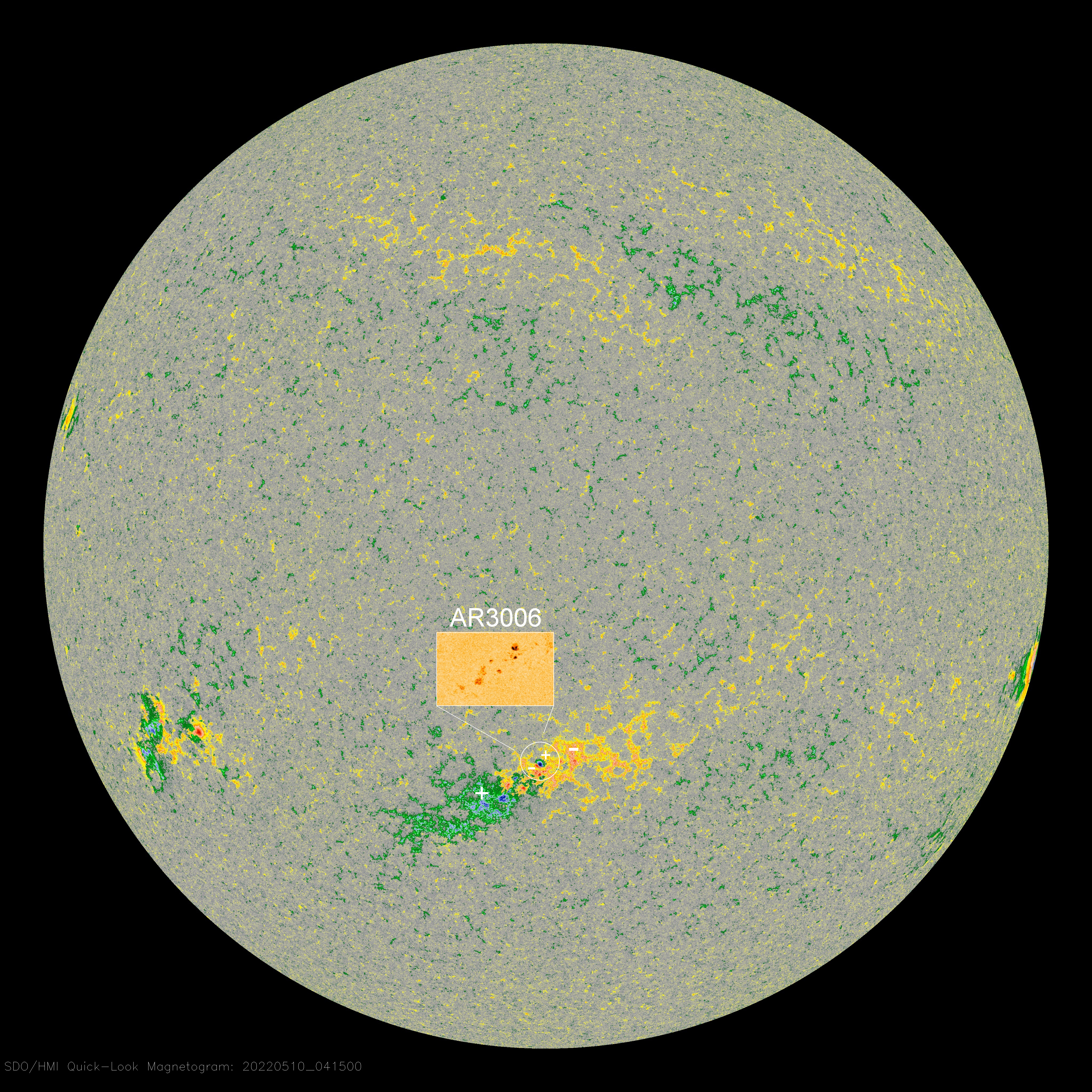
The mixture of magnetic polarities makes this sunspot interesting and dangerous. When opposite polarities bump together, it can light the fuse of magnetic reconnection--the explosive power source of solar flares. If AR3006 flares today, it will be geoeffective. The sunspot is directly facing Earth.
Update: The sunspot *did* flare today. An X1.5 class explosion on May 10th (1355 UT) caused a radio backout over the Atlantic Ocean and may have hurled a complicated CME toward Earth. Solar flare alerts: SMS Text
Realtime Space Weather Photo Gallery
Free: Spaceweather.com Newsletter
'NOCTILUCENT CLOUDS' OVER FLORIDA: Only a few years ago, the best place on Earth to see noctilucent clouds (NLCs) was near the Arctic Circle. Now it's Florida. Michael Holland Sr. photographed this one on May 6th from Lakeland, FL:
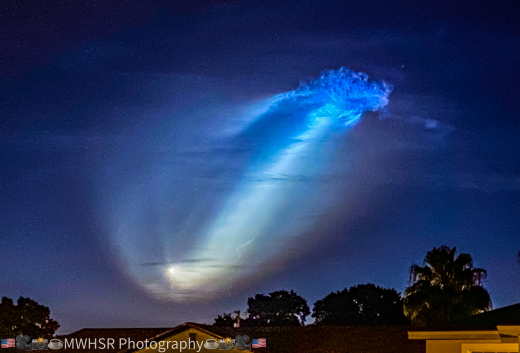
The electric-blue cloud formed in the wake of a SpaceX Falcon 9 rocket, which had just launched from Cape Canaveral carrying 53 Starlink satellites to low-Earth orbit. Ice crystals in the rocket's exhaust caught rays of sunlight in the upper atmosphere, creating the display.
"The noctilucent cloud was simply gorgeous," says Holland.
Years ago, when researchers said "noctilucent cloud," they meant an icy cloud made of meteoroids and water vapor in the polar mesosphere. Only rarely would such natural NLCs spread to low latitudes. Now the term is being used to describe rocket exhaust. Icy "rocket clouds" look a lot like their natural cousins, and they are increasingly common at low latitudes. Already this year SpaceX has launched fourteen Falcon 9 rockets from Cape Canaveral with many more on the schedule.
more images: from Jeff Berkes in Dry Tortugas National Park / Florida Keys; from Dr. Gilbert Plumer of Rockledge, Florida; from Brent of Orlando, Florida; from Martin Wise of Trenton, Florida
Realtime Noctilucent Cloud Photo Gallery
Free: Spaceweather.com Newsletter
STERLING SILVER DOLPHIN PENDANT: On Feb. 28, 2022, the students of Earth to Sky Calculus launched a cosmic ray research balloon. This sterling silver dolphin hitched a ride, flying 111,101 feet above the Sierra Nevada mountains of Central California:
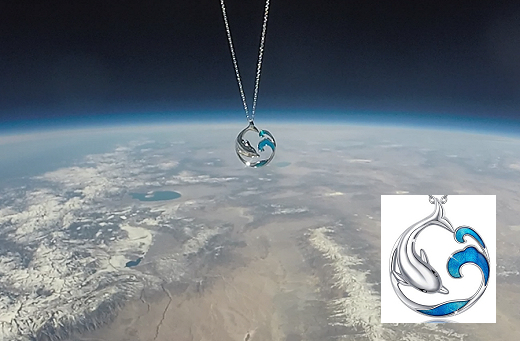
You can have it for $142.95. Leaping through blue crystal waves, the playful cetacean is 100% 925 sterling silver. It comes with a matching 18-inch sterling silver chain The entire pendant is lead-free, nickel-free, cadmium-free, and totally hypoallergenic.
Each pendant comes with a greeting card showing the dolphin in flight, and telling the story of its trip to the edge of space and back again. All sales support the student's cosmic ray research program.
Far Out Gifts: Earth to Sky Store
All sales support hands-on STEM education
Realtime Aurora Photo Gallery
Free: Spaceweather.com Newsletter