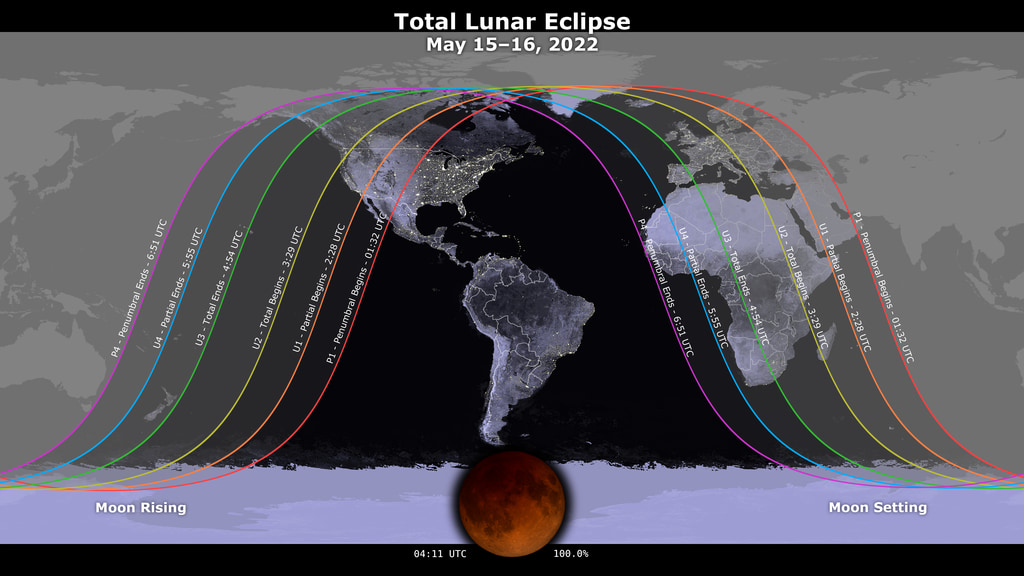
LUNAR ECLIPSE THIS WEEKEND: The Moon is about to turn red. On Sunday evening, the full Moon will pass through the shadow of Earth. The total lunar eclipse will be widely visible from the Americas on May 15th; and Africa and Europe on May 16th: visibility map. Lingering aerosols from the Tonga volcano could turn the Moon a darker shade of red than we have seen in many years. Browse: Eclipse photo gallery.
THE SUN CAN'T SHOOT STRAIGHT: So far this week, the sun has flared more than 20 times and hurled nearly as many CMEs into space. Not one of the storm clouds is heading for Earth. Yesterday's coronagraph movie from SOHO shows major CMEs flying to the left and to the right of our planet:

The sources of these two CMEs are farside sunspots--one located just behind the sun's eastern limb (left) and another just behind the sun's western limb (right). They couldn't land a blow.
The next CME might be on target, though. Sunspot AR3007 has a delta-class magnetic field that harbors energy for strong explosions--and it is almost directly facing Earth. NOAA forecasters estimate a 50% chance of M-class flares and a 20% chance of X-flares on May 12th. Solar flare alerts: SMS Text
Realtime Space Weather Photo Gallery
Free: Spaceweather.com Newsletter
THE CRESCENT VENUS PENDANT: Are you looking for a far-out gift? Nothing says "I love you" like a Venus Pendant from the edge of space. This one flew to the stratosphere onboard a cosmic ray research balloon on Jan. 8, 2022:
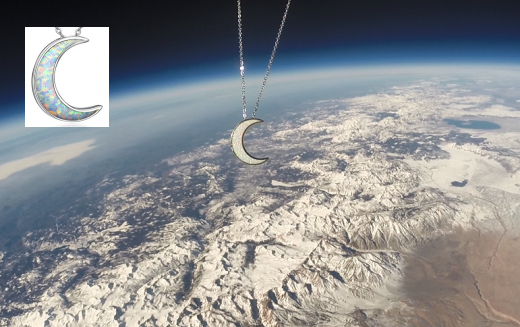
You can have it for $142.95. The opal crescent is framed by sterling silver with a matching hypoallergenic chain. It comes with a greeting card showing the pendant in flight and telling the story of its journey to the stratosphere.
Why is it a crescent? Because Venus itself was a crescent on the date of the flight. On Jan. 8, 2022, the second planet was at inferior conjunction with the sun. From Earth it looked like a slender crescent--the most beautiful phase of the Goddess of Love.
Far Out Gifts: Earth to Sky Store
All sales support hands-on STEM education
Realtime Aurora Photo Gallery
Free: Spaceweather.com Newsletter