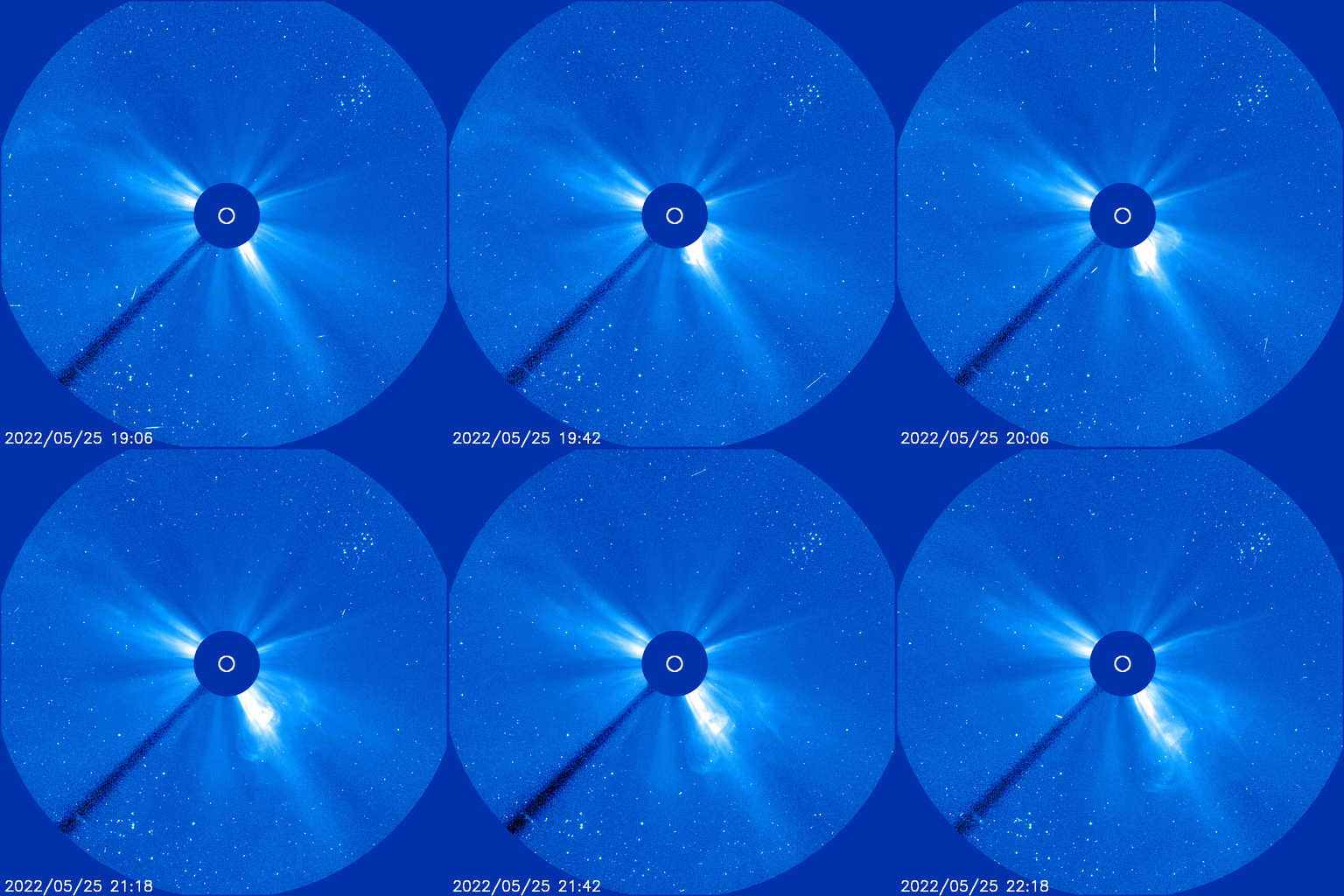
WAITING FOR THE CME: A coronal mass ejection (CME) expected to sideswipe Earth's magnetic field on May 28th has still not arrived. No problem; a geomagnetic storm happened anyway. Unrelated to the CME, a solar wind stream sparked 12 hours of G1-class storming on May 27-28. Meanwhile, the CME might still be en route, moving more slowly than expected. Stay tuned. Aurora alerts: SMS Text

AURORAS IN THE USA: Marybeth Kiczenski has been waiting years to take this picture. "Finally, last night I captured Northern lights over the Mackinac Bridge in Michigan!" she says.

"I decided to break out the telephoto lens for a close-up shot," she says. "Despite making the aurora a bit diffused due to the light pollution, it was neat to see!"
This display was caused by a co-rotating interaction region (CIR), which hit Earth on May 27th. CIRs are transition zones between slow- and fast-moving streams of solar wind; they contain shock waves that often do a good job sparking auroras. This particular CIR caused a G1-class storm on May 27th. A fast stream of solar wnd arrivng right behind it kept the storm going into the early hours of May 28th.
more images: from Brian Larmay of Pembine Wisconsin; from Rodrigo Roesch of Kewaunee, Wisconsin; from Tim Wieland of Charlevoix, Michigan; from Shayne Smith of Manistique, Michigan
Realtime Aurora Photo Gallery
Free: Spaceweather.com Newsletter
LUNAR OCCULTATION OF VENUS: For almost 5 hours yesterday, the planet Venus disappeared. It was hiding behind the Moon. Quentin Gineys photographed the lunar occultation from Réunion Island in the Indian Ocean:
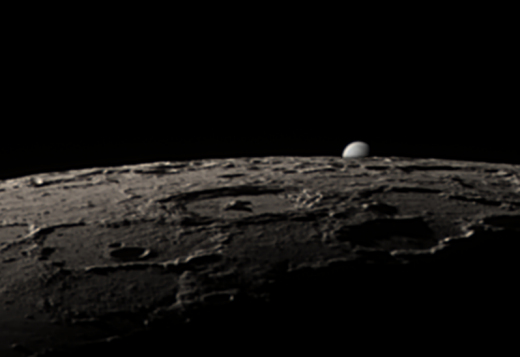
"To observe the occultation, I used an 11-inch Celestron telescope," says Gineys. "The phenomenon was very low, only 10 degrees above the horizon. I had to prepare my shooting location well, between roofs, a relay antenna and many palm trees."
The occultation was not visible everywhere. To see it, you had to be inside a narrow path stretching from southeast Asia to the Indian Ocean. Elsewhere, the Moon-Venus encounter was a beautiful near miss.
more images: from Shahrin Ahmad of Kuala Lumpur, Malaysia; from Hari Kumar of Trivandrum, India; from Andreas Walker of Rorschacherberg, Switzerland; from Gadi Eidelheit of Givat Shmuel, Israel; from Michal Lachký of Chynorany, Slovakia
Realtime Space Weather Photo Gallery
Free: Spaceweather.com Newsletter
CAPT. KIRK BEER COZY: Boldly going where no beer has gone before, this Capt. Kirk beer cozy flew to the edge of space on May 21, 2022. It hitched a ride onboard an Earth to Sky Calculus cosmic ray research balloon. Here it is parachuting back to Earth from an altitude of 109,888 feet:
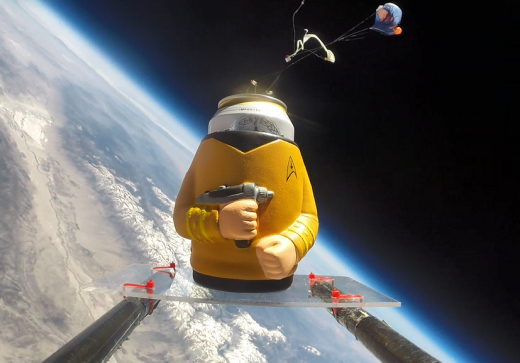
You can have it for $97.95. The students are selling beer cozies (beer not included) to support their cosmic ray ballooning program. They make great Father's Day and birthday gifts. Each one comes with greeting card showing the cozy in flight, and telling the story of its trip to the stratosphere and back again.
Far Out Gifts: Earth to Sky Store
All sales support hands-on STEM education
Realtime Noctilucent Cloud Photo Gallery
Free: Spaceweather.com Newsletter