QUIET WITH A CHANCE OF FLARES: With only three sunspots on the visible disk of the sun, solar activity is low. NOAA forecasters say there is a slight 5% chance of M-class flares today. The most likely source would be slowly-growing sunspot AR3025. Solar flare alerts: SMS Text.
THE TAU HERCULID METEOR SHOWER ACTUALLY HAPPENED: Forecasters were right. Debris from Comet 73P/Schwassmann-Wachmann 3 did hit Earth last night. Observers across North America witnessed the resulting display of tau Herculid meteors. It was not a meteor storm, as some had hoped, but instead a gentle shower punctuated by bright flurries.
The experience of Adam Sinclair in Stanley, Virginia, is typical: "In only 15 minutes I saw about 10 naked-eye tau Herculids," he says. This was the brightest:
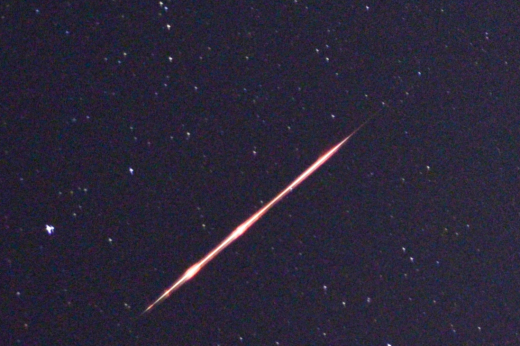
"After I uploaded my pictures to my PC, I realized that there were a lot of faint ones I hadn't noticed before," he says. "There was a faint meteor in about 30 pictures over a 15 minute period."
Near Redding, California, Craig Heden had ideal viewing conditions for the shower. "I counted 7 tau Herculids and 4 sporadics between 2145 and 2300 local time, including one brilliant, fragmenting red fireball, which made the viewing very worthwhile," he says.
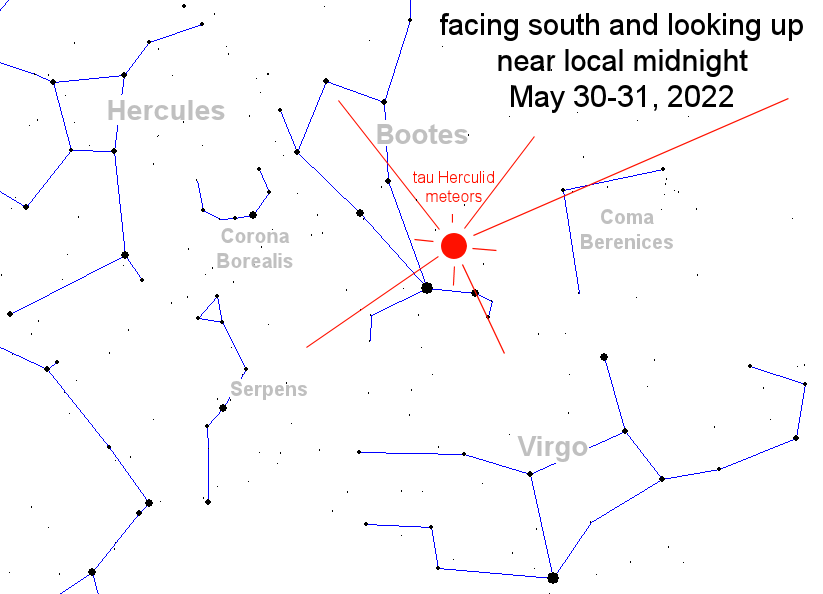
Many observers reporting to Spaceweather.com say the meteors were slow, they shined as brightly as 2nd to 4th magnitude stars, and their tails traced back to a radiant near Arcturus. These characteristics are in accord with debris coming from Comet 73P's breakup in 1995.
Eliot Herman saw a bright one over Tucson, Arizona:
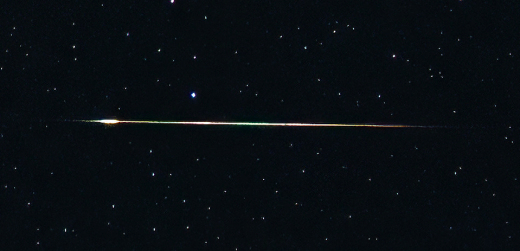
"This tau Herculid flared twice and appeared to be significantly brighter than Arcturus, mag 0," says Herman. "I counted nine in an hour or so around the predicted maximum and might have missed some looking another direction while rotating on a stool to search."
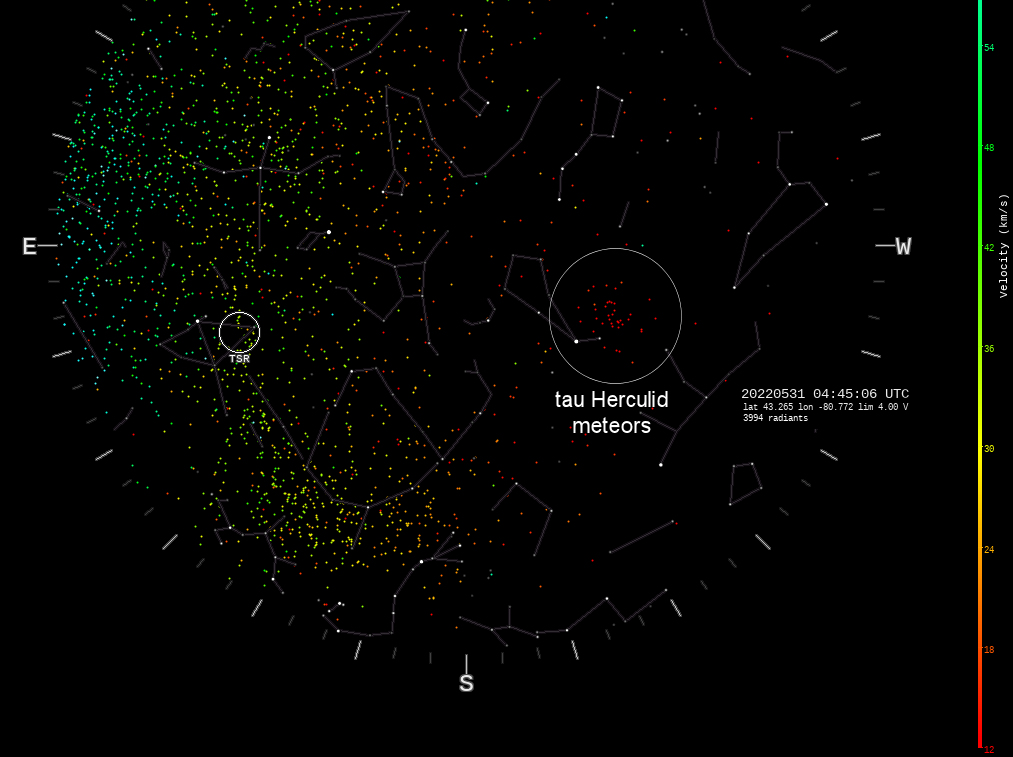
The Canadian Meteor Orbit Radar (CMOR) in western Ontario detected more than 30 slow tau Herculids. Take a look at their radar sky map; all of the meteors were clustered near Arcturus, as expected. Independent radio data reported by Japanese astronomers reveal two peaks of tau Herculid activity, perhaps linked to two distinct debris streams from Comet 73P/Schwassmann-Wachmann 3. It is noteworthy that these radio and radar detections include very small meteoroids too faint to see with the unaided eye.
more images: from Frankie Lucena of Cabo Rojo, Puerto Rico; from Francisco A. Rodriguez of Gran Canaria Island; from Michelle Nichols in the light-polluted suburbs of Chicago, Illinois; from George Varros of Mount Airy, Maryland; from David Blanchard of Mormon Lake, Arizona; from Samer Hariri of Northville, Michigan; from Troy Michael Bryan of Redington, Nebraska; from Charles Kiesel of Fort Branch, Indiana; from Brian Emfinger of Fayetteville, Arkansas; from Larry McNish of Calgary, Alberta;
Realtime Space Weather Photo Gallery
Free: Spaceweather.com Newsletter
"I LOVE YOU FOREVER" MOONSTONE PENDANT: Are you looking for a far-out gift? Consider the "I Love You Forever" Moonstone. This one hitched a ride to the stratosphere onboard a cosmic ray research ballooin on May 13, 2022:
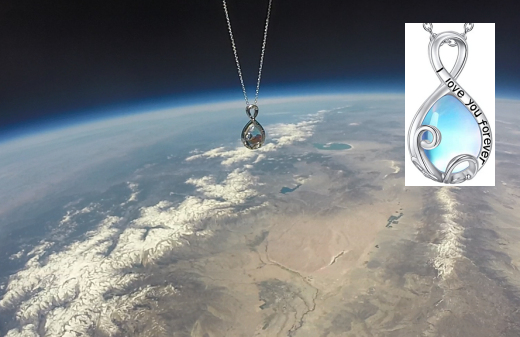
You can have it for $162.95. The moonstone's sterling silver infinity wrap is inscribed with the words "I love you forever." It makes a great anniversary or birthday gift. The moonstone comes with a greeting card showing the pendant in flight, telling the story of its trip to the edge of space and back again.
Far Out Gifts: Earth to Sky Store
All sales support hands-on STEM education
Realtime Noctilucent Cloud Photo Gallery
Free: Spaceweather.com Newsletter
Realtime Aurora Photo Gallery
Free: Spaceweather.com Newsletter