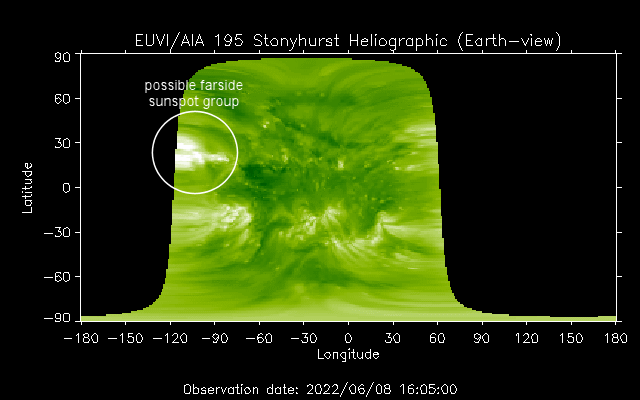
BLANK SUN: Today the sun is blank--no sunspots. This is a remarkable development more than 2 years after the start of surging Solar Cycle 25. The situation won't last long, though. NASA's STEREO-A spacecraft is monitoring a likely sunspot group approaching from behind the sun's northeastern limb. Solar flare alerts: SMS Text.
THE VENUS CLOUD DISCONTINUITY: A towering wall of acid clouds is racing through the atmosphere of Venus. Luigi Morrone photographed it from Agerola, Italy, on June 4th:
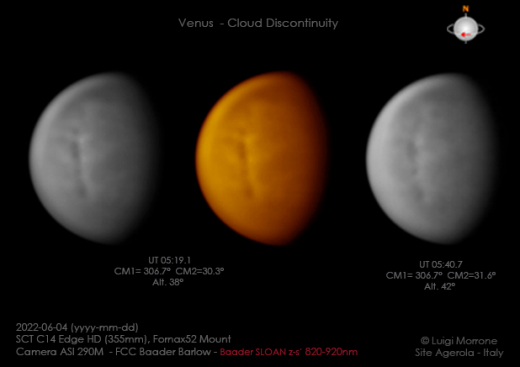
"It's called the Venus Cloud Discontinuity," says Morrone, who is part of an international network of amateur astronomers who have been tracking the massive structure. "I used a 14-inch Celestron telescope to record the discontinuity twice in 20 minutes."
The Venus Cloud Discontinuity is a relatively new discovery, photographed by Japan's Venus orbiter Akatsuki in 2016 and first spotted by JAXA scientist Javier Peralta. The massive structure cuts vertically across Venus's equator, stretching almost 5000 miles from end to end, and circles the planet faster than 200 mph, making one lap every ~5 Earth days.
Researchers following up on the discovery soon stumbled onto another surprise. Older photographs of Venus showed it, too. "[The Cloud Discontinuity] is a recurrent phenomenon that has gone unnoticed since at least the year 1983," they wrote in a May 2020 Geophysical Research Letter.
How do you overlook something so big? Visually, the Cloud Discontinuity is hidden underneath Venus's opaque cloudtops. To see it, you have to use an infrared filter, which reveals heat trickling up from below. Indeed, this is how amateurs are tracking the disturbance: "I used a Baader SLOAN 820-920nm near-infrared filter," notes Morrone.
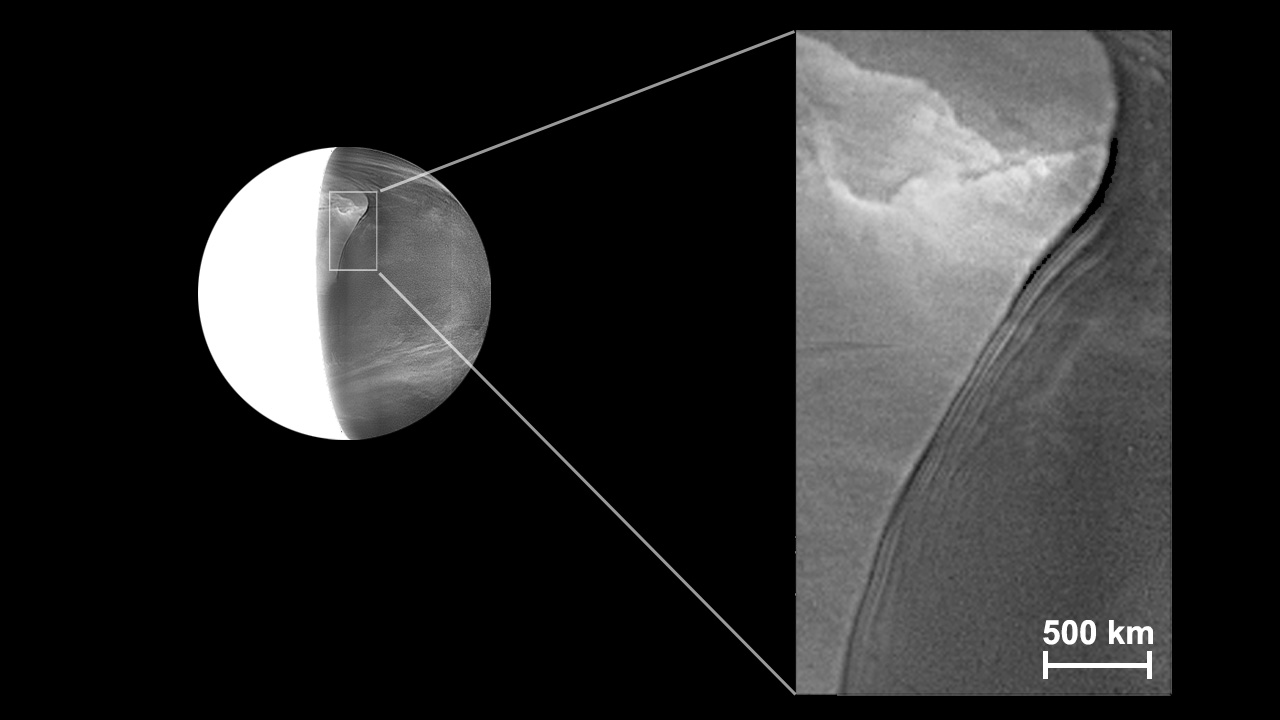
Above: Undulations behind the Cloud Discontinuity on April 15, 2016. Credits: Javier Peralta/JAXA-Akatsuki team. More images.
Researchers still aren't sure what the Cloud Discontinuity is. "This atmospheric disruption is a new meteorological phenomenon, unseen on other planets. Because of this it is difficult to provide a confident physical interpretation," says Peralta. Numerical simulations suggest that it might be some kind of exotic nonlinear Kelvin wave; the jury's still out.
Whatever it is, the structure might help solve a longstanding mystery: Why does Venus's atmosphere rotate so much faster than the planet itself? The hot, deadly air on Venus spins nearly 60 times faster than its surface, an effect known as "super-rotation." Venus's Cloud Discontinuity could be assisting the spin-up by transporting angular momentum from the deep atmosphere to the cloudtops.
Amateur astronomers, if you would like to monitor this phenomenon, check out the preprint "Amateur Observers Witness the Return of the Venus Cloud Discontinuity" (Kardasis et al.), which discusses observing techniques. Venus is waiting in the morning sky.
Realtime Space Weather Photo Gallery
Free: Spaceweather.com Newsletter
JEDI WINE GLASS: Father's Day is less than two weeks away. Are you looking for a far out gift? Consider the Jedi Wine Glass. This one hitched a ride to the stratosphere onboard a cosmic ray research balloon on June 1, 2022:
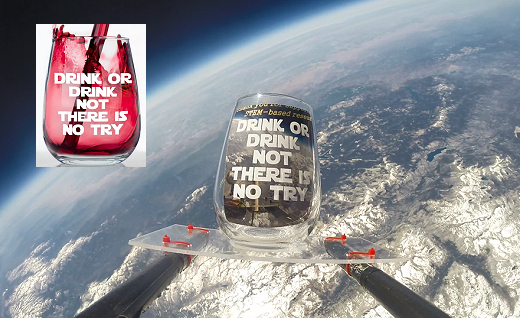
You can have it for $99.95. The funny stemless wine glass spent 2 hours floating in the stratosphere while cosmic ray sensors gathered data. It experienced temperatures as low as -63C and a vacuum-like air pressure only 0.2% of sea level.
The students of Earth to Sky Calculus are selling Jedi wine glasses to support their cosmic ray ballooning program. Each one comes with a greeting card showing the glass in flight and telling the story of its trip to the stratosphere and back again.
Far Out Gifts: Earth to Sky Store
All sales support hands-on STEM education
Realtime Aurora Photo Gallery
Free: Spaceweather.com Newsletter
Realtime Noctilucent Cloud Photo Gallery
Free: Spaceweather.com Newsletter