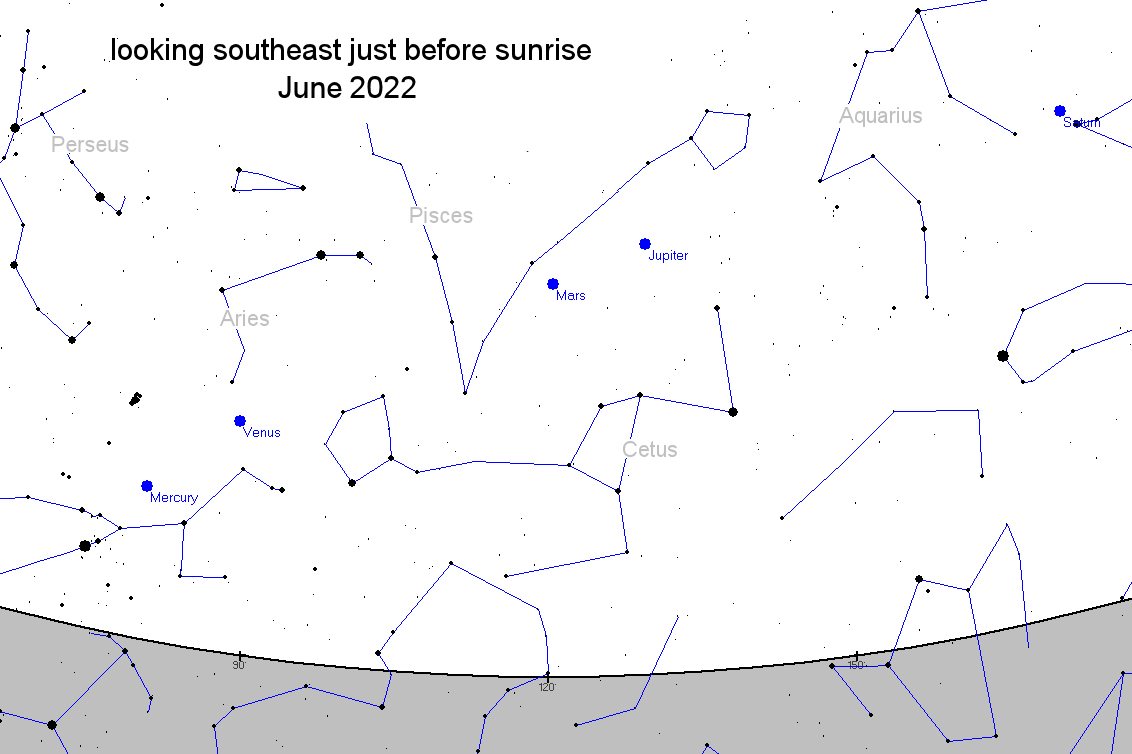
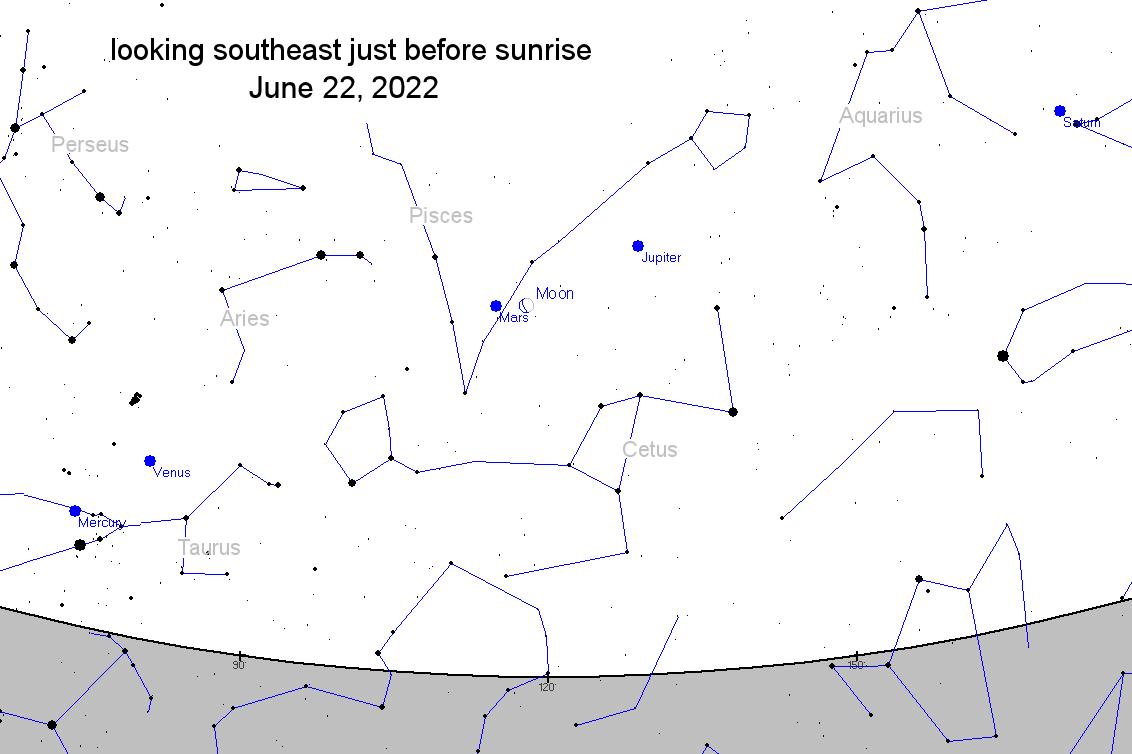
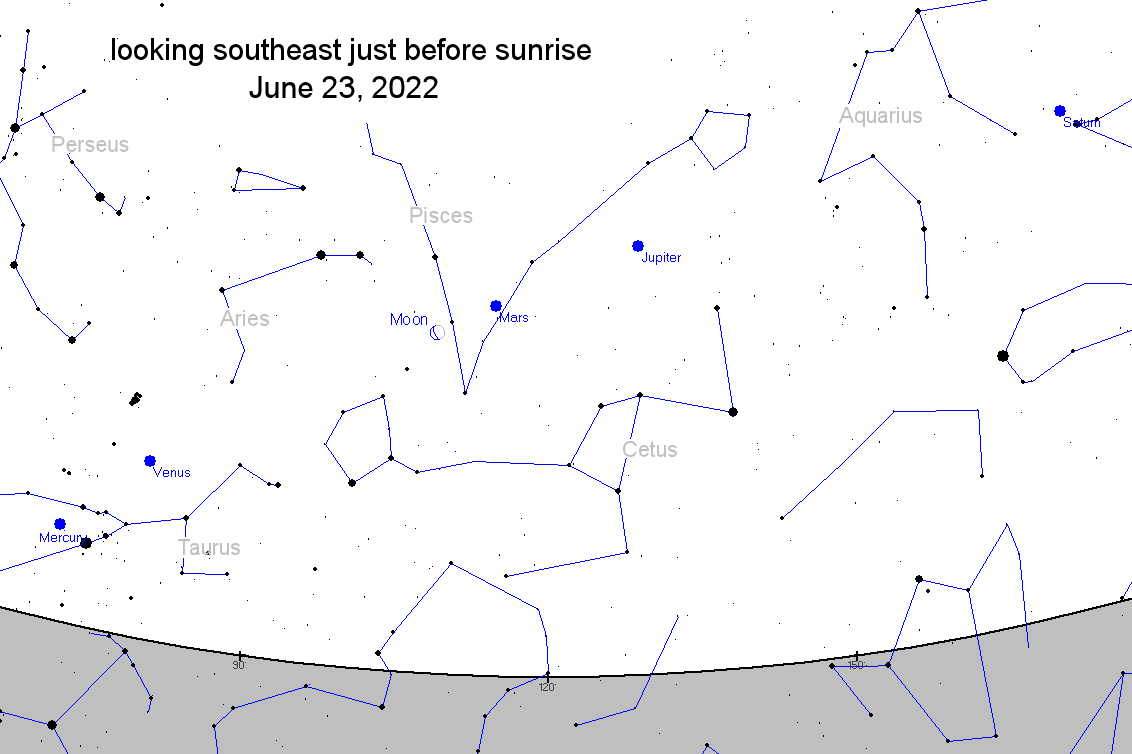
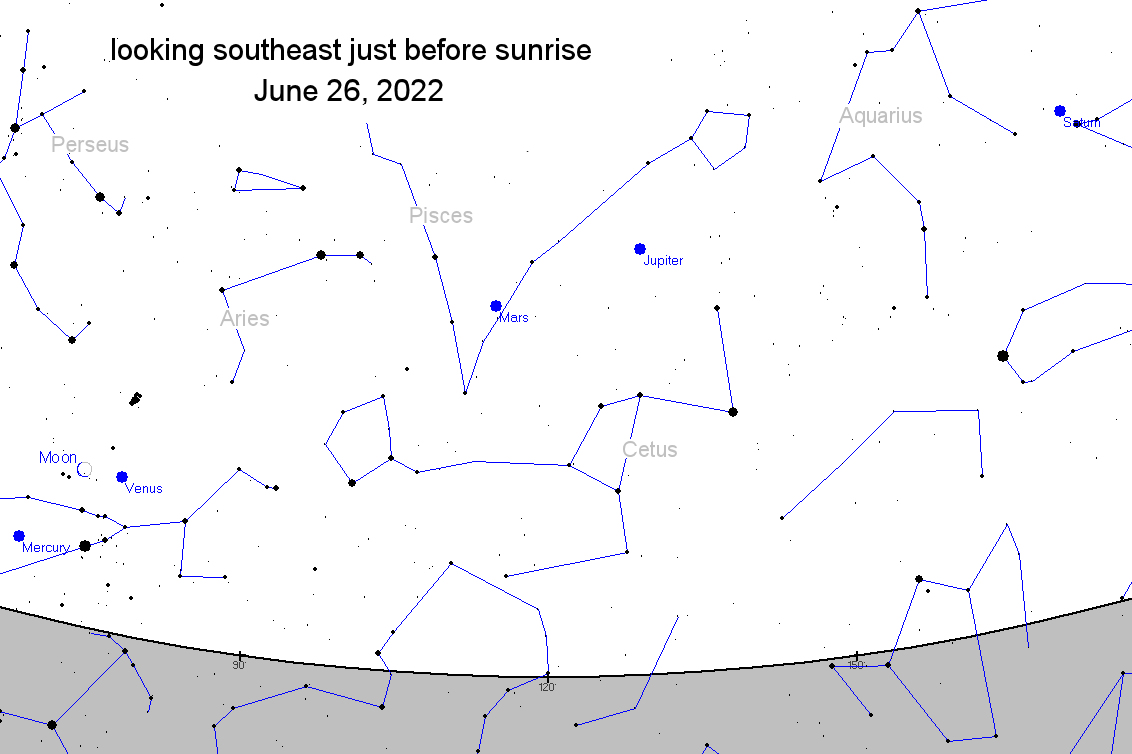
RARE MORNING SKY SHOW: For the first time since Dec. 2004, five naked-eye planets have lined up at dawn in order of their distance from the sun. It's a rare morning sky show. Next week, the Moon will hop from planet to planet, producing a series of early morning conjunctions. Set your alarm for dawn and enjoy the show! Sky maps: today, June 21, 22, 23, 24, 25, 26.



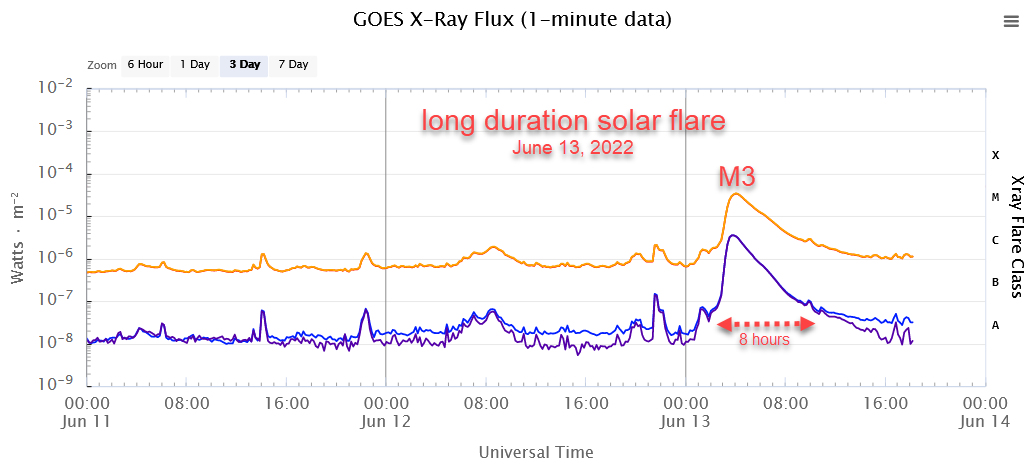
LONG-DURATION SOLAR FLARE AND CME: Growing sunspot AR3032 exploded on June 13th (0407 UT), producing an M3-class solar flare that lasted nearly 8 hours from beginning to end. NASA's Solar Dynamics Observatory recorded the slow-motion blast:
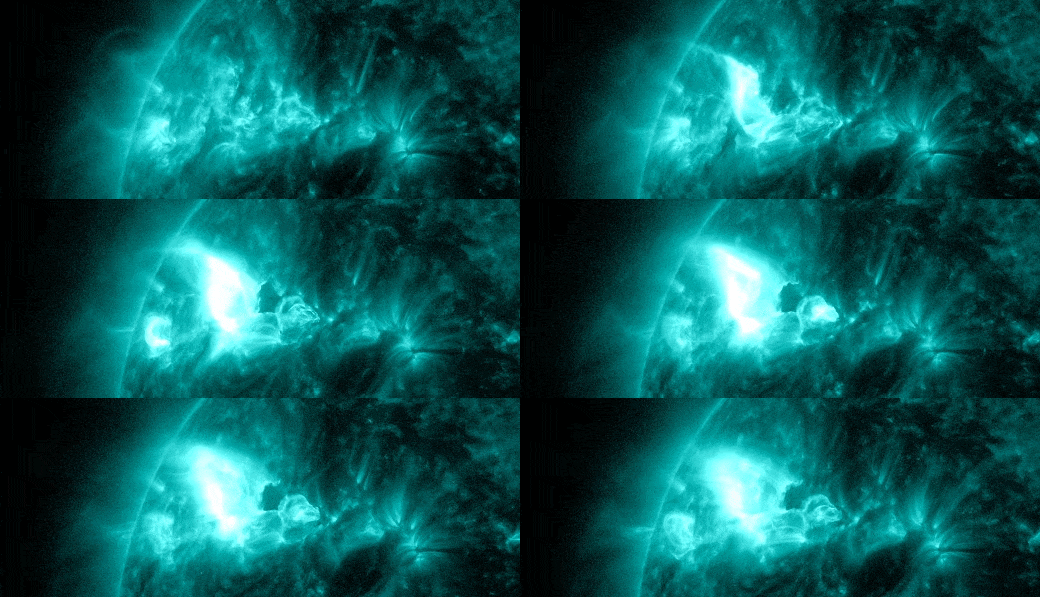
Extreme ultraviolet radiation from the flare ionized the top of Earth's atmosphere, causing a shortwave radio blackout over Japan and southeast Asia: blackout map. Radio operators in the area may have noticed unusual propagation effects at frequencies below 30 MHz for more than an hour after the flare's peak.
Also, the explosion hurled a magnificent CME into space, according to coronagraphs onboard the Solar and Heliospheric Observatory (SOHO). Click to set the scene in motion:
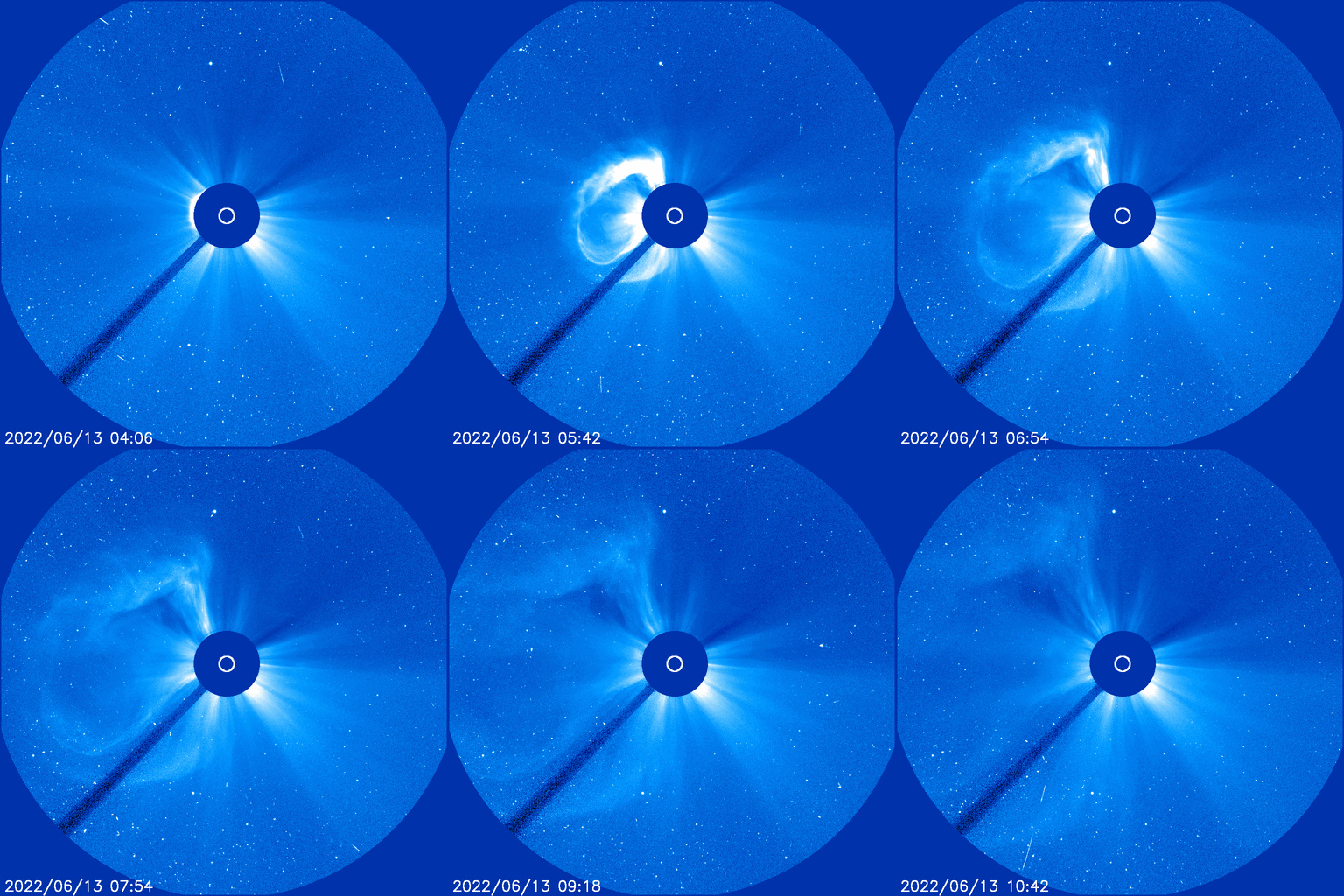
NOAA analysts have determined that the CME will pass near Earth later this week, possibly delivering a glancing blow to our planet's magnetosphere. Their simulation suggests an arrival time of 0900 UT on June 15th. Minor G1-class geomagnetic storms are possible if and when the CME makes contact. Solar flare alerts: SMS Text.

Realtime Aurora Photo Gallery
Free: Spaceweather.com Newsletter
FAR-OUT FATHER'S DAY GIFTS: What do you get the dad who has everything? Consider a gift from the edge of space. Every item in the Earth to Sky Store has flown to the top of Earth's atmosphere onboard a cosmic ray balloon, and they're all 10% off between now and Father's Day (June 19th).

Each gift comes with a unique greeting card showing the item in flight and telling the story of its journey to the stratosphere and back again. Cosmic ray data collected during the flights form a unique record of radiation in Earth's atmosphere--100% gathered and analyzed by young scientists. Sales support the students and their high-altitude ballooning program.
Don't forget to use the coupon code LUKEIAMYOURFATHER at checkout for a 10% Father's Day discount.
Far Out Gifts: Earth to Sky Store
All sales support hands-on STEM education
SUNSET POLLEN CORONA: Warning: This sunset might make you sneeze. "The pine is now strongly flowering here in middle Finland, filling the air with allergens," reports Vesa Vauhkonen, who photographed the resulting pollen corona on June 10th:

Note the lumpy rings of light around the setting sun. That's the pollen corona. "Some of the pollen coronas we've been seeing are very impressive, both in size, colors and geometry," says Vauhkonen. "I captured these images just before sunset at the lake of Niinivesi in Rautalampi."
Coronas are rings of light that surround the sun when sunlight is scattered from the outside of small particles. Tiny droplets of water in clouds can make coronas, too, but pollen grains do even better. They make intensely colored rings.
Pollen coronas tend to be elliptical and lumpy because the underlying grains are, too. This photo of pine pollen seen through a microscope shows what's going on:

They look like Mickey Mouse hats--a result of air sacs that help carry them in the wind. These align the grains so that the unruly swarm can scatter light coherently, encoding their individual structures into the shape of the overall corona.
Realtime Space Weather Photo Gallery
Free: Spaceweather.com Newsletter
Realtime Noctilucent Cloud Photo Gallery
Free: Spaceweather.com Newsletter