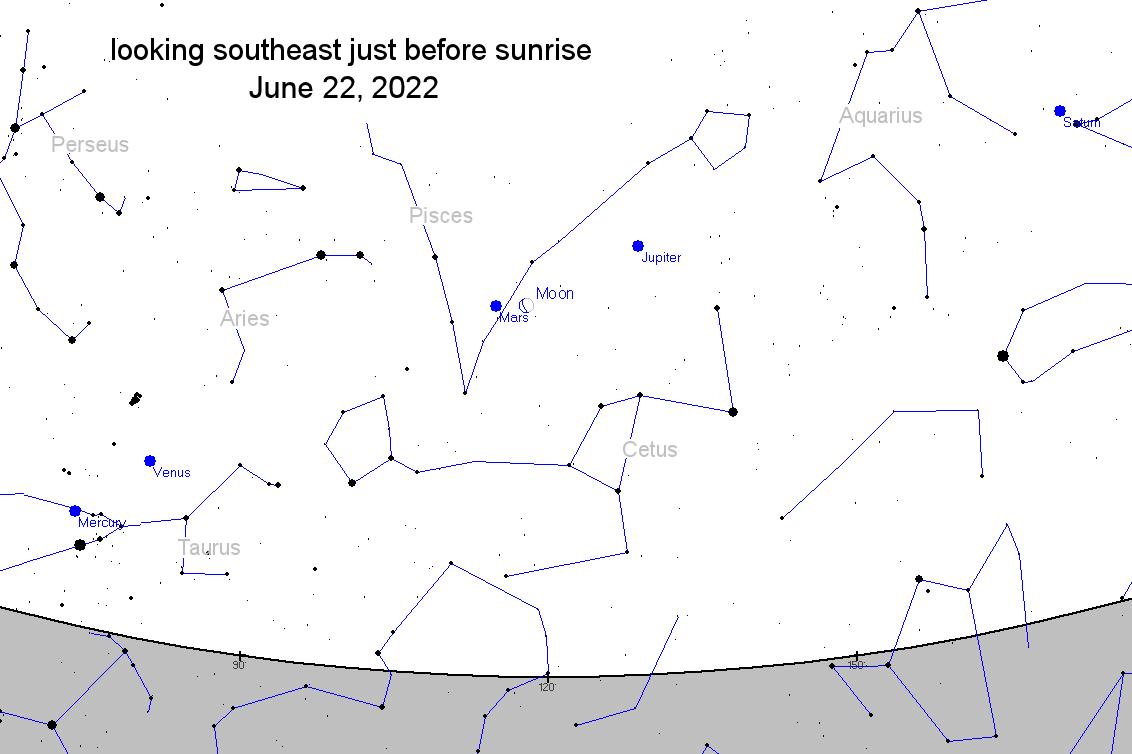
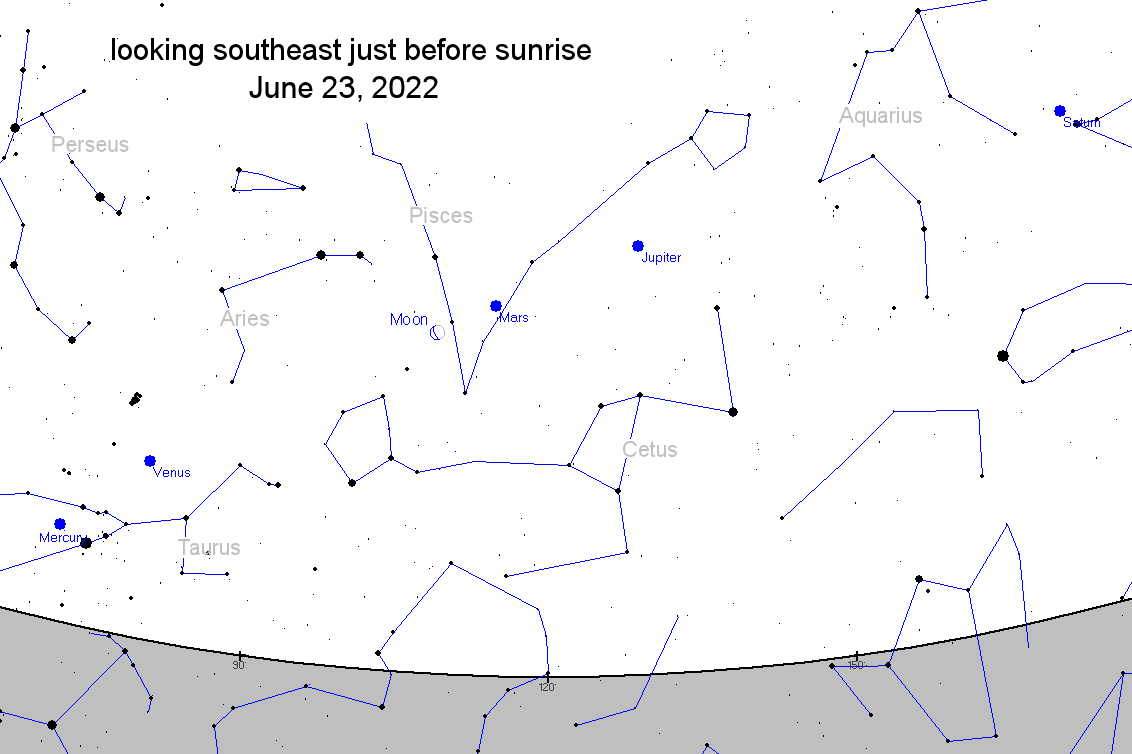
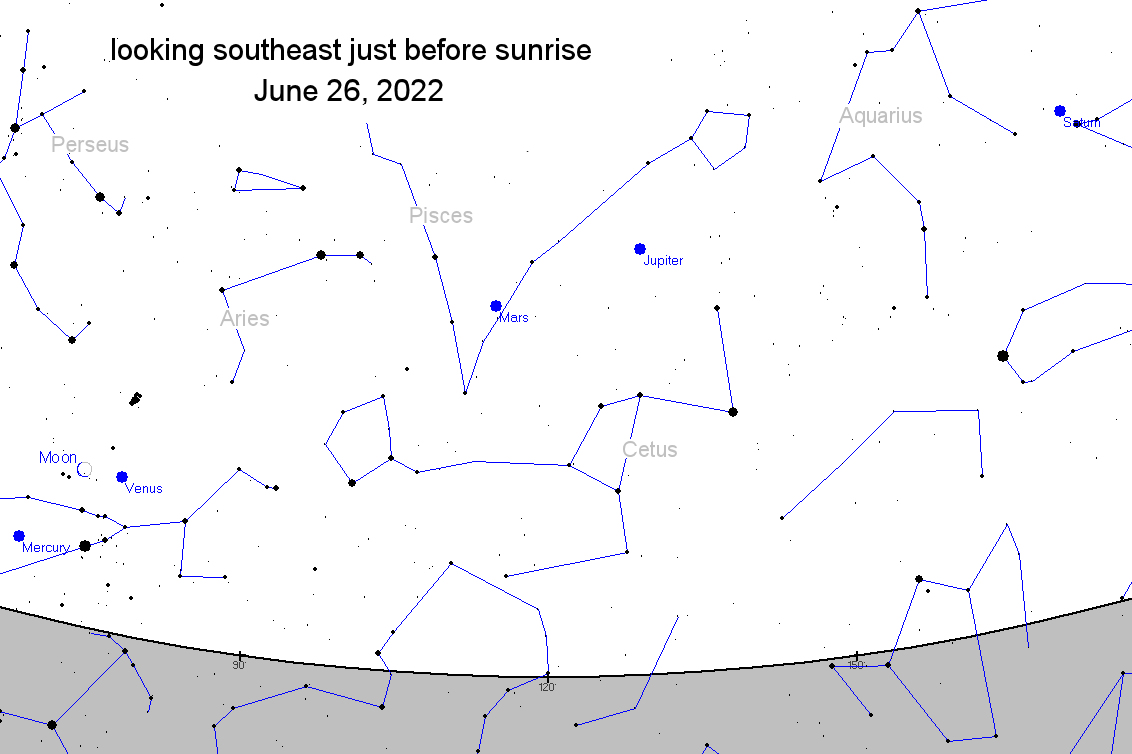
MORNING PLANET SHOW: For the first time in almost 20 years, five naked-eye planets have lined up in the morning sky in order of their distance from the sun: Mercury, Venus, Mars, Jupiter and Saturn. This week the Moon will hop from planet to planet, producing a series of beautiful conjunctions. Set your alarm for dawn and enjoy the show! Sky maps: June 22, 23, 24, 25, 26.


MID-LATITUDE NOCTILUCENT CLOUDS: On the summer solstice, June 21st, Charles Chiofar of Buckley, Washington, woke up before sunrise to check out the sky. "While taking photos of the planets, noctilucent clouds (NLCs) also put on a rather good display," he says. This is a 20 second exposure:
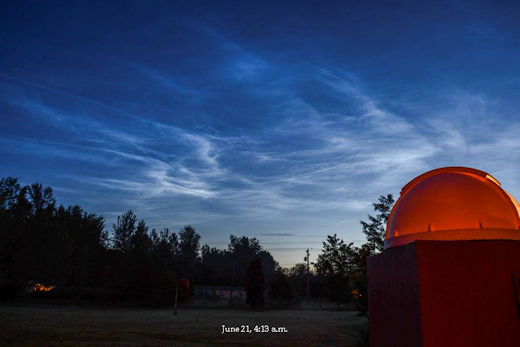
Chiofar's sighting marks the lowest latitude excursion of NLCs so far this year. Buckley is at +47o N. Usually, NLCs are most widespread during weeks around solstices--i.e., now. Sky watchers at mid-latitudes should be alert for these clouds of frosted meteor smoke; just before sunrise or after sunset is the best time to look.

Realtime Noctilucent Cloud Photo Gallery
Free: Spaceweather.com Newsletter
SPACEX MYSTERY, SOLVED: The mystery of SpaceX's "rocket powered auroras" has been solved. On Sunday morning, June 19th, SpaceX launched a Falcon 9 rocket from Cape Canaveral. Photographers accustomed to seeing these launches were surprised when something unusual happened. A red glow stretched across the Milky Way. It looked like the aurora borealis, as shown in this photo from Christopher Hoffman in Saint Mary's County, Maryland:
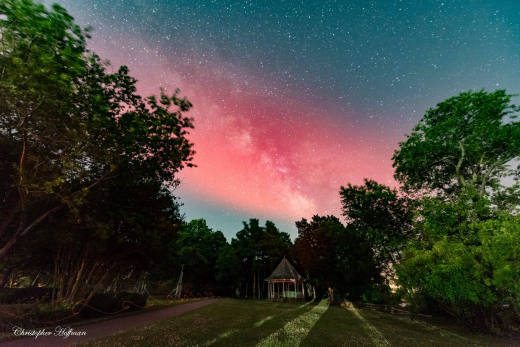
"I went out with some first time photographers to teach them how to set up their cameras for night sky photography," says Hoffman. "We took a 30 second exposure, and when the exposure was finished I saw this red glowing area covering the Milky Way."
Photographers in New York, Ohio, North Carolina and Tennesee saw it, too. The glow appeared about 10 minutes after the Falcon 9 rocket lifted off, and many observers likened its appearance to auroras. However, there was no geomagnetic storm in progress. It had to be the rocket.
What happened? Space physicist Jeff Baumgardner of Boston University has the answer: "This glow is probably the exhaust gasses from the rocket's 2nd stage causing the ionosphere to recombine quickly. This is a well studied phenomenon when rocket engines are firing in the altitude regime 200-250 km."

Above: A similar display of red light appeared over the eastern USA following the launch of a Titan IV rocket on April 30, 2005. [full story]
In simplified form, here is what happens: The upper atmosphere is filled with oxygen ions (O+). Of particular interest is the F-layer of the ionosphere, because it is rich in O+. When the Falcon 9 rocket reaches the F-layer, it adds water (H2O) and carbon dioxide (CO2) to the mix, spewing the molecules out of its engine. Oxygen ions are hungry for electrons, and the newly arriving molecules are eager to provide them. Electrons "re-combine" with oxygen, turning ions into atoms. As electrons cascade down the oxygen atom's energy levels, they emit red photons at a wavelength of 6300 Å--the same color as red auroras.
more images: from Josh Thum of Sevierville, Tennessee; from Brenda Calinawan of Kortright, New York; from David Cortner of Rutherford College, NC
Realtime Space Weather Photo Gallery
Free: Spaceweather.com Newsletter
"I LOVE YOU FOREVER" MOONSTONE PENDANT: Are you looking for a far-out gift? Consider the "I Love You Forever" Moonstone. This one hitched a ride to the stratosphere onboard a cosmic ray research ballooin on May 13, 2022:
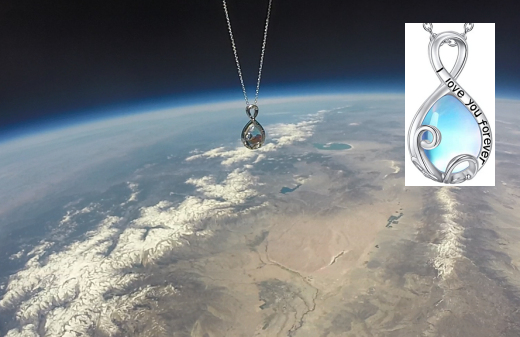
You can have it for $162.95. The moonstone's sterling silver infinity wrap is inscribed with the words "I love you forever." It makes a great anniversary or birthday gift. The moonstone comes with a greeting card showing the pendant in flight, telling the story of its trip to the edge of space and back again.
Far Out Gifts: Earth to Sky Store
All sales support hands-on STEM education
Realtime Aurora Photo Gallery
Free: Spaceweather.com Newsletter