MINOR GEOMAGNETIC STORM WATCH: There is a chance of minor geomagnetic storms on June 28th and 29th when a CME might sideswipe or even directly hit Earth's magnetic field. A confusing mish-mash of overlapping CMEs has left the sun in recent days, especially on June 26th, and it has been difficult to determine their trajectories. As a result, this is a low-confidence forecast. Aurora alerts: SMS Text
COMET K2 ENTERS THE INNER SOLAR SYSTEM: For the past 3 million years, Comet C/2017 K2 (PanSTARRS) has been falling toward the sun--a long, slow journey from the Oort cloud. Finally, it's here. Austrian astrophotographer Michael Jaeger photographed "Comet K2" entering the inner solar system on June 25th:
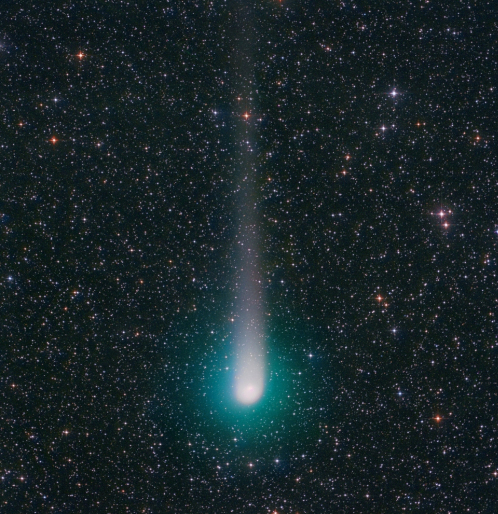
"This is a 22-minute exposure with my 16-inch telescope," says Jaeger. "The comet was about 9th magnitude."
Comet K2 caused a sensation when it was discovered in 2017. At first, it appeared to be one of the biggest comets in modern history, with a nucleus as much as 160 km wide. Hubble Space Telescope observations have since downsized it to 18 km. That's still big (typical comet nuclei measure 1 to 3 km), but not a record setter. K2 is comparable in size to Halley's Comet.
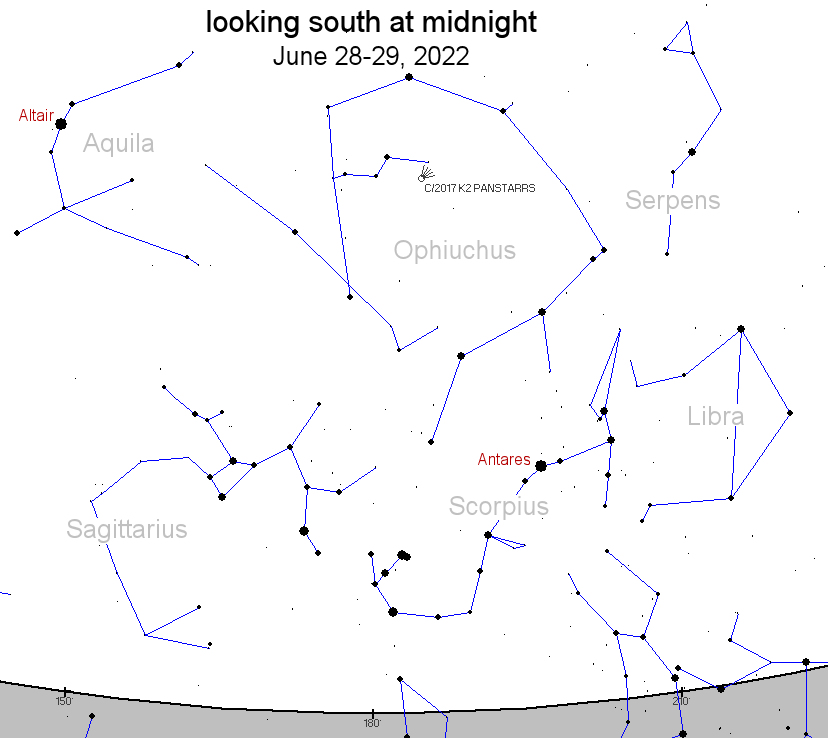
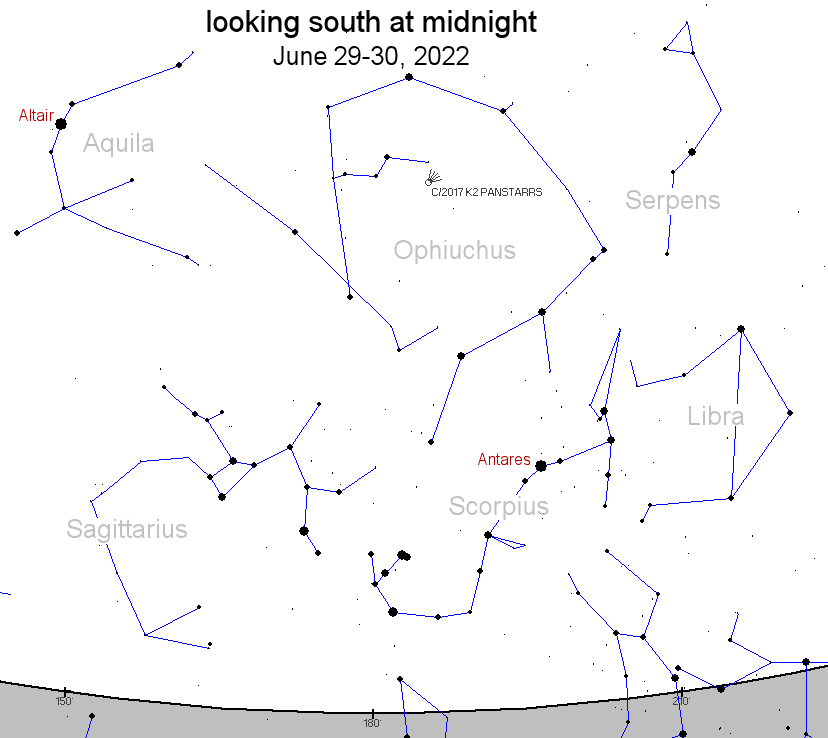
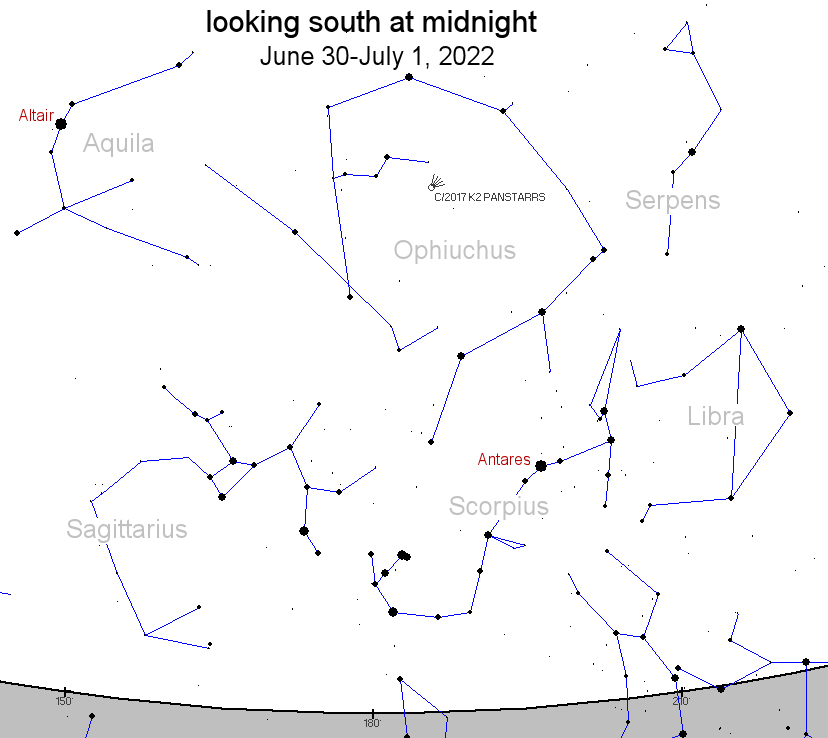
The comet will make its closest approach to Earth (1.8 AU away) on July 14th, brightening to 7th or 8th magnitude. This is too dim to see with the naked eye, but an easy target for backyard telescopes. A good time to look is now before the full Moon of July 13th interferes. Comet K2 may be found high in the midnight sky in the constellation Ophiuchus.
Sky maps: June 29, 30, July 1. Additional resources: current coordinates, 3D orbit, light curve.
more images: from Roland Fichtl of Engelhardsberg, Germany; from José J. Chambó of Valencia, Spain; from Fritz Helmut Hemmerich of Alhama de Granada, Spain; from Alessandro Bianconi of Dolianova, Italy; from Paul Robinson in the Sierra Nevada mountains of California; from Lionel Majzik of Hakos, Khomas, Namibia
Realtime Space Weather Photo Gallery
Free: Spaceweather.com Newsletter
STERLING SILVER RAINBOW DRAGONFLY (GOLDEN HEART): Are you looking for a far-out gift? Consider a rainbow dragonfly from the edge of space. On June 3, 2022, this sterling silver pendant hitched a ride onboard an Earth to Sky Calculus cosmic ray research balloon:
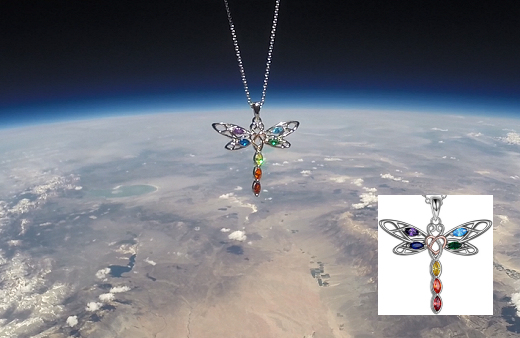
You can have it for $172.95. The dragonfly's heart is a golden Celtic love knot, and its wings are decorated with a spray of rainbow-colored crystals. The students are selling dragonfly pendants to support their cosmic ray ballooning program. Each one comes with a greeting card showing the pendant in flight and telling the story of its trip to the stratosphere and back again.
Far Out Gifts: Earth to Sky Store
All sales support hands-on STEM education
Realtime Noctilucent Cloud Photo Gallery
Free: Spaceweather.com Newsletter
Realtime Aurora Photo Gallery
Free: Spaceweather.com Newsletter