GEOMAGNETIC STORM WATCH: NOAA forecasters say there is a chance of minor G1-class geomagnetic storm on July 6th when a stream of solar wind is expected to hit Earth's magnetic field. The gaseous material is flowing from a cyclops-like hole in the sun's atmosphere. Aurora alerts: SMS Text.


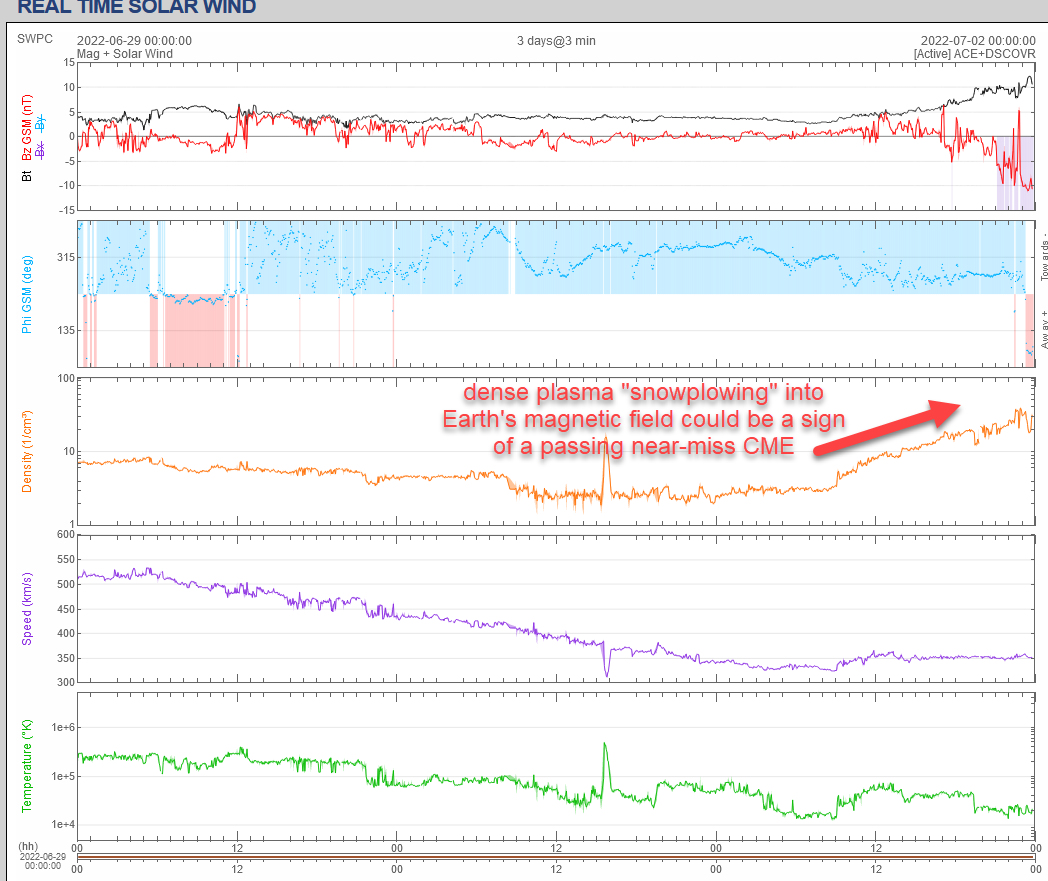
SOMETIMES A NEAR-MISS IS CLOSE ENOUGH: ON July 1st, a CME passed close to Earth. It did not hit. Instead, it snowplowed some dense solar wind plasma in our direction. That was enough to spark a G1-class geomagnetic storm with auroras across many northern-tier US states. Rocky Raybell sends this picture from Keller, Washington:
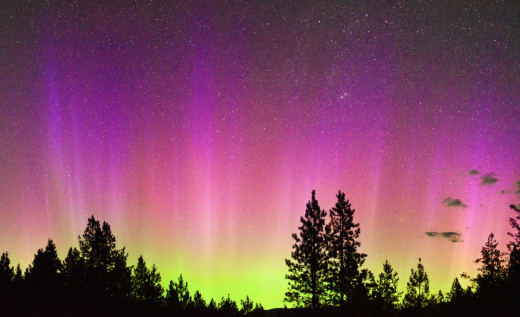
"The auroras were active from 10:30pm on July 1st until 2:30am on July 2nd," says Raybell. "Most of the time it was a stable band of green with red on top. Just after midnight the purple pillars started sliding across the horizon--a beautiful show!"
more images: from Marybeth Kiczenski of Ludington, MI; from Dwight Brady of Marquette, MI; from Sarah Goodwin of Mears, MI; from Thomas Spence of Tofte, MN; from Greg Ash of Minnesota
Realtime Aurora Photo Gallery
Free: Spaceweather.com Newsletter
A SUDDEN INCREASE IN NOCTILUCENT CLOUDS: Something unexpected just happened in the mesosphere. As June came to an end, NASA's AIM spacecraft detected a sharp increase in the frequency of noctilucent clouds (NLCs), the most in 15 years:
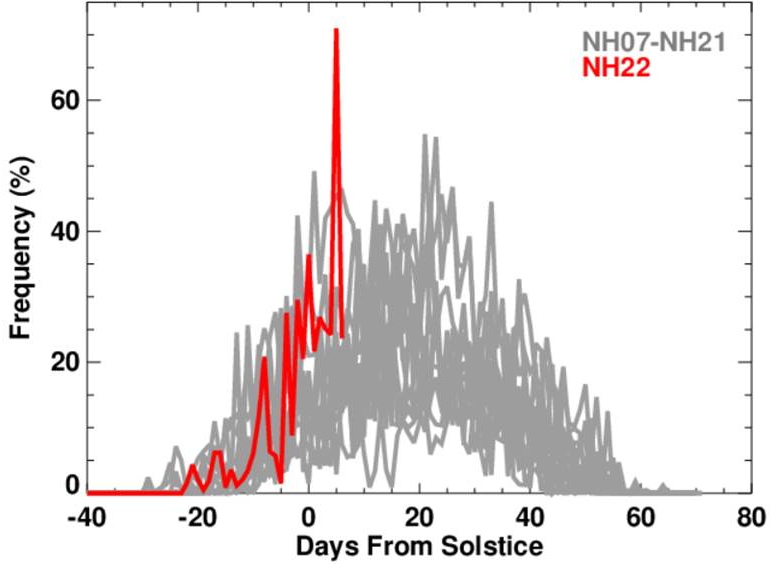
"In the last couple of days we saw a huge spike in the clouds," says Cora Randall, a professor at the University of Colorado Boulder. Randall works with AIM data and she prepared the plot, above.
NLCs are Earth's highest clouds. Seeded by meteoroids, they float at the edge of space more than 80 km above the ground. NLCs form when summertime wisps of water vapor rise up to the mesosphere, allowing water to crystallize around specks of meteor smoke.
Oliver Schwenn witnessed the outbreak on June 30th from Aarhus, Denmark:
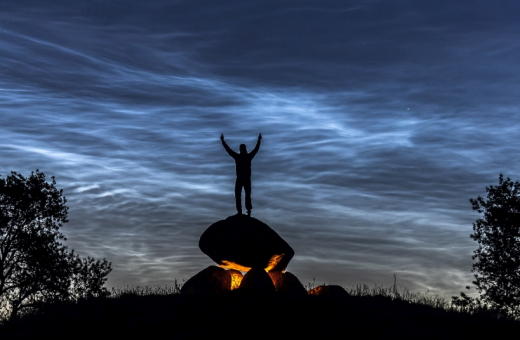
"I photographed the display shortly before midnight," says Schwenn. "The clouds were shining brightly in the night sky."
What's causing this? It could be SpaceX.
"We're speculating that the spike might be due to extra water vapor transported to higher latitudes from rocket launches," says Randall. "But much more quantitative analysis would be required to confirm that or not."
The timing makes sense. It takes about 10 days for water vapor from rocket engines to waft up to the mesosphere. This takes us back to SpaceX's launch of the Globalstar satellite on June 19th, which caused a number of remarkable phenomena in the sky due to the extra burn time of its second-stage engine. Noctilucent clouds may be yet another by-product of that unusual launch.
Noctilucent clouds are normally a polar phenomenon. However, since the outburst began we have received reports of NLCs from as far south as Washington State and Oregon. Look for the clouds, ripply and electric-blue, just after sunset.

Realtime Space Weather Photo Gallery
Free: Spaceweather.com Newsletter
STERLING SILVER RAINBOW DRAGONFLY (GOLDEN HEART): Are you looking for a far-out gift? Consider a rainbow dragonfly from the edge of space. On June 3, 2022, this sterling silver pendant hitched a ride onboard an Earth to Sky Calculus cosmic ray research balloon:
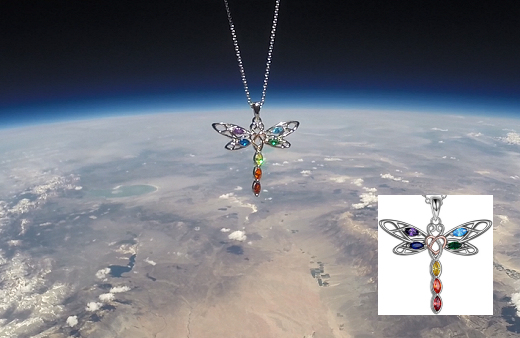
You can have it for $172.95. The dragonfly's heart is a golden Celtic love knot, and its wings are decorated with a spray of rainbow-colored crystals. The students are selling dragonfly pendants to support their cosmic ray ballooning program. Each one comes with a greeting card showing the pendant in flight and telling the story of its trip to the stratosphere and back again.
Far Out Gifts: Earth to Sky Store
All sales support hands-on STEM education
Realtime Noctilucent Cloud Photo Gallery
Free: Spaceweather.com Newsletter