GEOMAGNETIC STORM WATCH: NOAA forecasters say there is a chance of minor G1-class geomagnetic storms on July 6th when a stream of solar wind is expected to hit Earth's magnetic field. The gaseous material is flowing from a cyclops-like hole in the sun's atmosphere. Aurora alerts: SMS Text.


NEW SUNSPOT: A new sunspot is emerging over the sun's northeastern limb.Pepe Manteca of Barcelona, Spain, took a look and found a dark core big enough to swallow Earth:
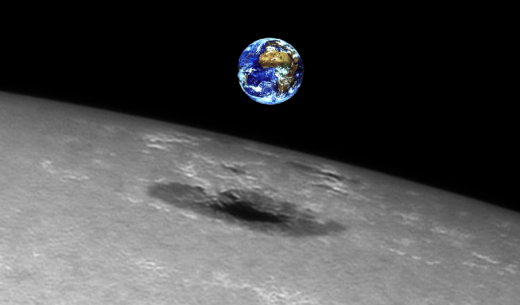
Provisionally numbered AR3053, the sunspot is crackling with almost-M-class solar flares. It will turn toward Earth in the days ahead, increasing the geoeffectiveness of its explosions. Aurora alerts: SMS Text.
Realtime Space Weather Photo Gallery
Free: Spaceweather.com Newsletter
AURORAS ON THE 4TH OF JULY: A CME that narrowly missed Earth on July 1st ignited a pair of geomagnetic storms with auroras during the long holiday weekend. Greg Ash photographed the light show during the early hours of July 4th from Ely, Minnesota:
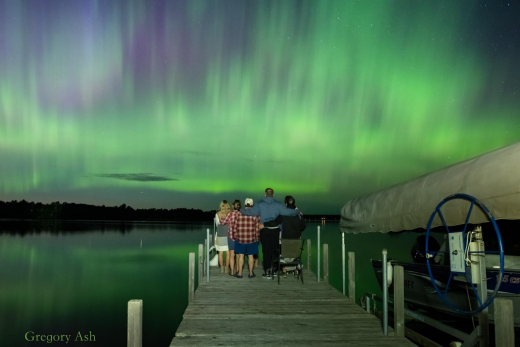
"It was a pleasure to watch three generations captivated by this beautiful pulsating colorful light show," says Ash. "The auroras were very visible to the naked eye."
The CME that caused the display was probably launched from the sun on June 28th by an erupting filament of magnetism. It wasn't squarely on the sun-Earth line and didn't actually strike our planet. Instead, as it passed by, it shoved dense solar wind plasma toward Earth; think of the wake of a passing speed boat. Ripples from the near miss sparked G1-class geomagnetic storms on July 2nd and July 4th.

"The twin storms not only produced beautiful auroras, but also they also moved magnetometer needles including my own here in the UK," reports Stuart Green who recorded the event:
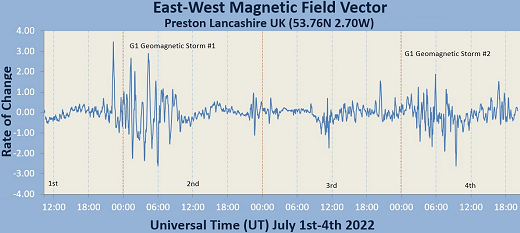
The squiggles in Green's chart represent changes in ground-level magnetic fields caused by the CME. "The sensor is buried in my garden about 0.5 meters below the surface in an East/West orientation," he explains. "This allows very sensitive (sub nanotesla) measurements of magnetic declination during geomagnetic storms."
Green built his own magnetometer from scratch. Would you like to do the same? Here's how.
more images: from Jake Stehli of Winona, Minnesota; from Rocky Raybell of Keller, Washington; from Marybeth Kiczenski of Ludington, Michigan; from George Dunham of Crawford, Colorado; from Dwight Brady of Marquette, MI; from Sarah Goodwin of Mears, MI; from Thomas Spence of Tofte, MN; from Michele Sadauskas of Glidden, WI; from Matthew D. Moffet of Billings, Montana; from Kalyky of Kinsey, Montana
Realtime Aurora Photo Gallery
Free: Spaceweather.com Newsletter
THE EDGE OF SPACE BUTTERFLY: Are you looking for a far-out gift? Consider the Edge of Space Butterfly. On June 26, 2022, this crystal pendant hitched a ride onboard an Earth to Sky Calculus cosmic ray research balloon:
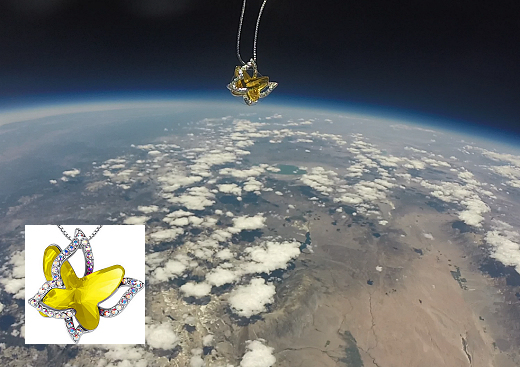
You can have it for $162.95. The inner yellow citrine crystal is surrounded by a "spread your wings" lattice of sparkling zirconia. A rich layer of rhodium plating ensures the longevity of the pendant and its 18-inch chain.
The Edge of Space Butterfly makes a great anniversary, Christmas, or birthday gift. It comes with a greeting card showing the pendant in flight and telling the story of its trip to the stratosphere and back again.
Far Out Gifts: Earth to Sky Store
All sales support hands-on STEM education
Realtime Noctilucent Cloud Photo Gallery
Free: Spaceweather.com Newsletter