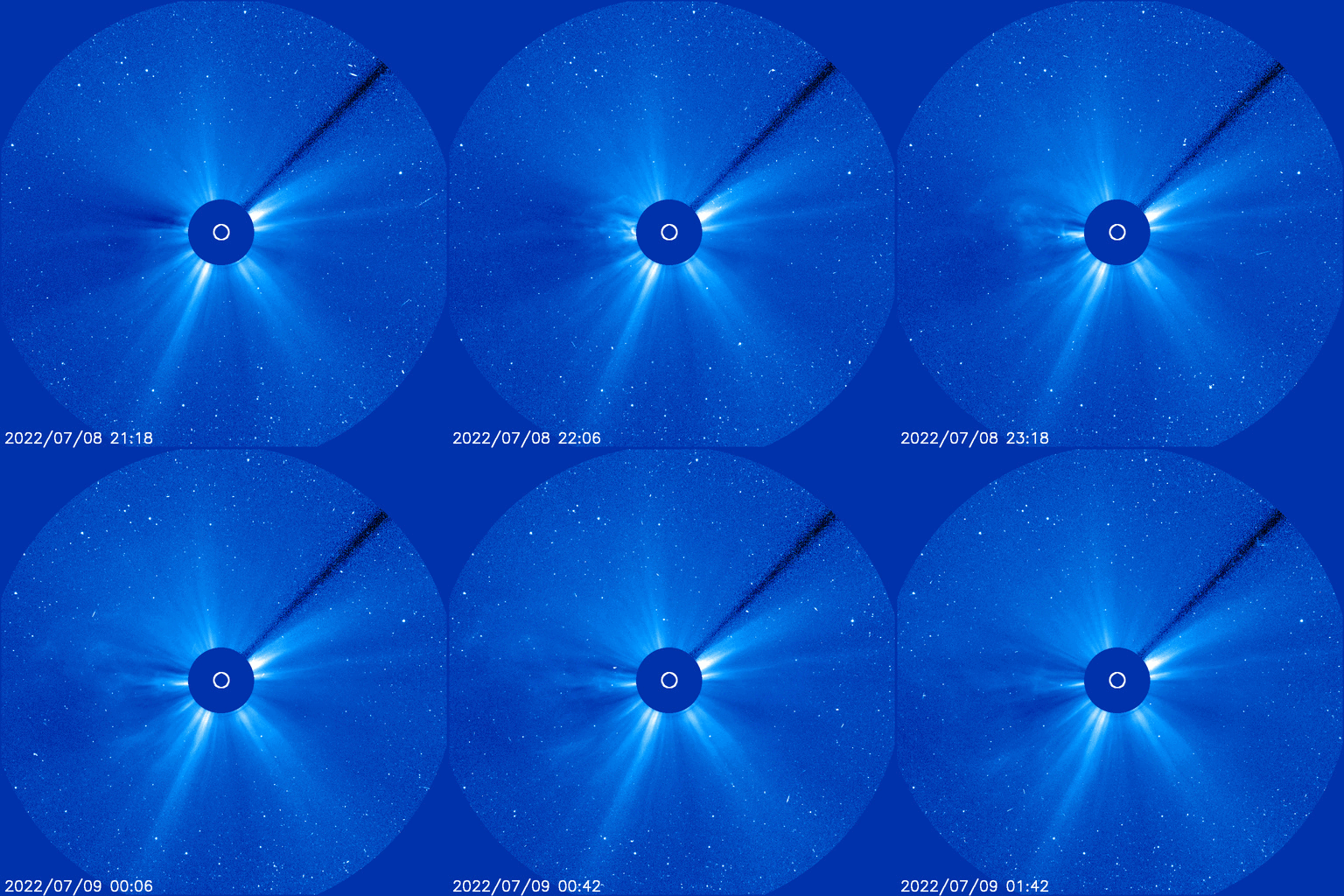
UPDATED CME FORECAST: A partial halo CME that left the sun on July 8th (movie) might not hit Earth after all. A new analysis by NOAA suggests a near miss on July 11th instead of the hoped-for glancing blow. Near misses can still spark geomagnetic activity, but this updated forecast lowers the odds of a full-fledged geomagnetic storm. Solar flare alerts: SMS Text.
THE STARFISH PRIME GEOMAGNETIC STORM: Sixty years ago, one of the biggest geomagnetic storms of the Space Age struck Earth. It didn't come from the sun.
"We made it ourselves," recalls Clive Dyer of the University of Surrey Space Centre in Guildford UK. "It was the first anthropogenic space weather event."
On July 9, 1962, the US military detonated a thermonuclear warhead 250 miles above the Pacific Ocean--a test called "Starfish Prime." What happened next surprised everyone. Witnesses from Hawaii to New Zealand reported auroras overhead, magnificent midnight "rainbow stripes" that tropical sky watchers had never seen before. Radios fell silent, then suddenly became noisy as streetlights went dark in Honolulu.
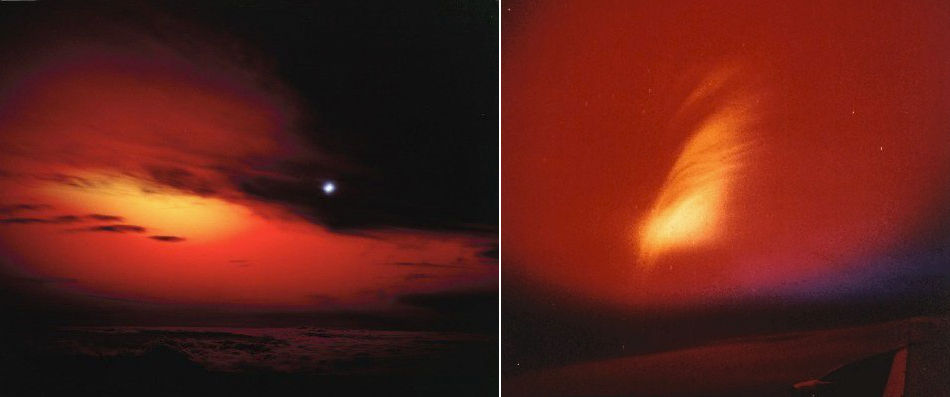
'Nuclear auroras' viewed from Honolulu (left) and a surveillance aircraft (right) on July 9, 1962.
Essentially, Starfish Prime created an artificial solar storm complete with auroras, geomagnetic activity, and blackouts. Much of the chaos that night was caused by the electromagnetic pulse (EMP)--a ferocious burst of radiation that ionized the upper atmosphere. Ionized air over the Pacific pinned down Earth's magnetic field, then let it go again when the ionization subsided. The rebound created a manmade geomagnetic storm for hundreds of miles around the blast zone.
"The explosion led to the early demise of all the spacecraft in orbit at the time," says Dyer. "These included Ariel-1, the UK's first spacecraft, and Telstar-1, a US communications satellite which had the bad luck to be launched the very next day."
Normally, geomagnetic storms bring down satellites via orbital decay. The upper atmosphere heats up and expands to the point where it can pull satellites down toward Earth. Starfish Prime was different.
"The explosion filled Earth's magnetosphere with energetic electrons, adding them to our planet's natural radiation belts," explains Dyer. These artificial electrons hit satellites hard, degrading their electronics and solar arrays.
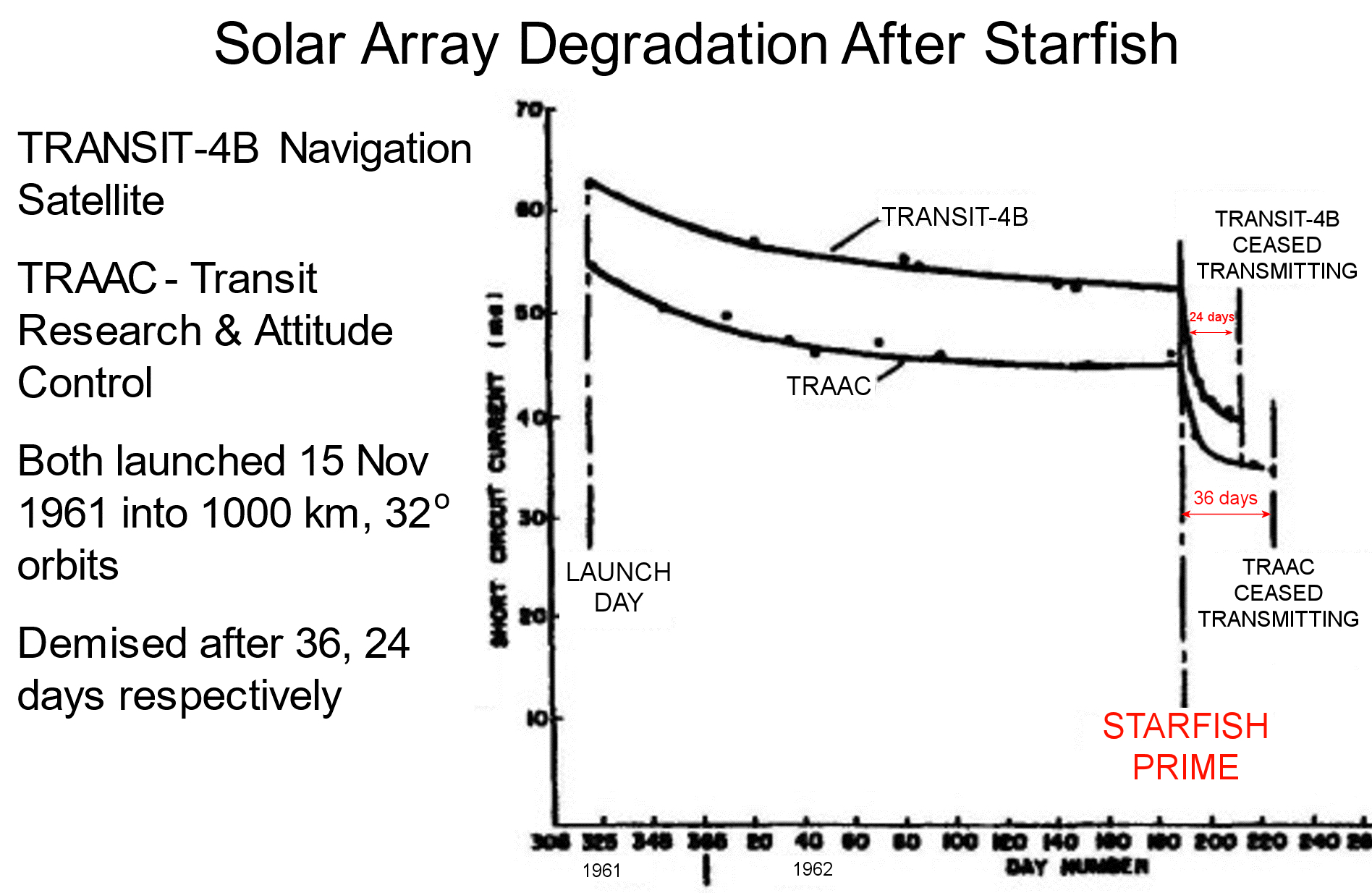
Credit: R.E. Fischell, “ANNA-1B Solar Cell Damage Experiment,” Transcript of the Photovoltaic Specialists Conference, April 10, 1963, Washington DC.
"Ariel-1 became almost unusable after only 4 days due to power degradation and tape recorder failure," recalls Dyer. "The Telstar satellite lasted until November 1962 when its command decoder failed. It still managed to provide the first transatlantic TV feed, synchronize UK/US time to 1 microsecond and inspired the Tornado's rock classic 'Telstar,' which used recordings of a flushing toilet played backwards."
The flux of energetic electrons trapped in Earth's magnetosphere remained high for years, hammering satellites deep into the 1960s.
Dyer, who is widely known for his studies of extreme space weather, was still in school when the explosion occured. It set the stage for his entire career. "Starfish Prime," he says, "was a defining event."
An expanded and sharable version of this story may be found here.
Realtime Aurora Photo Gallery
Free: Spaceweather.com Newsletter
"I LOVE YOU MORE" OPAL: Nothing says "I love you" like jewelry from space. On June 3, 2022, this sterling silver opal pendant hitched a ride on an Earth to Sky Calculus cosmic ray research balloon. At the apex of the flight it floated 101,326 feet above the Sierra Nevada mountains of central California:
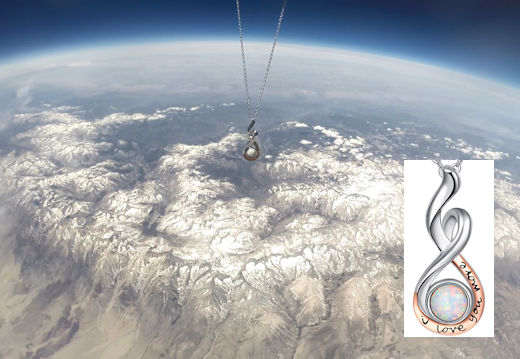
You can have it for $142.95. The opal's infinity wrap is engraved with "I Love You More." It's the perfect birthday, anniversary or (never too early!) Christmas gift for that special someone who loves space. Each pendant comes with a greeting card showing the pendant in flight and telling the story of its trip to the stratosphere and back.
Far Out Gifts: Earth to Sky Store
All sales support hands-on STEM education
Realtime Space Weather Photo Gallery
Free: Spaceweather.com Newsletter
Realtime Noctilucent Cloud Photo Gallery
Free: Spaceweather.com Newsletter