THE BASTILLE DAY EVENT: You know a solar flare is strong when even the Voyager spacecraft feel it. Twenty-two years ago today (July 14, 2000) the sun exploded with so much force, it sent shockwaves to the edge of the solar system.
Earth was on the doorstep of the blast, nicknamed the "Bastille Day Event" because it happened on the national day of France. Subatomic particles accelerated by the flare peppered satellites and penetrated deep into Earth's atmosphere. Radiation sensors on Earth's surface registered a rare GLE--a "ground-level event."
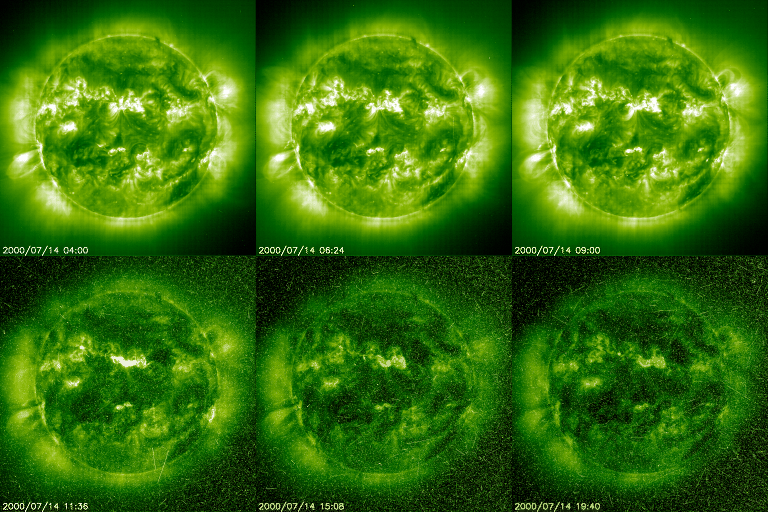 | 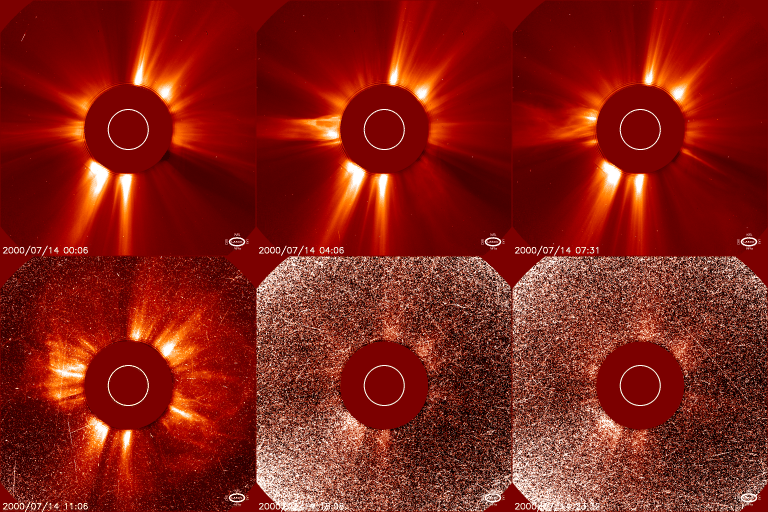 |
| Above: SOHO images of the X5.7-class Bastille Day solar flare (left) and CME (right). "Snow" in the images is a result of energetic protons hitting the spacecraft | |
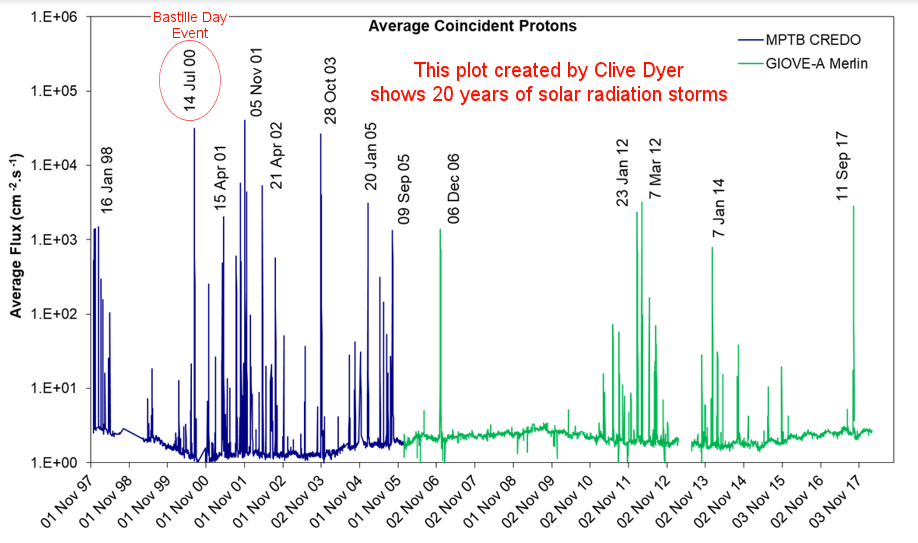
"People flying in commercial jets at high latitudes would have received double their usual radiation dose," says Clive Dyer of the University of Surrey Space Centre in Guildford UK, who studies extreme space weather. "It was quite an energetic event--one of the strongest of the past 20 years."
A day later the CME arrived. Impact on July 15th sparked an extreme (Kp=9) geomagnetic storm. The sun had just set on the east coast of North America when the auroras appeared.
"I was out in the yard doing chores and saw bright red auroras overhead," recalls Uwe Heine of Caswell County, North Carolina. "I called over to our neighbor, Carrie, who was also outside. I told her those were not sunset colors. It was an aurora, and super rare to see this far south!"
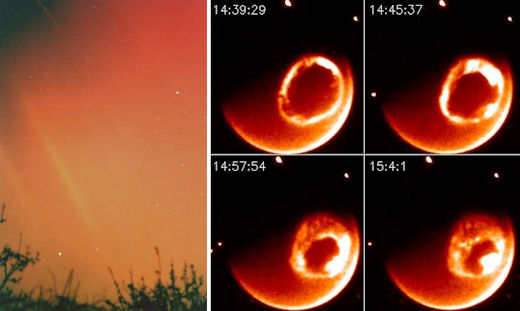
Above: Auroras on July 15, 2000, photographed by (left) Grant Privett of Farnborough UK and (right) NASA's IMAGE spacecraft.
In New York, the sky exploded with light, recalls Lou Michael Moure. "I was living on Long Island at the time. A family member came running into my room, begging me to come outside to see 'the sky on fire.' The sky truly looked as if it was ablaze. Hues of white and green eventually gave way to reds that blanketed the heavens from horizon to horizon."
By the time the storm subsided on July 16th, auroras had been reported as far south as Texas, Florida and Mexico.
A few other storms of the Space Age have have been equally strong, but the Bastille Day Event is special to researchers. It was the first major solar storm after the 1995 launch of SOHO, the Solar and Heliospheric Observatory. Data from the young satellite taught researchers a lot, very quickly, about the physics of extreme flares.
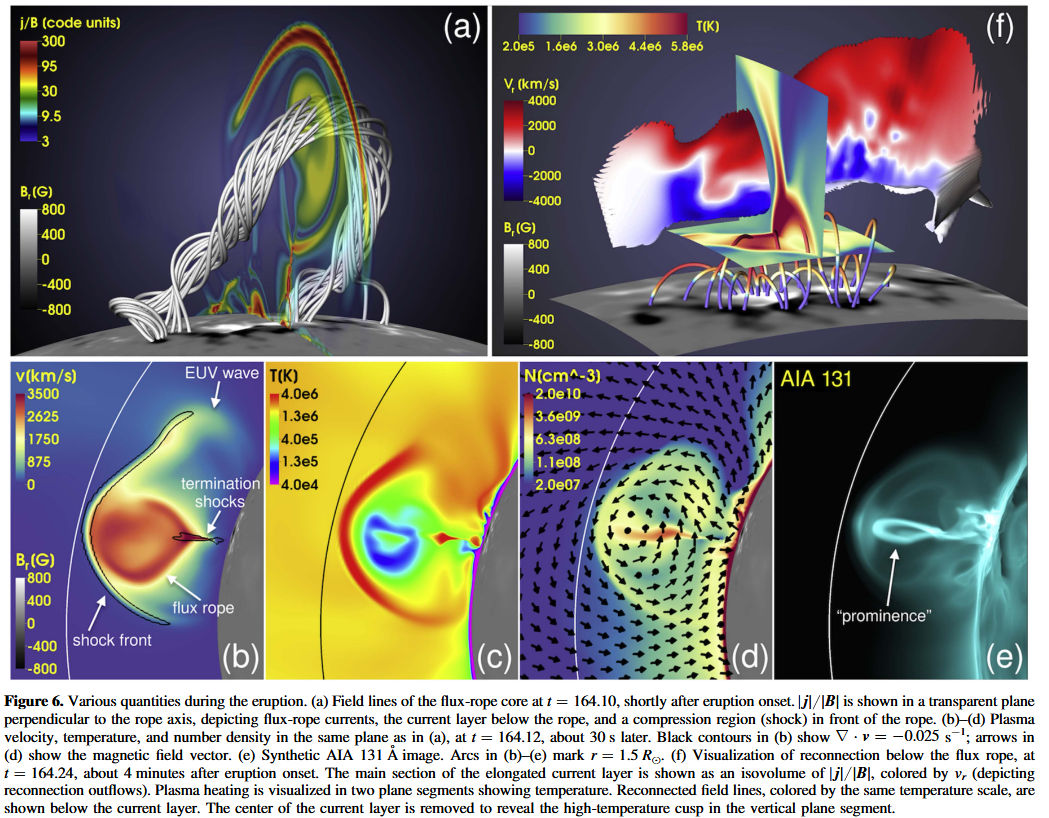
Above: A modern MHD computer simulation of the Bastille Day explosion. Credit: Tibor Török et al., The Astrophysical Journal, 856:75 (22pp), 2018 March 2
Tibor Török of Predictive Science, Inc., is one of many researchers still studying the Bastille Event decades later. "The event took place close to disk center, so we had a great view of the action," he says. Török recently applied a modern magnetohydrodynamic (MHD) computer model to some of the data, and found that 1033 ergs of magnetic energy were released in the explosion--about the same as a thousand billion WWII atomic bombs.
No wonder the Voyagers felt it.
It took the Bastille Day CME months to reach the distant spacecraft--180 days to Voyager 2, and 245 days to Voyager 1. Being near the edge of the solar system, both spacecraft were naturally bathed in high levels of cosmic rays. The CME swept aside that ambient radiation, creating a temporary reduction called a "Forbush Decrease." Conditions returned to normal 3 to 4 months later and, finally, the storm was over.
Could another Bastille Day Event be in the offing? Solar Cycle 25 is ramping up, with a new Solar Max expected in 2025. Stay tuned.
Realtime Space Weather Photo Gallery
Free: Spaceweather.com Newsletter
"I LOVE YOU MORE" OPAL: Nothing says "I love you" like jewelry from space. On June 3, 2022, this sterling silver opal pendant hitched a ride on an Earth to Sky Calculus cosmic ray research balloon. At the apex of the flight it floated 101,326 feet above the Sierra Nevada mountains of central California:
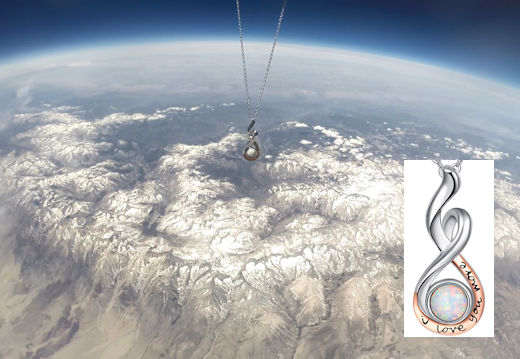
You can have it for $142.95. The opal's infinity wrap is engraved with "I Love You More." It's the perfect birthday, anniversary or (never too early!) Christmas gift for that special someone who loves space. Each pendant comes with a greeting card showing the pendant in flight and telling the story of its trip to the stratosphere and back.
Far Out Gifts: Earth to Sky Store
All sales support hands-on STEM education
Realtime Aurora Photo Gallery
Free: Spaceweather.com Newsletter
Realtime Noctilucent Cloud Photo Gallery
Free: Spaceweather.com Newsletter