THE BASTILLE DAY SOLAR STORM: You know a solar flare is strong when even the Voyager spacecraft feel it. Twenty-two years ago, the sun exploded with so much force, it sent shockwaves to the edge of the solar system. Full Story.
COMET K2 AND THE GLOBULAR CLUSTER: Big Comet C/2017 K2 (PanSTARRS) has arrived. Yesterday, it made its closest approach to Earth, and tonight it is passing by globular cluster M10. Graziano Ventre photographed the encounter from Bellagio, Italy:
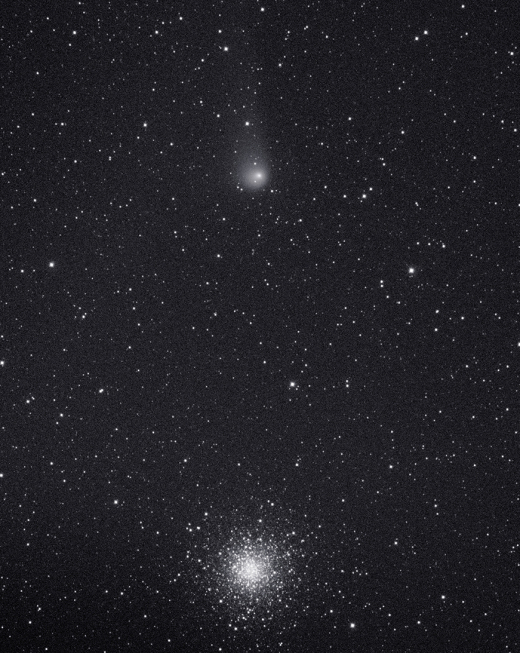
"This was the view through my 8-inch telescope," says Ventre.
Both the comet and the star cluster are easy targets for backyard optics. M10 is magnitude +6.6 and Comet K2 is +8.0. They're a good match requiring only modest exposure times.. At closest approach on July 15th, the pair will be less than 0.5 degrees apart. If you have a GOTO telescope, just tell it to slew to "M10" and you'll find the comet as well. They are in the constellation Ophiuchus high in the midnight sky.
more images: from Eliot Herman using a telescope in Siding Springs, Australia; from Rick Clevenger of Tellico Plains, TN; from Guy Auroy of Indre - Centre Val de Loire, France; from Filipp Romanov using a telescope in Mayhill, New Mexico
Realtime Space Weather Photo Gallery
Free: Spaceweather.com Newsletter
THE DRIEST CLOUDS ON EARTH: Last night, the midnight sky over Europe began to glow electric-blue. "The season for noctilucent clouds (NLCs) continues," reports Marek Nikodem, who photographed the display just outside Szubin, Poland:
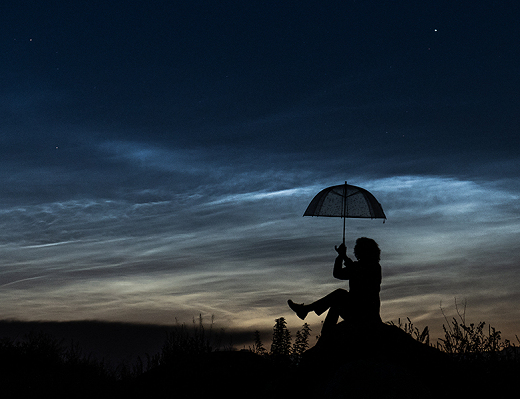
"But take it easy," says Nikodem. "You don't need an umbrella. You can leave it at home. It never rains from these clouds. They are the driest clouds on Earth."
Indeed, they are. The mesosphere where NLCs form is so incredibly dry that widely-spaced water molecules need help sticking together. Meteor smoke provides the "glue." Water molecules frost the surface of disintegrated meteoroids, forming icy noctilucent clouds. All of this happens 83 km above Earth surface where the temperature is 120 degrees C below zero and the water vapor concentration is only a few parts per million--no umbrella required.
Realtime Noctilucent Cloud Photo Gallery
Free: Spaceweather.com Newsletter
STERLING SILVER TIGER HEART PENDANT: Are you looking for a far-out gift? Consider the sterling silver Tiger Heart Pendant. On June 26, 2022, this one hitched a ride to the stratosphere onboard an Earth to Sky Calculus cosmic ray research balloon:
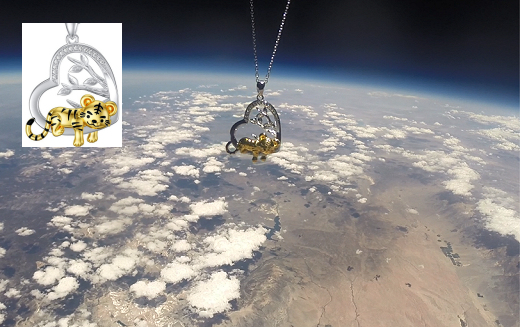
You can have it for $133.95. The golden tiger is surrounded by a partial halo of sparkling cubic zirconia crystals, tracing the shape of a heart. A rich layer of rhodium plating ensures the longevity of the pendant and its 18-inch chain.
The Tiger Heart Pendant makes a great anniversary, Christmas, or birthday gift. It comes with a greeting card showing the pendant in flight and telling the story of its trip to the stratosphere and back again.
Far Out Gifts: Earth to Sky Store
All sales support hands-on STEM education
Realtime Aurora Photo Gallery
Free: Spaceweather.com Newsletter