GEOMAGNETIC STORM WARNING: Geomagnetic storms are possible on July 23rd when a full-halo CME is expected to hit Earth's magnetic field. The storm cloud was hurled toward Earth yesterday by a solar tsunami eruption. NOAA forecasters say that G1- to G2-class (minor to moderate) storms are likely with a slight chance of escalating to category G3 (strong).



At what time will the CME hit? This NASA model of the approaching cloud pinpoints the impact within a few hours around 0000 UT on July 23rd:
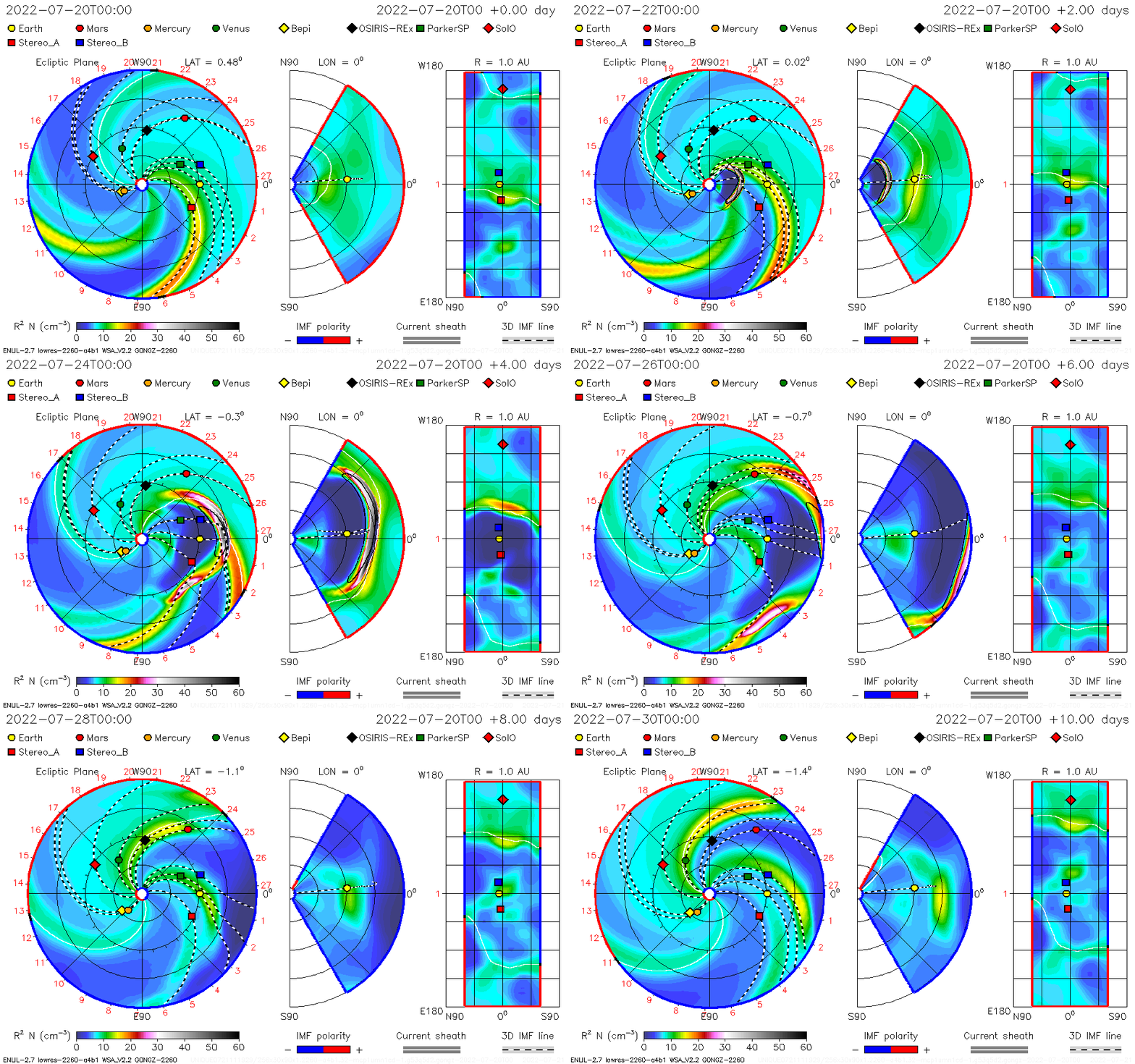
In the animation, Earth is marked by a yellow dot. Note that Mars, a red dot, also gets hit--a glancing blow on July 25th.
An independent NOAA model of the CME predicts a slightly later arrival, with the densest part of the storm cloud reaching Earth around 0400 UT on July 23rd. Either way, NOAA or NASA, the timing favors sky watchers in western Europe and North America. In the most optimistic case of a G3-category storm, auroras could descend as far south as Illinois and Oregon (geomagnetic latitude 50 degrees) during the night of July 22-23. Aurora alerts: SMS Text.
Realtime Space Weather Photo Gallery
Free: Spaceweather.com Newsletter
NOCTILUCENT ALGAE: Two nights ago, Ruslan Merzlakov of Nykøbing Mors, Denmark, went outside looking for noctilucent clouds. Instead he found noctilucent algae. The tiny dinoflagellates were glowing blue at midnight, a phenomenon known as "bioluminescence."

"It was an amazing experience playing with these algae in the waters of Limfjord," says Merzlakov. "I have never before seen them so bright in Denmark."
Bioluminescent algae tend to be brightest during summer months. It's no coincidence that they are extra-bright this week. Europe is experiencing an extreme summer heat wave. "The daytime temperature was +30C, and that night it was +23C," says Merzlakov. "For comparison, our typical nighttime temperature at this time of year is only +15C."
Like algae, noctilucent clouds (NLCs) are also brightest during summer months. NLCs form when wisps of water vapor rise up to the edge of space and crystallize around disintegrated meteoroids. The electric-blue color of NLCs is strikingly similar to that of the algae, although the physics and chemistry are entirely different.
All we need now is a picture of noctilucent algae and noctilucent clouds at the same time. European photographers, you know what to do.
Realtime Noctilucent Cloud Photo Gallery
Free: Spaceweather.com Newsletter
STERLING SILVER DRAGONFLY: Are you looking for a far-out gift? Consider the Sterling Silver Dragonfly. This winged pendant hitched a ride onboard an Earth to Sky Calculus cosmic ray balloon, flying 113,451 feet above the Sierra Nevada mountains of California:
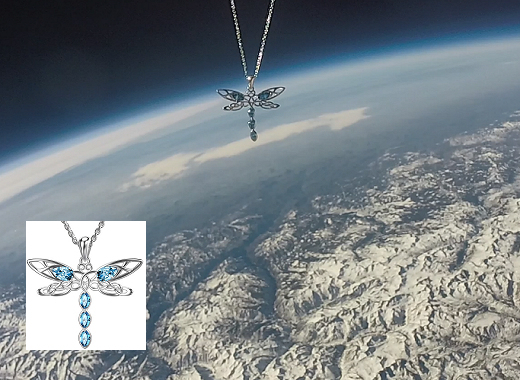
You can have it for $172.95. The dragonfly's heart is a Celtic love knot, and its wings are decorated with blue marquise crystals--all plated with 14k white gold. It's an exquisite ensemble for birthdays, anniversaries or any other romantic occasion.
The students are selling dragonfly pendants to support their cosmic ray ballooning program. Each one comes with a greeting card showing the pendant in flight and telling the story of its trip to the stratosphere and back again.
Far Out Gifts: Earth to Sky Store
All sales support hands-on STEM education
Realtime Aurora Photo Gallery
Free: Spaceweather.com Newsletter