CME IMPACT SPARKS AURORAS AND STEVE: Arriving almost exactly on time, a CME hit Earth's magnetic field on July 23rd at 0259 UT. The impact sparked a G1-class geomagnetic storm with auroras from coast to coast in North America.

"At about 12 midnight, I noticed a familiar light purple vertical glow to the east," reports Greg Ash of Ely, Minnesota. "It was STEVE!"
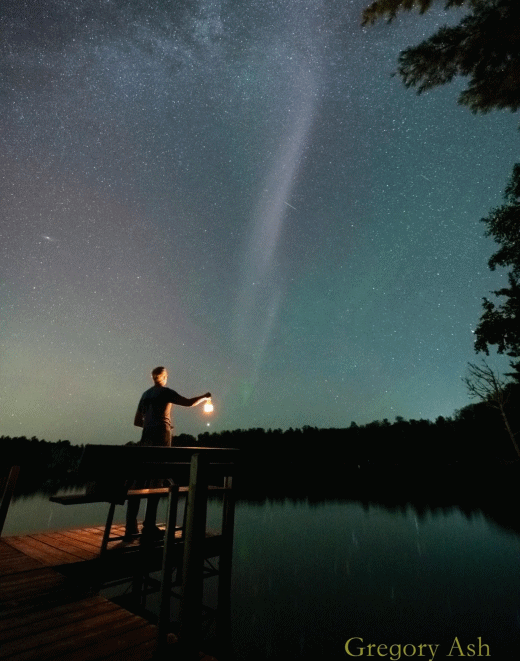
STEVE is actually not an aurora. The purple-colored arc is the glow from a supersonic river of gas, which flows through Earth’s magnetosphere during some geomagnetic storms. Short for "Strong Thermal Emission Velocity Enhancement," STEVE is a relatively recent discovery.
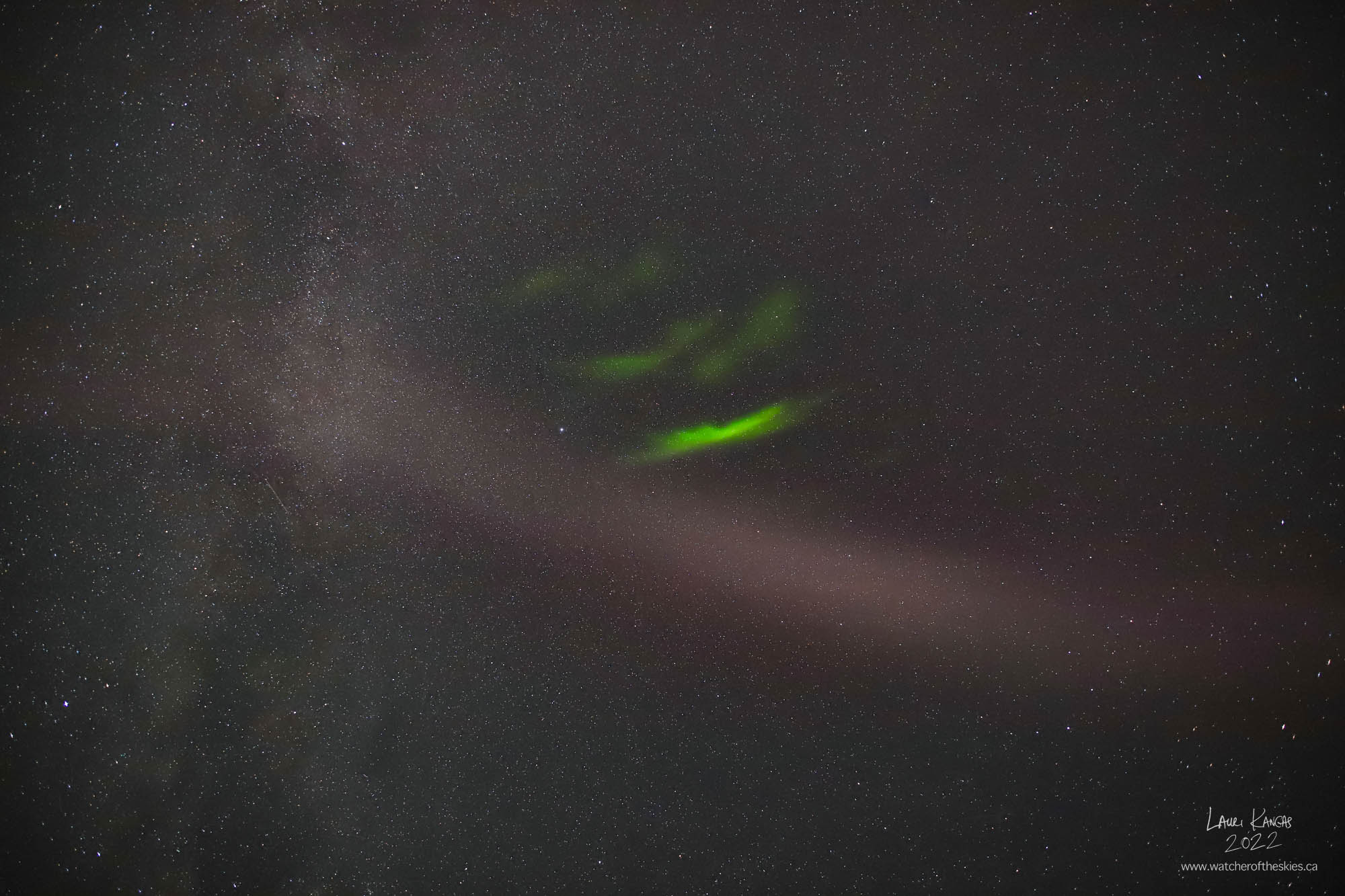
Lauri Kangas of Ontario, Canada, saw STEVE, too. "It was quite an active display with green pickets dancing in the Milky Way amongst the satellites and airplanes," says Kangas. "STEVE appeared and disappeared several times over an hour around midnight CDT."
Regular auroras (not STEVE) were sighted from New Hampshire to Washington, and one photographer recorded their glow as far south as Virginia:
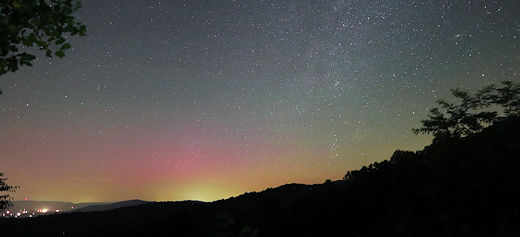
Peter Forister took this picture from the Shenandoah National Park. Using a long exposure, he captured a layer-cake of color with red auroras in the middle and green airglow on top. "The auroras were visible for just a few minutes around 12:15 am EST," says Forister.
The storm has subsided now. There is a slight chance that it could flare up again because the solar wind velocity in the CME's wake remains above 500 km/s. If it does re-ignite, however, we would expect no more than minor G1-class activity. Aurora alerts: SMS Text.
PS. Congratulations to NOAA analysts for a pinpoint prediction. The CME, which was hurled into space by a solar tsunami eruption on July 21st, arrived within one hour of their forecast.
Realtime Aurora Photo Gallery
Free: Spaceweather.com Newsletter
STERLING SILVER DRAGONFLY: Are you looking for a far-out gift? Consider the Sterling Silver Dragonfly. This winged pendant hitched a ride onboard an Earth to Sky Calculus cosmic ray balloon, flying 113,451 feet above the Sierra Nevada mountains of California:
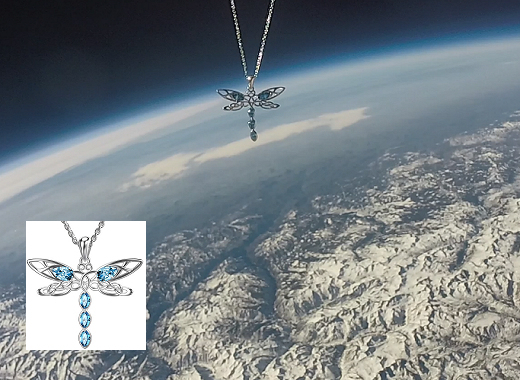
You can have it for $172.95. The dragonfly's heart is a Celtic love knot, and its wings are decorated with blue marquise crystals--all plated with 14k white gold. It's an exquisite ensemble for birthdays, anniversaries or any other romantic occasion.
The students are selling dragonfly pendants to support their cosmic ray ballooning program. Each one comes with a greeting card showing the pendant in flight and telling the story of its trip to the stratosphere and back again.
Far Out Gifts: Earth to Sky Store
All sales support hands-on STEM education
SUMMER MOONDOGS: A record-breaking heat wave is baking the USA. Yet there is some cold air if you know where to look for it. Last night in Albany, Missouri, Dan Bush photographed signs of ice around the Moon:
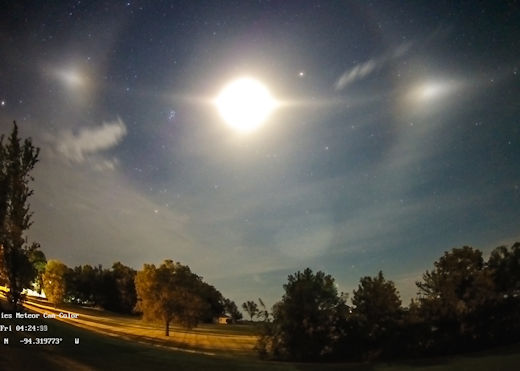
"One of our video cameras in the Missouri Skies Meteor Camera Network caught these rare moondogs as well as a bright Moon halo," says Bush.
Moondogs are the bright spots to the left and right of the Moon. Like the circular Moon halo, they are caused by ice crystals in high clouds.
"This sort of phenomenon is usually associated with cold winter weather," adds Bush. "These particular icy clouds may have been blow-off from the tops of some storms to the north and west of Missouri."
Realtime Space Weather Photo Gallery
Free: Spaceweather.com Newsletter
Realtime Noctilucent Cloud Photo Gallery
Free: Spaceweather.com Newsletter