SOLAR ECLIPSE SEASON IN SPACE: Eclipse season for NASA's Solar Dynamics Observatory (SDO) has begun. Every day for the next three weeks, around 0730 UT, Earth will pass between SDO and the sun, producing images that look like this. This is a twice-a-year event for SDO caused by the alignment of the sun and Earth as seen from the spacecraft's geosynchronous orbit. Solar flare alerts: SMS Text.

COSMIC RAY UPDATE: Cosmic rays in the atmosphere are rapidly subsiding. In the past year alone, radiation levels in the air high above California have plummeted more than 15%, according to regular launches of cosmic ray balloons by Spaceweather.com and Earth to Sky Calculus. The latest measurement on July 23, 2022, registered a 6 year low:

To many readers this may sound counterintuitive. After all, don't solar flares produce radiation? Yes, but most high-energy radiation doesn't come from the sun; it comes from deep space. Every day galactic cosmic rays from distant supernova explosions pass through the Solar System. When they hit the top of Earth's atmosphere, they create a secondary spray of radiation, which we measure using sensors onboard our balloons.
The sun makes it more difficult for these cosmic rays to reach Earth. Simply put, when the sun is active, its magnetic field gets stronger and more tangled. Cosmic rays have trouble penetrating the magnetic thicket. Also, individual CMEs sweep aside cosmic rays, causing sharp reductions called "Forbush Decreases." The two effects blend together to bring daily radiation levels down.
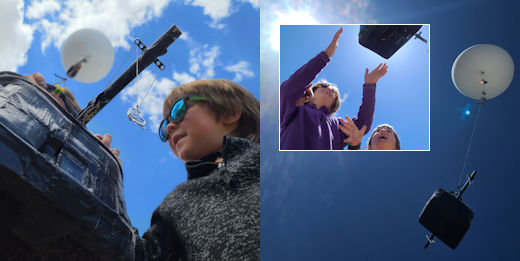
Above: Earth to Sky students launch a cosmic ray balloon on July 23, 2022.
There is considerable interest in atmospheric cosmic rays. Climate scientists are engaged in a lively debate about whether or not cosmic rays affect cloud cover. (The consensus seems to be mostly not.) Cosmic rays also penetrate aircraft, boosting the risk of cancer among frequent fliers and flight crews.
Solar Maximum is expected in 2025, so the downward trend in cosmic radiation should continue for years to come. How low will it go? Stay tuned for updates.
Realtime Aurora Photo Gallery
Free: Spaceweather.com Newsletter
COSMIC RAY BALLOON PHOTOGRAPHS PYROCUMULOUS CLOUDS: An extreme wildfire is burning out of control near Yosemite National Park. Here's what it looks like from the stratosphere:
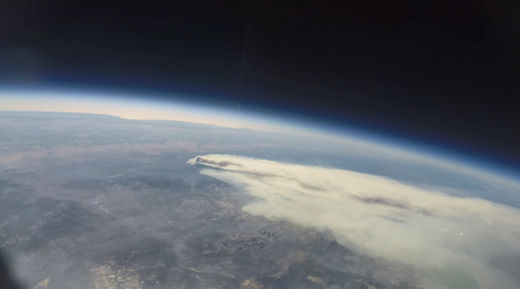
This image shows the "Oak Fire" from an altitude of 98,540 feet. At the epicenter, a pyrocumulous cloud can be seen rising more than 10,000 feet in the air. From there, a wedge of dense smoke stretches more than 60 miles across the Sierra, blanketing Mono Lake in the lower right corner.
The photo was taken by a camera onboard a cosmic ray research balloon, which we launched on July 23rd to investigate that morning's geomagnetic storm. The Oak Fire was an unexpected catch.
Realtime Space Weather Photo Gallery
Free: Spaceweather.com Newsletter
"I LOVE YOU MORE" MOONSTONE PENDANT: Nothing says "I love you" like a moonstone from space. On May 26th, this sterling silver moonstone pendant hitched a ride to the stratosphere on an Earth to Sky Calculus cosmic ray balloon. Here it is floating 112,201 feet above the Sierra Nevada mountains of central California:
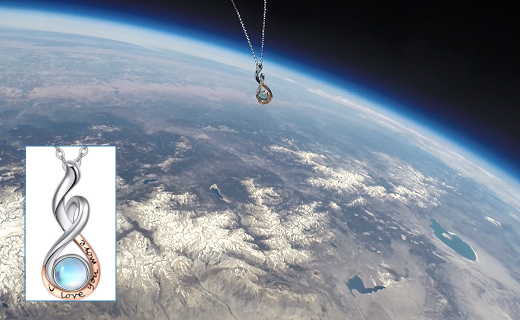
You can have it for $142.95. The students are selling these pendants to support their cosmic ray ballooning program. Engraved with "I Love You More," it makes a great anniversary, birthday or (never too early!) Christmas gift. Each pendant comes with a greeting card showing the moonstone in flight and telling the story of its trip to the stratosphere and back again.
Far Out Gifts: Earth to Sky Store
All sales support hands-on STEM education
Realtime Noctilucent Cloud Photo Gallery
Free: Spaceweather.com Newsletter