QUIET SUN: Solar activity is low. Multiple sunspot groups have decayed since yesterday, leaving the sun with no explosive active regions. NOAA forecasters say there is no more than a 1% chance of strong solar flares on July 28th. Solar flare alerts: SMS Text.
CHINA'S NEW SPACE STATION JUST DOUBLED IN SIZE: Fifty-one thousand pounds. That's how much mass China just added to the Tiangong space station. On July 24th, the Chinese space agency launched a laboratory module named "Wentian" from the southern Hainan Province. Photographer Jeff Dai was on hand to witness the launch and a subsequent flyby of the station hours later:

"I watched China's space station fly over the Wenchang Spacecraft Launch Site at the break of dawn on July 25th just hours after Wentian blasted off on a Long March-5B Y3 carrier rocket," says Dai. "Suddenly a bright fireball cut across the night sky from Taurus to Orion. WOW!"
Wentian has since docked with Tiangong, doubling the young station's mass and length. Check Heavens Above for local flyby times; when it flies overhead, the expanded station is now as bright as a 1st magnitude star.
There is some controversy connected to this launch. The 23-metric-ton Long March-5B Y3 rocket booster is out of control, expected to tumble back to Earth within days. According to The Aerospace Corporation, "a reentry of this size will not burn up in the Earth’s atmosphere, and the general rule of thumb is that 20–40 percent will reach the ground. There is a non-zero probability of the surviving debris landing in a populated area—over 88 percent of the world’s population lives under the reentry’s potential debris footprint." Fingers crossed, a harmless water landing remains the most probable outcome. Stay tuned for updates.
Realtime Space Weather Photo Gallery
Free: Spaceweather.com Newsletter
COZY CAVES ON THE MOON: The Moon is a harsh mistress: During the day temperatures soar to a scorching 260 F, then plummet to minus 280 F at night. However, NASA's Lunar Reconnaisance Orbiter (LRO) may have discovered places without these extremes. The temperature inside this lunar pit hovers around a comfortable 63 F:

Pits were first discovered on the Moon in 2009, and since then, scientists have wondered if they led to caves that could be used as shelters from cosmic rays, solar radiation and micrometeorites.
The pits are thought to be sections of collapsed lava tubes. Also found on Earth, lava tubes form when a crust forms over a river of lava, leaving a long, hollow tunnel. If the ceiling of a solidified lava tube collapses, it opens a pit that can lead into the cave-like tube.
A new study published earlier this month described how researchers used LRO's thermal camera named "Diviner" to peer inside some lunar pits, with a special focus on a football-field-sized pit in the Sea of Tranquillity. The temperature they found in permanently shadowed areas fluctuated only slightly throughout the lunar day, remaining at around 63 F. If a cave extends from the bottom of the pit, as images suggest, it too would have this relatively comfortable temperature.
"Humans evolved living in caves, and to caves we might return when we live on the Moon," says David Paige, a co-author of the paper from UCLA.
Realtime Aurora Photo Gallery
Free: Spaceweather.com Newsletter
MIDNIGHT BLACK SPACE PEARL: Space is black--and so is this pearl. On July 22nd, the students of Earth to Sky Calculus launched the Midnight Pearl to the stratosphere onboard a cosmic ray research balloon:
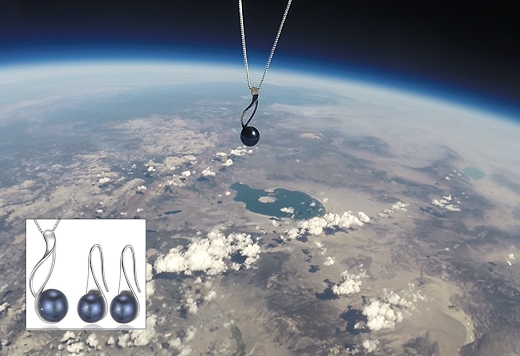
You can have it for $179.95--earrings included! Matching pearl earrings flew inside the payload among the cosmic ray sensors.
The students are selling space pearls to support their cosmic ray ballooning program. Wrapped in a sterling silver infinity twist, each Midnight Pearl comes with a greeting card showing the pendant in flight and telling the story of its trip to the edge of space.
Far Out Gifts: Earth to Sky Store
All sales support hands-on STEM education
Realtime Noctilucent Cloud Photo Gallery
Free: Spaceweather.com Newsletter