CHINESE ROCKET RETURNS TO EARTH: China's massive Long March 5B rocket booster returned to Earth on July 30th, splashing down in the Indian Ocean at 1645 UTC, according to US Space Command. This is the rocket booster that propelled the Wentian science lab to China's Tiangong space station on July 24th. There is almost certainly debris in the ocean as 20% to 40% of the 23-ton booster was expected to survive re-entry. Update: A spectacular video of the re-entry was recorded from Malaysia.
THREE METEOR SHOWERS IN ONE NIGHT: Be alert for fireballs tonight, July 30th. Earth is passing through debris streams from three comets: 169P/NEAT, 96P/Machholz, and 109P/Swift-Tuttle. Respectively, these produce the alpha Capricornid, southern delta Aquariid, and Perseid meteor showers. (Earth is only in the outskirts of the Perseid stream.) Together, the three showers will combine for as many as 20 meteors per hour with a sprinkling of bright fireballs after local midnight.
Dan Bush of Albany, Missouri, photographed one this morning:
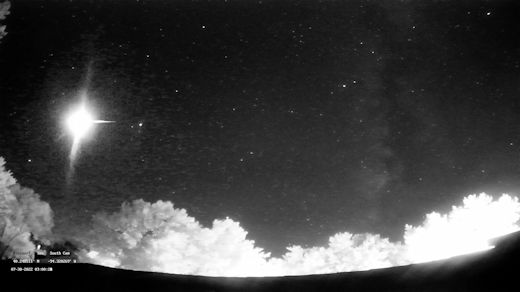
That bright light is not the Moon, it's a fireball. "I'm 90% sure it was an alpha Capricornid," says Bush, who also recorded the fireball in color using another, all-sky camera.
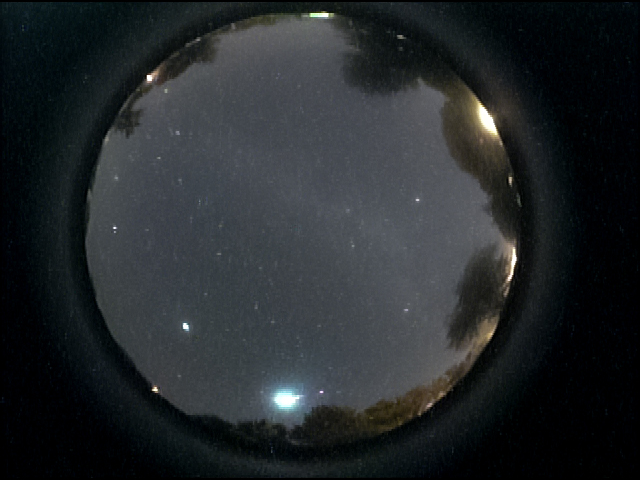
Alpha Capricornids are famous for their fireballs. The underlying debris stream was created by a major fragmentation event ~5000 years ago when as much as half of parent comet 169P/NEAT disintegrated. The gravely debris naturally produces slow bright fireballs when hitting Earth's atmosphere. Forecasters believe this shower will intensify in the years ahead as Earth moves deeper into the debris stream.
Realtime Space Weather Photo Gallery
Free: Spaceweather.com Newsletter
"I LOVE YOU FOREVER" MOONSTONE PENDANT: Are you looking for a far-out gift? Consider the "I Love You Forever" Moonstone. This one hitched a ride to the stratosphere onboard a cosmic ray research balloon on May 13, 2022:
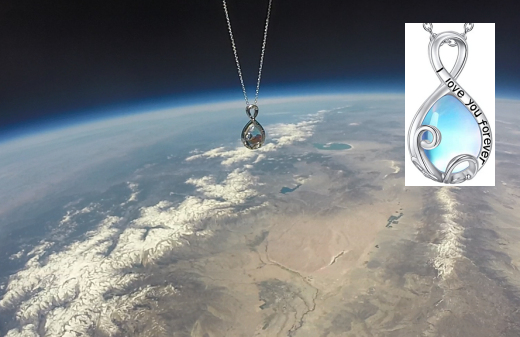
You can have it for $162.95. The moonstone's sterling silver infinity wrap is inscribed with the words "I love you forever." It makes a great anniversary or birthday gift. The moonstone comes with a greeting card showing the pendant in flight, telling the story of its trip to the edge of space and back again.
Far Out Gifts: Earth to Sky Store
All sales support hands-on STEM education
SPACE TRAFFIC BOOSTS NOCTILUCENT CLOUDS: Never before have so many rockets been launched. In 2021, the space agencies of Earth broke the all-time record for global rocket launches with 133, and in 2022 it looks like the record will be broken again with more than 150. China and SpaceX are big contributors to this increase.
High above Earth, something else is increasing: Noctilucent Clouds (NLCs). It's no coincidence. A new paper just published in the AGU journal for Earth and Space Science confirms that "space traffic has a strong influence on the interannual variability of these bright mesospheric clouds."
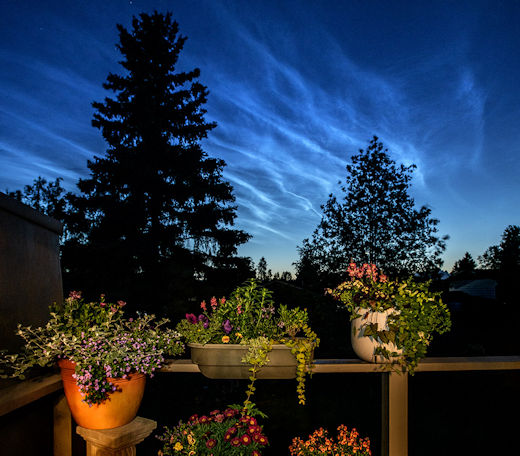
Above: Noctilucent clouds over Anchorage AK on July 26, 2022. Credit: Todd Salat.
Noctilucent clouds are a natural phenomenon. During summer months, wisps of water vapor rise up to the mesosphere, 83 km high, and crystalize around specks of disintegrated meteoroids. Sky watchers at northern latitudes can easily see the clouds, which are filled with fine ripples and shine at night with an electric blue color.
Rocket launches are boosting NLCs. A team of researchers led by Michael Stevens of the Naval Research Lab in Washington, DC, looked at data from NASA's AIM spacecraft, which was launched in 2007 to study noctilucent clouds. They found a strong correlation between the number of rockets launched each July and the abundance of clouds in the mesosphere.
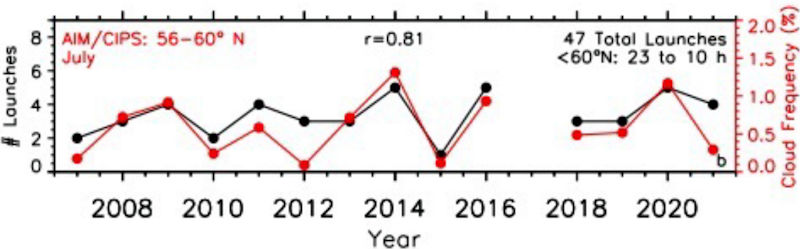
Above: July rocket launches (black) vs. the abundance of noctilucent clouds (red)
The link is simple: Rockets produce plumes of water vapor. Winds carry these plumes toward the polar mesosphere where they become raw material for NLCs. Rockets launched in the "morning" between 11 pm and 10 am local time are most effective. During those times, diurnal wind patterns push the plumes toward the noctilucent zone.
Researchers have long known that rockets can produce NLCs. Seminal studies led by Stevens in the early 2000s linked specific space shuttle launches to outbursts of the clouds over both of Earth's poles (refs: #1, #2). The shuttle program ended in 2011, but the "rocket effect" has continued and probably increased (researchers are still investigating the trends at mid-latitudes during the satellite era).
This is good news for sky watchers who love seeing "frosted meteor smoke" light up the night. Rockets make NLCs both brighter and more widespread. Researchers, on the other hand, may have mixed feelings. NLCs can be a sensitive indicator of changes to Earth's climate system--e.g., revealing long-range teleconnections and the abundance of greenhouse gases in the upper atmosphere. Rocket launches could swamp these delicate signals.
Either way, the launch schedule continues. Be alert for noctilucent clouds!
Realtime Noctilucent Cloud Photo Gallery
Free: Spaceweather.com Newsletter
Realtime Aurora Photo Gallery
Free: Spaceweather.com Newsletter