CHANCE OF EARTH-DIRECTED FLARES: Growing sunspot AR3068 has developed a 'beta-gamma' magnetic field that harbors energy for M-class solar flares. Any explosions today will be geoeffective because the sunspot is almost directly facing Earth. Solar flare alerts: SMS Text.
GIANT SOLAR PROMINENCE: There's a loop of plasma on the sun's eastern limb so large that normal scientific notation doesn't describe it. "It's ginormous," explains Richard N. Schrantz, who sends this picture from his backyard observatory in Nicholasville, Kentucky:
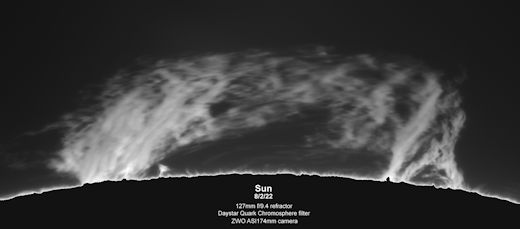
The arch is 325,000 km long--almost the distance between Earth and the Moon. These dimensions make it an easy target for backyard solar telescopes. If you have one, don't wait. The right foot of the structure is increasingly unstable, and the whole thing could collapse at any moment.
more images: from Dézsi Attila of Tószeg, Hungary; from Jean Pierre Brahic of Uzes, France; from Philippe Tosi of Ariège, France; from P-M Hedén of Vallentuna Sweden; from Apollo Lasky of Naperville, Illinois; from James Roger Samworth of Nailstone, UK; from Dr. J. Wayne Wooten of Pensacola, Florida; from Didier Favre of Bondoufle, France; from John Gould of Cambewarra, Australia;
Realtime Space Weather Photo Gallery
Free: Spaceweather.com Newsletter
WELCOME BACK, MILKY WAY: In Denmark, the Milky Way is back. Last night, for the first time all summer, Ruslan Merzlyakov photographed it from Nykøbing Mors:
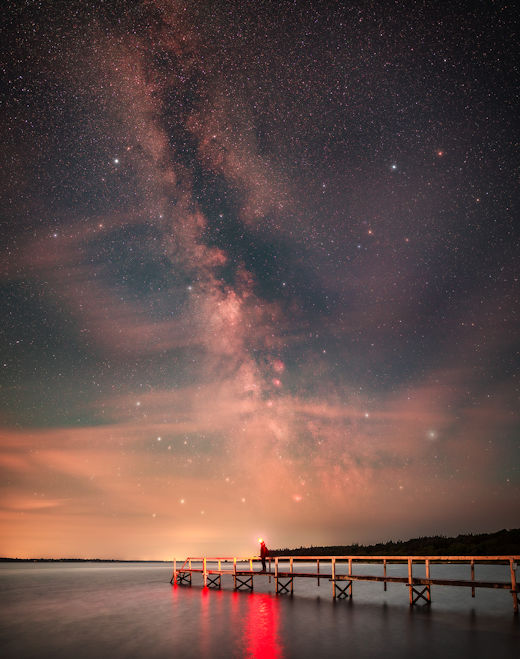
"Our summer skies are finally getting dark enough for us to see the Milky Way again," says Merzlyakov. "Like most stars, the Milky Way has not been visible for more than 2 months here in Denmark - instead we had the blue hour."
Now that the Milky Way has returned, can auroras be far behind? The solar wind is currently blowing faster than 500 km/s and the Moon is only days past New. Let the green hour begin. Aurora alerts: SMS Text.
Realtime Milky Way Photo Gallery
Free: Spaceweather.com Newsletter
STERLING SILVER OPAL PENDANT: It's our most beautiful space pendant ever: The Sterling Silver Opal. The students of Earth to Sky Calculus just launched one to the stratosphere onboard a cosmic ray research balloon:
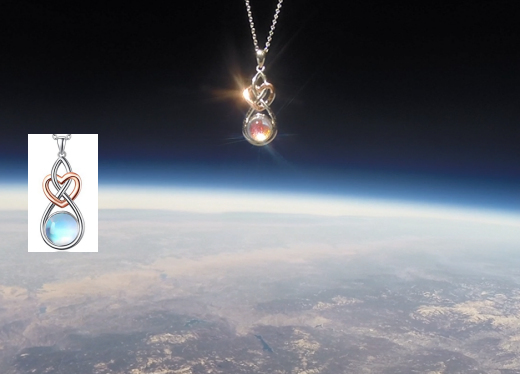
You can have it for $179.95. Wrapped in a sterling silver Celtic love knot, the opal is suspended from a matching 18-inch chain. Each pendant comes with a greeting card showing the opal in flight, telling the story of its trip to the edge of space and back again.
Opals are cousins of moonstones; in fact they look the same in low light. But when bright sunlight strikes an opal, something special happens. A spray of color emerges from the stone. This happened while the stone was in the stratosphere (see above) and it remains capable of this beautiful trick back on Earth.
Far Out Gifts: Earth to Sky Store
All sales support hands-on STEM education
Realtime Noctilucent Cloud Photo Gallery
Free: Spaceweather.com Newsletter
Realtime Aurora Photo Gallery
Free: Spaceweather.com Newsletter