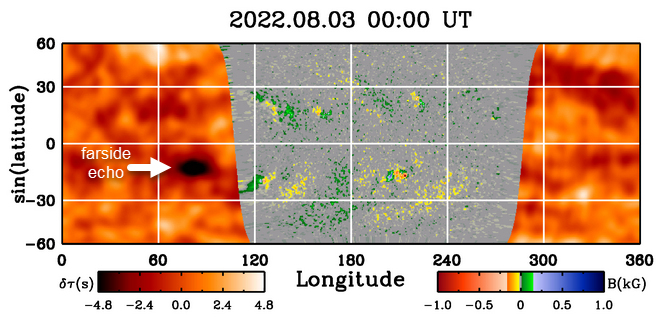
FARSIDE SUNSPOT: There is a sunspot on the farside of the sun so big it is changing the way the sun vibrates. Helioseismic maps reveal its acoustic echo not far behind the sun's southeastern limb. The sunspot will turn to face Earth a few days from now. Solar flare alerts: SMS Text.
BLUE JET LIGHTNING SIGHTED OVER TEXAS: Seeing one blue jet is rare. Photographer Matthew Griffiths just caught several of them over the Big Bend National Park in Texas. "This is by far the best," he says:
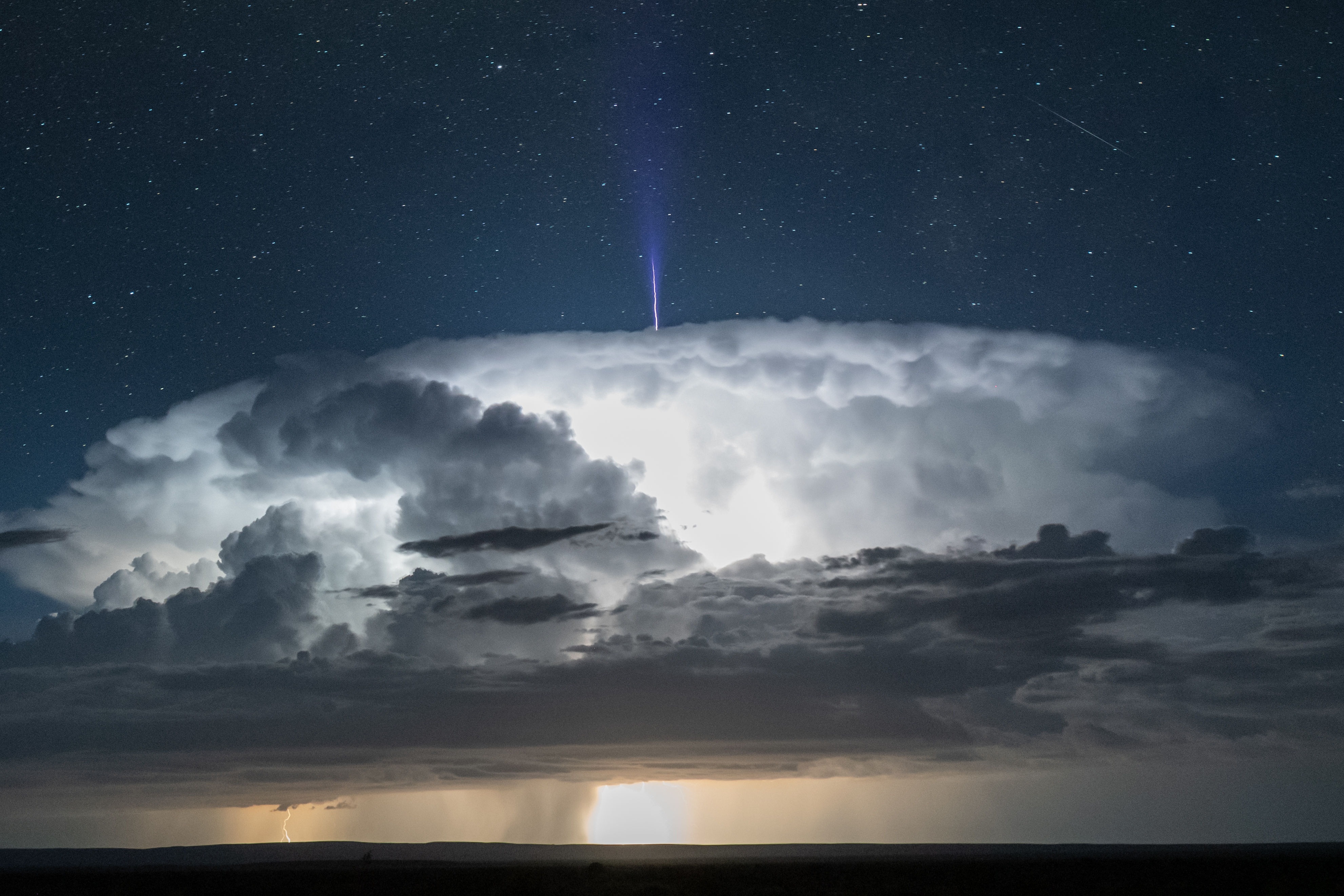
Above: A blue jet emerges from a thunderhead in Big Bend National Park, photographed by Matthew Griffiths in Marfa, Texas: more.
Griffiths is an amateur photographer, primarily interesting in wildlife and the Milky Way. "On July 28th, I was starting a five night West Texas road trip to capture the Milky Way," he says. "But with thunderstorms storms in the distance I decided to try for red sprites instead."
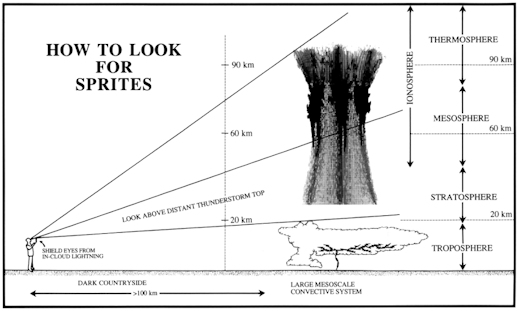
He ended up photographing the sprite's elusive blue cousin. First recorded by cameras on the space shuttle in 1989, blue jets are part of a growing menagerie of cloudtop "transient luminous events." Sprites, ELVES and green ghosts are other examples. They are all elusive, but blue jets may be the hardest to catch.
"We're not sure why ground-based observers see them so rarely," says Oscar van der Velde of the Lightning Research Group at the Universitat Politècnica de Catalunya. "It might have something to do with their blue color. Earth's atmosphere naturally scatters blue light, which makes them harder to see. Blue jets might be more common than we think."
A rookie mistake might have helped Griffiths. "This is only my second time trying for sprites. I might have aimed my camera too close to the cloud tops where bright lightning washed out the sprites; in fact, I couldn't find any sprites in my photos. But I think my camera angle was just right for catching the bright blue jet."
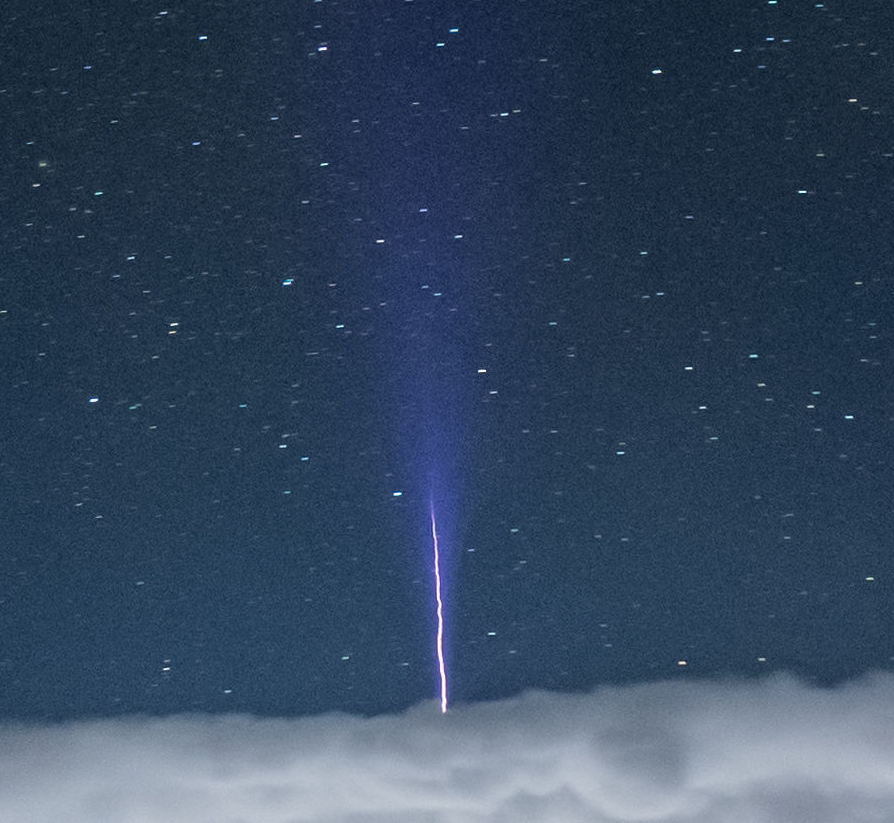
Above: A zoomed-in view showing the jet's sharp lance-like core and a diffuse fan of electric-blue overhead.
Blue jets might look like lightning, but they are not the same. Normal lightning carves a scorching-hot path through the atmosphere, heating the air to 30,000 degrees Celsius. Blue jets are made of cold plasma akin to gas inside a flourescent light bulb. You could touch one with your hand and it might not hurt.
And, of course, they go up instead of down. Photos taken from the International Space Station (ISS) show that blue jets reach astonishing altitudes, as high as 170,000 feet. This is high enough to touch the ionosphere, possibly forming a new and poorly understood branch of Earth's global electrical circuit.
"Also," says van der Velde, "there can be considerable production of NOx and ozone by these discharges, potentially affecting the chemistry of the upper atmosphere."
Clearly, it is important to study blue jets. Photographers, now you know where to look.
Realtime Space Weather Photo Gallery
Free: Spaceweather.com Newsletter
THE INFINITY PEARL: Nothing says "I love you forever" like the Infinity Pearl. The students of Earth to Sky Calculus launched this unique pendant to the stratosphere onboard a cosmic ray research balloon. For more than 2 hours it floated 101,378+ feet above the Sierra Nevada mountains of central California:

You can have it for $249.95. The students are selling space pearls to support their cosmic ray ballooning program. Measuring 9 mm in diameter, the Infinity Pearl is mounted on a sterling silver infinity twist and suspended from a matching 17 inch long sterling silver chain. Each one comes with a greeting card showing the pendant in flight and telling the story of its journey to the edge of space.
Far Out Gifts: Earth to Sky Store
All sales support hands-on STEM education
Realtime Noctilucent Cloud Photo Gallery
Free: Spaceweather.com Newsletter
Realtime Aurora Photo Gallery
Free: Spaceweather.com Newsletter