PERSEID METEOR SHOWER: Earth has entered a stream of debris from Comet Swift-Tuttle, source of the annual Perseid meteor shower. We're only in the outskirts of the stream now, but already Perseid fireballs are streaking across the night sky. The shower will peak in bright moonlight on Aug. 12-13 when Earth touches the densest part of the debris zone: observing tips.
'EARTHQUAKE BALLOONS' IN THE STRATOSPHERE: If you want to detect an earthquake on Venus--good luck. The planet's surface is hot enough to melt lead, and the atmospheric pressure is crushing. No ground-based seismometer could possibly survive.
What's an extraterrestrial seismologist to do? Launch a balloon.
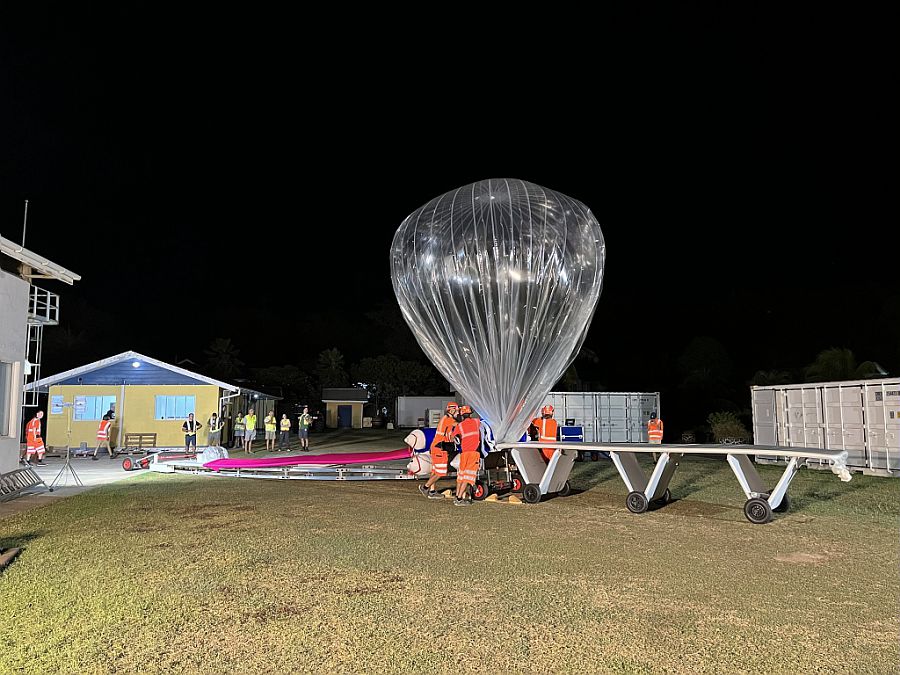
Above: Researchers prepare to launch a Strateole-2 balloon with sensors capable of detecting earthquakes from thousands of kilometers away.
A new paper just published in the Geophysical Research Letters reports the detection of a magnitude 7.3 earthquake by a fleet of balloons floating through the stratosphere above Indonesia's Flores Sea. Onboard infrasound sensors registered acoustic waves rippling upward from the sea surface below, proving that, here on Earth, balloons can be used as seismometers.
"The same technique should work in the atmosphere of Venus," says Raphael Garcia, the study's lead author and a planetary scientist at the Institut Supérieur de l’Aéronatique et de l’Espace of the University of Toulouse. "Balloon-based sensors could float high above Venus's deadly surface, collecting data at a safe distance."
In the fall of 2021, the Centre National d’Etudes Spatiales (CNES) launched a fleet of 16 balloons from Mahé Island in the Seychelles archipelago. Unlike ordinary weather balloons, which explode in a matter of hours, these were "superpressure balloons," which can remain aloft for months. Stratospheric winds carried them over the Flores Sea.
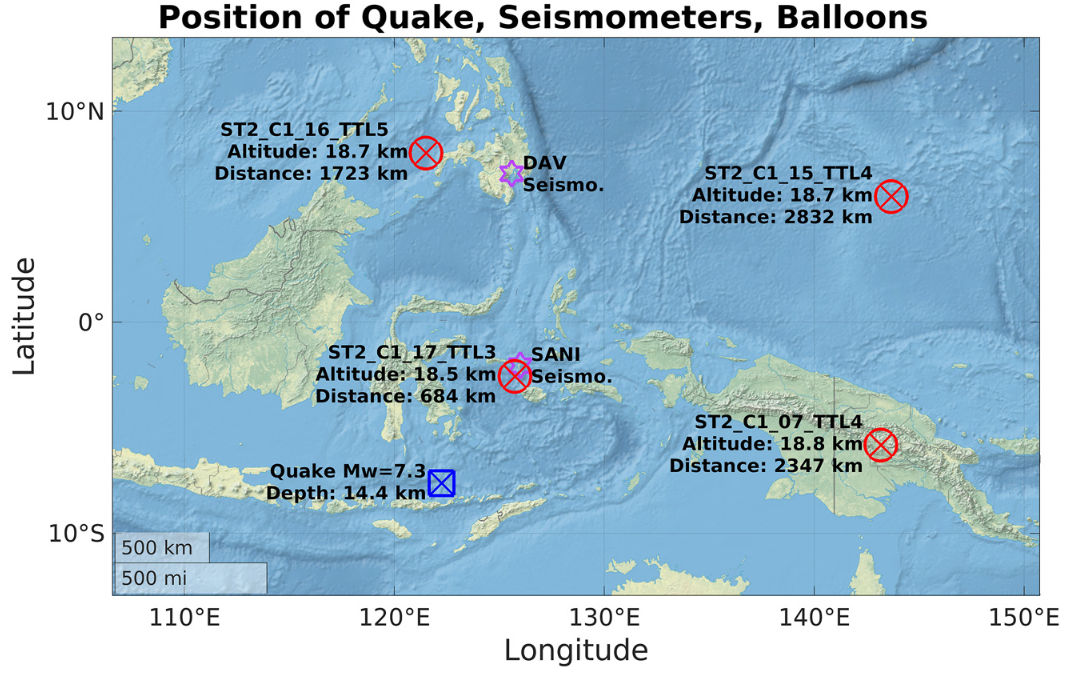
Above: Position of the Flores Sea quake (blue square) with ground seismometers (purple stars) and Strateole-2 balloons (red circles)
Four balloons picked up the undersea quake on Dec. 14, 2021. Combining their signals, researchers pinpointed the epicenter within 300 km, the magnitude of the quake within 0.8 units, and its onset within 50 seconds. Furthermore, waveforms recorded by the infrasound sensors were detailed enough to sense structures in the Earth 100 km deep.
Garcia would like to do the same thing on Venus. "We know nothing of its interior," he says. "We don't know how it's made inside, and seismology is one of the best tools to figure that out."
Seismic balloons could come in handy on Earth, too. "Balloons could be used to cover ocean regions where conventional seismometers are not yet deployed," notes Garcia. "Another advantage: Balloons may be rapidly deployed just after a big quake for monitoring aftershocks."
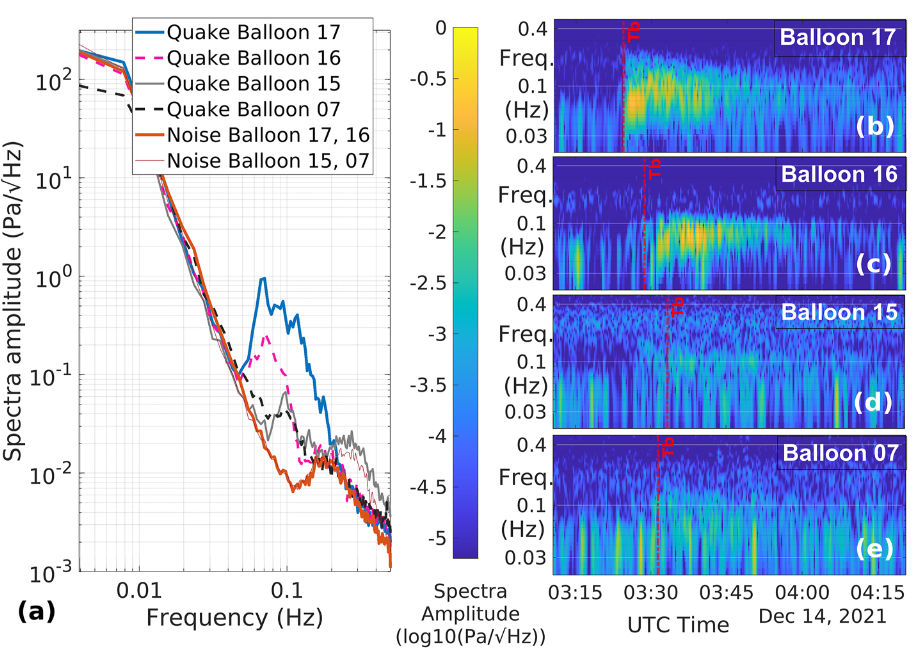
Above: Acoustic waves recorded by four balloons during the Flores Sea earthquake.
The test flights have already unearthed a curiosity in South America. On Nov. 28, 2021, just one of the balloons detected a magnitude 7.5 earthquake in northern Peru. The infrasound frequency, 0.23 Hz, was higher than expected; for comparison, the Flores Sea quake registered a more typical 0.085–0.125 Hz. Garcia's team believes the high pitch may have been caused by a "ringing" of sediments in the Amazonian basin.
Sensing earthquakes from the stratosphere is relatively new. Researchers at Caltech and the Jet Propulsion Laboratory did it for the first time in July 2019. Garcia's study marks the first time an earthquake was detected by more than one balloon. It won't be the last.
For more information, read the original research here.
Realtime Space Weather Photo Gallery
Free: Spaceweather.com Newsletter
COSMIC RAY YIN-YANG PENDANT: To celebrate the yin-yang relationship between solar activity and galactic cosmic rays, the students of Earth to Sky Calculus just launched a yin-yang pendant to the stratosphere. On July 23rd, it flew 104,265 ft high onboard a cosmic ray research balloon:
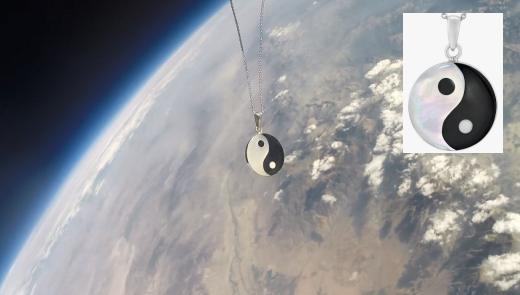
You can have it for $133.95. The pendant's sterling silver frame surrounds balancing swirls of black onyx and mother of pearl--all suspended from a matching 18-inch sterling silver chain. It makes a great anniversary, birthday or (never too early!) Christmas gift.
The students are selling yin-yang pendants to support their cosmic ray ballooning program. Each one comes with a greeting card showing the pendant in flight and telling the story of its journey to the edge of space and back again.
Far Out Gifts: Earth to Sky Store
All sales support hands-on STEM education
WHAT LIES ON TOP OF A STORM CLOUD: Cleaning up the yard has its benefits. "Yesterday, I was picking up dog poop in my backyard when I looked up to admire an approaching storm," says Ron Robisch of Monrovia, Maryland. This is what he saw:
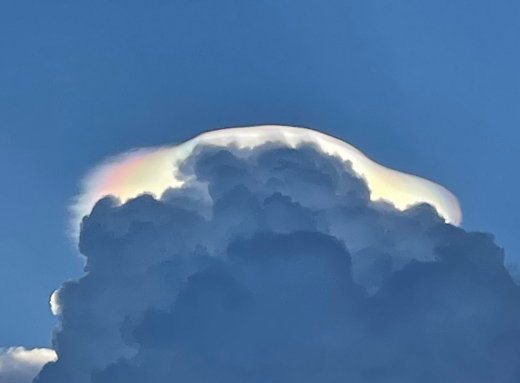
"There was a hint of rainbow above the leading cloud, so I pulled out my iPhone, zoomed in, and snapped this shot," he says.
Robisch captured an iridescent pileus cloud. This type of cloud forms on sunny afternoons when the heat of the summer sun causes cumulus clouds to boil upwards. Moist layers of air above the cumulus get shoved toward the sky, cooling and condensing to form a cap or 'pileus' (Latin for cap) full of water droplets. Dappled by sunlight at the top of the storm cloud, those droplets glow with iridescent colors.
"I mean, you just NEVER know when you might notice something cool!" says Robisch.
Realtime Space Weather Photo Gallery
Free: Spaceweather.com Newsletter
Realtime Noctilucent Cloud Photo Gallery
Free: Spaceweather.com Newsletter
Realtime Aurora Photo Gallery
Free: Spaceweather.com Newsletter