PERSEID METEORS VS THE FULL MOON: Earth is approaching a dense stream of debris from Comet Swift-Tuttle, source of the annual Perseid meteor shower. Meteor rates should rise quickly during the next 24 hours with a peak expected on Aug. 12-13. Full moonlight will interfere with the display, overwhelming many faint meteors. Fortunately, there will be plenty of Perseid fireballs. Enjoy the show: observing tips.
STARLINK AND THE PLEIADES: SpaceX launched another batch of 52 Starlink internet satellites from Cape Canaveral on Tuesday, August 9th. The next night, Kevin Fetter of Brockville, Ontario, watched them fly past the Pleiades:
Fetter caught at least 51 of the satellites, some sparkling beautifully in high altitude sunlight. "They passed close enough to the star cluster to make a really nice view," he says.
The August 9th launch was the SpaceX's 21st Starlink mission of the year, bringing the total number of Starlinks in orbit to 3009. This is both an impressive achievement and a potentially troubling development for Earth's orbital ecosystem. The next Starlink launch is scheduled for August 12th--tomorrow!--from the Vandenberg Space Force Base in California.
Realtime Space Weather Photo Gallery
Free: Spaceweather.com Newsletter
'EARTHQUAKE BALLOONS' IN THE STRATOSPHERE: If you want to detect an earthquake on Venus--good luck. The planet's surface is hot enough to melt lead, and the atmospheric pressure is crushing. No ground-based seismometer could possibly survive.
What's an extraterrestrial seismologist to do? Launch a balloon.
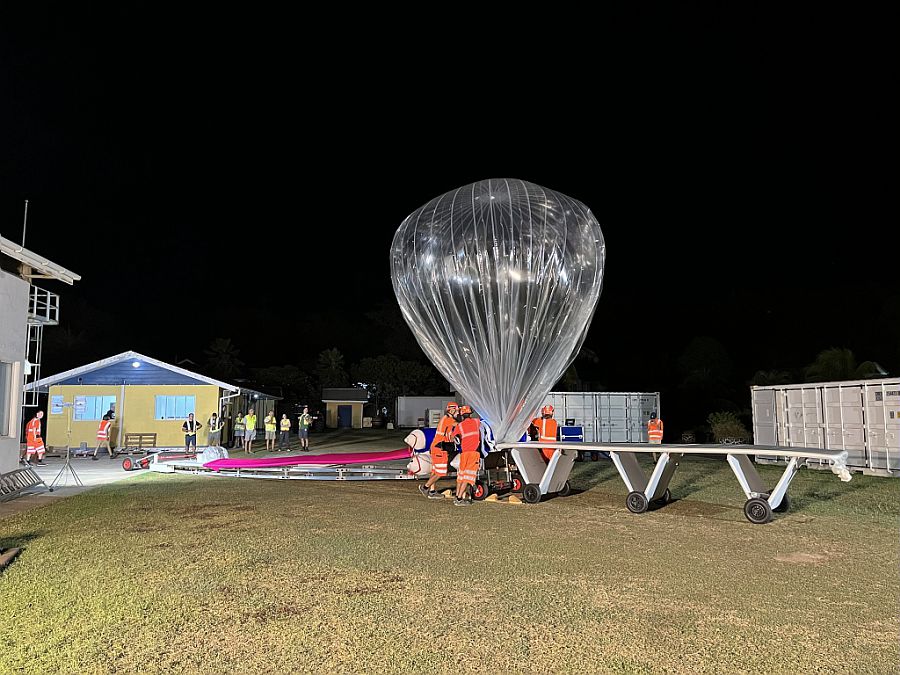
Above: Researchers prepare to launch a Strateole-2 balloon with sensors capable of detecting earthquakes from thousands of kilometers away.
A new paper just published in the Geophysical Research Letters reports the detection of a magnitude 7.3 earthquake by a fleet of balloons floating through the stratosphere above Indonesia's Flores Sea. Onboard infrasound sensors registered acoustic waves rippling upward from the sea surface below, proving that, here on Earth, balloons can be used as seismometers.
"The same technique should work in the atmosphere of Venus," says Raphael Garcia, the study's lead author and a planetary scientist at the Institut Supérieur de l’Aéronatique et de l’Espace of the University of Toulouse. "Balloon-based sensors could float high above Venus's deadly surface, collecting data at a safe distance."
In the fall of 2021, the Centre National d’Etudes Spatiales (CNES) launched a fleet of 16 balloons from Mahé Island in the Seychelles archipelago. Unlike ordinary weather balloons, which explode in a matter of hours, these were "superpressure balloons," which can remain aloft for months. Stratospheric winds carried them over the Flores Sea.
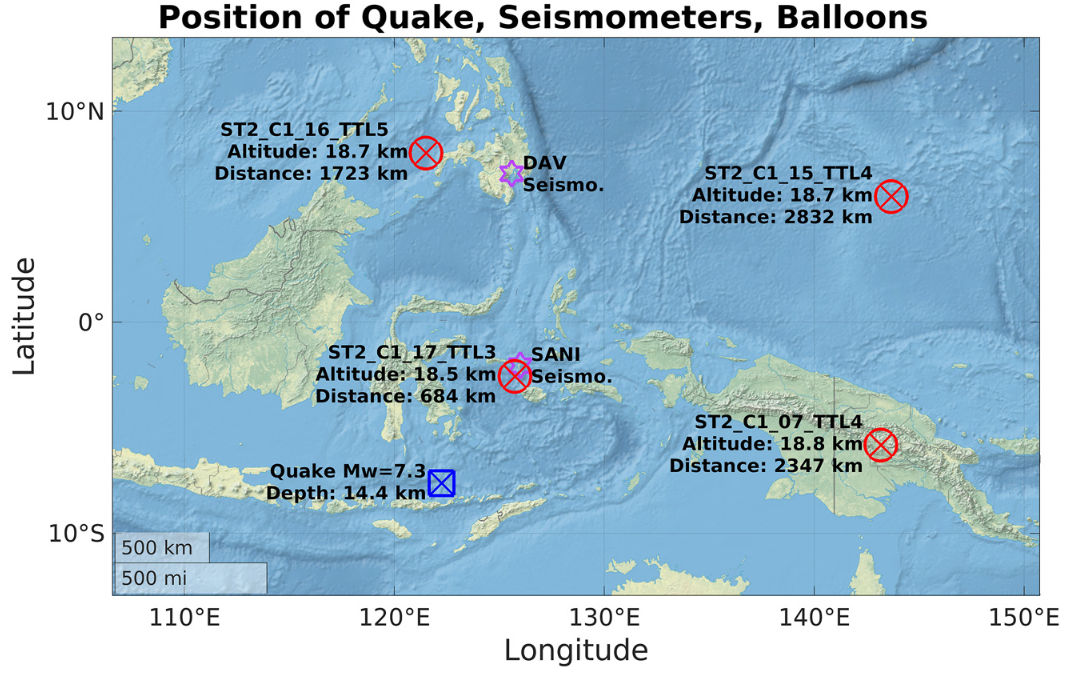
Above: Position of the Flores Sea quake (blue square) with ground seismometers (purple stars) and Strateole-2 balloons (red circles)
Four balloons picked up the undersea quake on Dec. 14, 2021. Combining their signals, researchers pinpointed the epicenter within 300 km, the magnitude of the quake within 0.8 units, and its onset within 50 seconds. Furthermore, waveforms recorded by the infrasound sensors were detailed enough to sense structures in the Earth 100 km deep.
Garcia would like to do the same thing on Venus. "We know nothing of its interior," he says. "We don't know how it's made inside, and seismology is one of the best tools to figure that out."
Seismic balloons could come in handy on Earth, too. "Balloons could be used to cover ocean regions where conventional seismometers are not yet deployed," notes Garcia. "Another advantage: Balloons may be rapidly deployed just after a big quake for monitoring aftershocks."
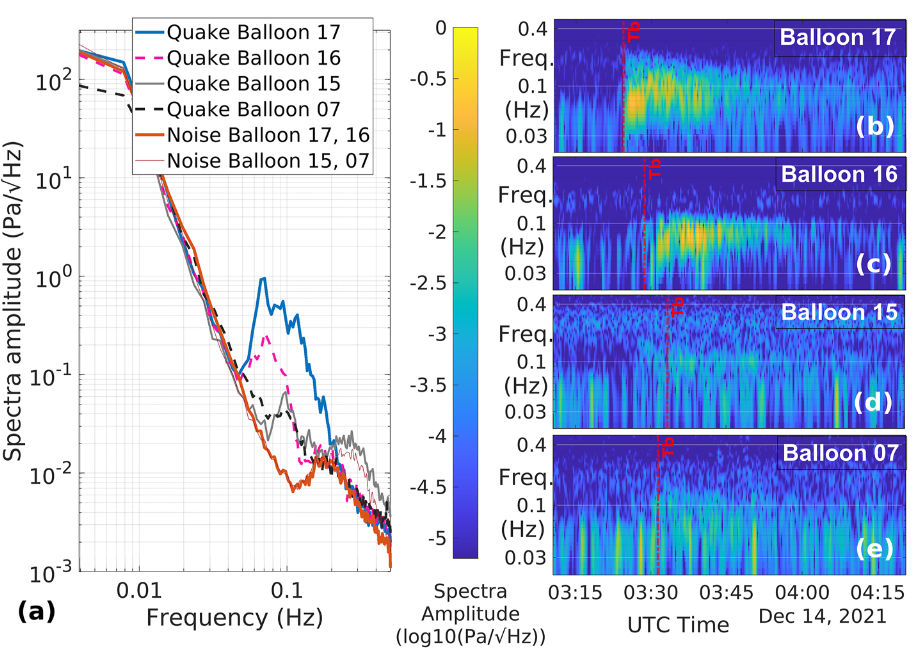
Above: Acoustic waves recorded by four balloons during the Flores Sea earthquake.
The test flights have already unearthed a curiosity in South America. On Nov. 28, 2021, just one of the balloons detected a magnitude 7.5 earthquake in northern Peru. The infrasound frequency, 0.23 Hz, was higher than expected; for comparison, the Flores Sea quake registered a more typical 0.085–0.125 Hz. Garcia's team believes the high pitch may have been caused by a "ringing" of sediments in the Amazonian basin.
Sensing earthquakes from the stratosphere is relatively new. Researchers at Caltech and the Jet Propulsion Laboratory did it for the first time in July 2019. Garcia's study marks the first time an earthquake was detected by more than one balloon. It won't be the last.
For more information, read the original research here.
"SO LONG, AND THANKS FOR ALL THE FISH": This is a great gift for fans of Douglas Adams and the Hitchhiker's Guide to the Galaxy. The students of Earth to Sky Calculus have launched a pod of laser-etched dolphins to the stratosphere. Riding onboard a cosmic ray research balloon, they traveled 34.7 km (113,845 feet) above Earth's surface:
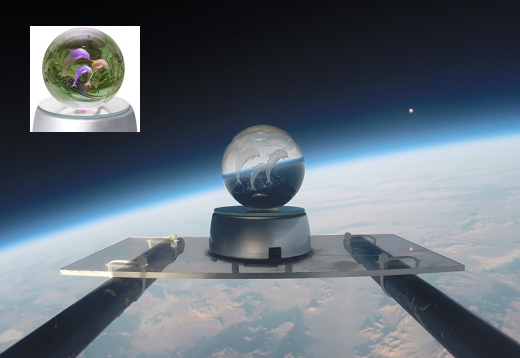
You can have them for $119.95. The students are selling this and other edge of space gifts to support their cosmic ray monitoring program.The crystal sphere comes with a unique gift card showing the dolphins in flight and telling the story of their journey to the edge of space.
Also included is a multi-colored LED illuminated stand. This creates a colorful visual effect and allows the orb to be used as a far-out night light.
Far Out Gifts: Earth to Sky Store
All sales support hands-on STEM education
Realtime Noctilucent Cloud Photo Gallery
Free: Spaceweather.com Newsletter
Realtime Aurora Photo Gallery
Free: Spaceweather.com Newsletter