INCREASING CHANCE OF FLARES: Active sunspot AR3079 is crackling with C-class solar flares. This movie from the Solar Dynamics Observatory shows one of the explosions on Aug. 13th happening not far from a dark magnetic filament:
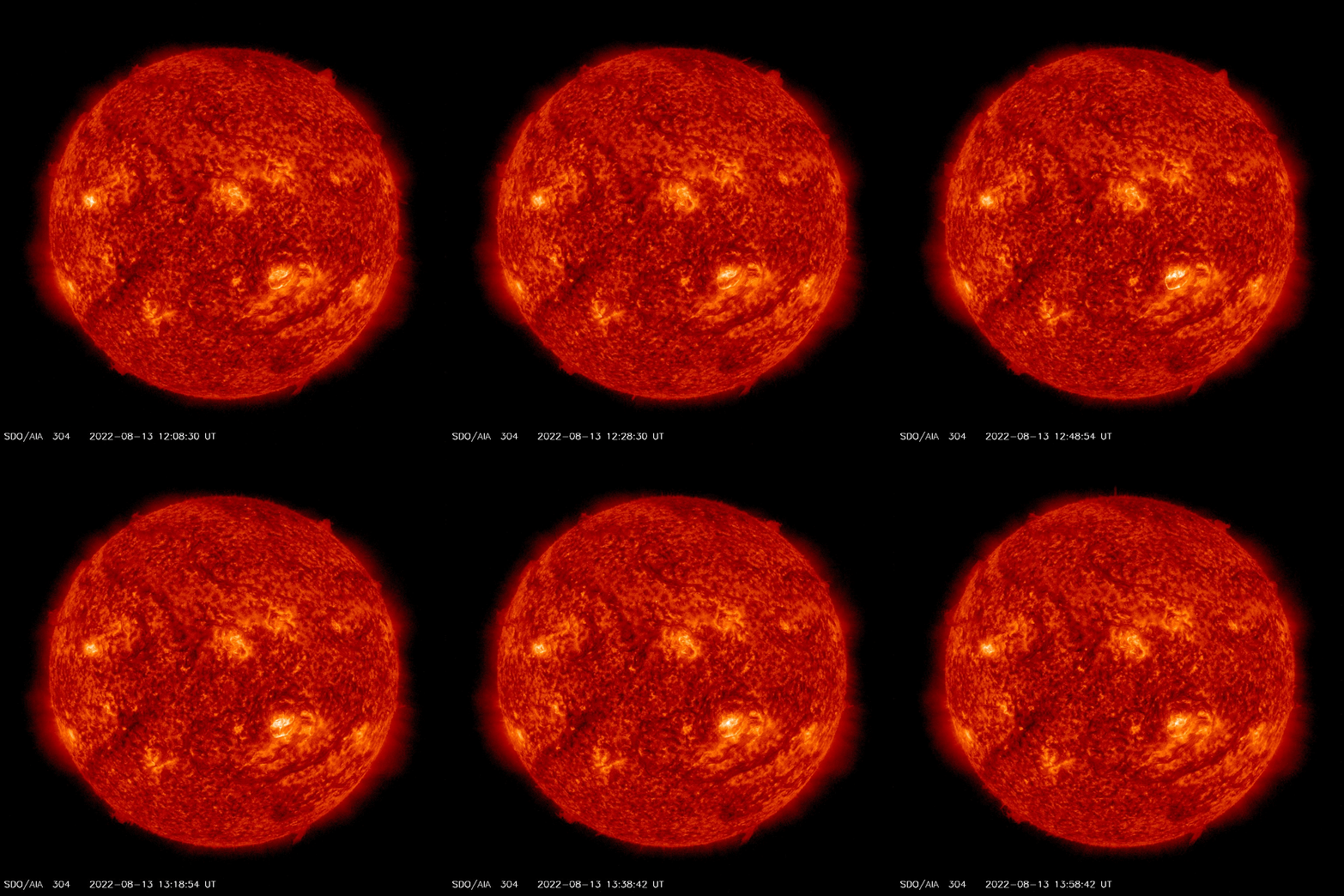
The proximity of the filament may be significant. Repeated nearby flares could destabilize the structure, resulting in a CME-producing explosion.
Meanwhile, activity in the core of AR3079 is intensifying, and an M-flare could be in the offing. Stay tuned. Solar flare alerts: SMS Text
THE PERSEID METEOR SHOWER IS UNDERWAY: Today, Aug. 13th, Earth is passing through a stream of debris from Comet Swift-Tuttle, source of the annual Perseid meteor shower. We won't see as many Perseids as usual because the meteor shower is competing with the nearly-full Moon. Only the brightest Perseids will be visible through the glare. Browse: photo gallery.
This morning, Georg Klingersberger photographed a rainbow-colored Perseid disintegrating over Kobernaußen, Austria:
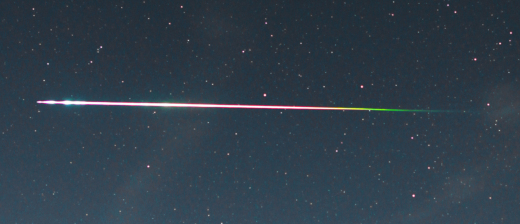
"At first the Perseids seemed to be asleep," says Klingersberger. "I waited and waited under a bright full Moon seeing only planes and satellites. Then wow! This happened. Amazement and goosebumps."
Realtime Perseid Photo Gallery
Free: Spaceweather.com Newsletter
A NEW FORM OF SPACE WEATHER ON BETELGEUSE: You've heard of a CME, a "coronal mass ejection." They happen all the time. A piece of the sun's tenuous outer atmosphere (corona) blows off and sometimes hits Earth. Something far more terrible has happened to Betegeuse. The red giant star produced an SME, or "surface mass ejection."
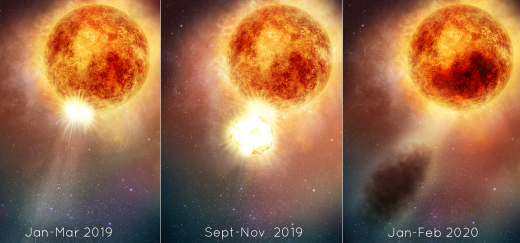
Above: An artist's concept of an SME on Betelgeuse. Credit: Elizabeth Wheatley (STScI)
NASA astronomers believe that in 2019 a colossal piece of Betelgeuse's surface blew off the star. The mass of the SME was 400 billion times greater than a CME or several times the mass of Earth's Moon. Data from multiple telescopes, especially Hubble, suggest that a convective plume more than a million miles across bubbled up from deep inside the star, producing shocks and pulsations that blasted a chunk off the surface.
"We've never before seen such a huge mass ejection from the surface of a star," says Andrea Dupree of the Harvard-Smithsonian Center for Astrophysics, who is leading the study. "Something is going on that we don't completely understand."
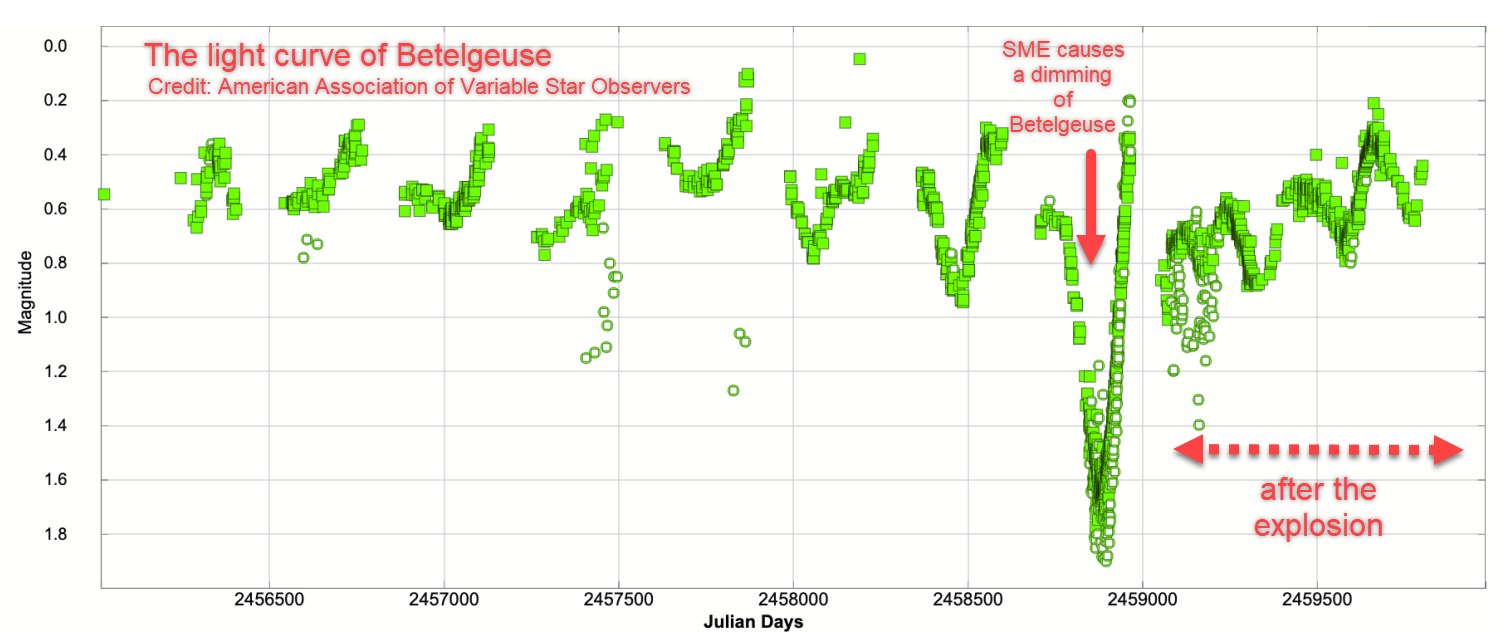
After it left the star, the SME cooled, forming a dark cloud that famously dimmed Betelgeuse in 2019 and 2020. Even casual sky watchers could look up and see the change. Some astronomers worried that the dimming foreshadowed a supernova explosion. The realization that an SME is responsible has at least temporarily calmed those fears.
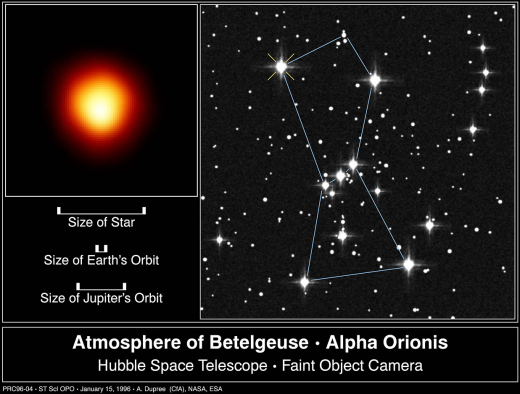
Above: A Hubble image of Betelgeuse located in the shoulder of Orion.
Betelgeuse's brightness has since returned to normal, but something strange is still going on. Astronomers have long known that Betelgeuse is a variable star with a 430-day period. Its metronome-like change in brightness has been observed for more than 200 years. As Betelgeuse recovers, however, those pulsations are no longer regular: See the data. Spectra taken by Hubble and the Tillinghast telescope in Arizona imply that years later the surface of Betelgeuse is still bouncing like a plate of gelatin dessert--a testament to the ferocity of the blowout.
Betelgeuse is so large that if it replaced the sun at the center of our solar system, its atmosphere would extend past Jupiter. Dupree used Hubble to resolve hot spots on the star's surface in 1996. This was the first direct image of a star other than the sun.
What's happening now "is a totally new phenomenon that we can observe directly and resolve surface details with Hubble," says Dupree. "We're watching stellar evolution in real time."
Realtime Space Weather Photo Gallery
Free: Spaceweather.com Newsletter
THE EDGE OF SPACE BUTTERFLY: Are you looking for a far-out gift? Consider the Edge of Space Butterfly. On June 26, 2022, this crystal pendant hitched a ride onboard an Earth to Sky Calculus cosmic ray research balloon:
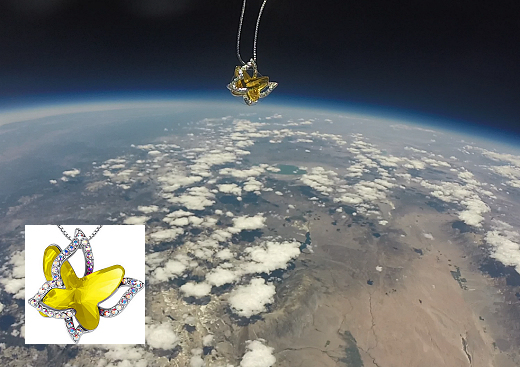
You can have it for $172.95. The inner yellow citrine crystal is surrounded by a "spread your wings" lattice of sparkling zirconia. A rich layer of rhodium plating ensures the longevity of the pendant and its 18-inch chain.
The Edge of Space Butterfly makes a great anniversary, Christmas, or birthday gift. It comes with a greeting card showing the pendant in flight and telling the story of its trip to the stratosphere and back again.
Far Out Gifts: Earth to Sky Store
All sales support hands-on STEM education
Realtime Noctilucent Cloud Photo Gallery
Free: Spaceweather.com Newsletter
Realtime Aurora Photo Gallery
Free: Spaceweather.com Newsletter