ALL QUIET: Barring an unexpected solar flare (full disclosure: almost all solar flares are unexpected), space weather should remain calm for the rest of the week. No CMEs are coming, and the next solar wind stream isn't expected to reach Earth until Aug. 29th. Solar flare alerts: SMS Text
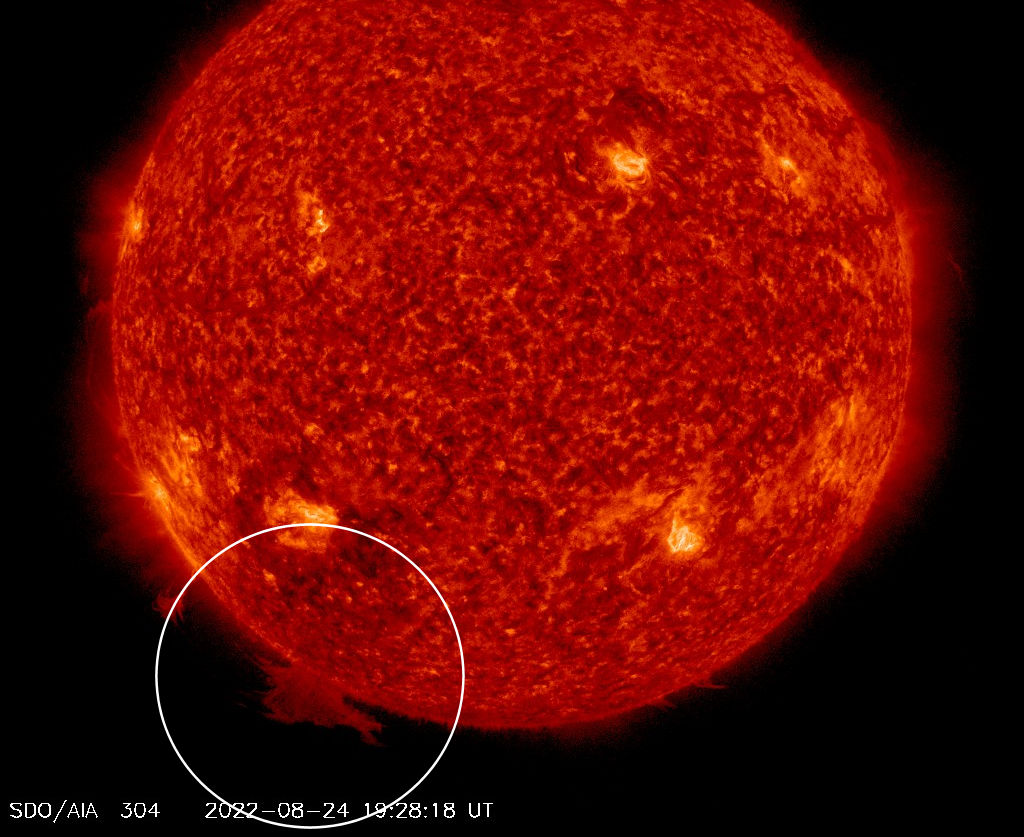
PLASMA FOREST: Astronomers are monitoring a large prominence on the southeastern limb of the sun. If trees were made of plasma, this is what the forest would look like:
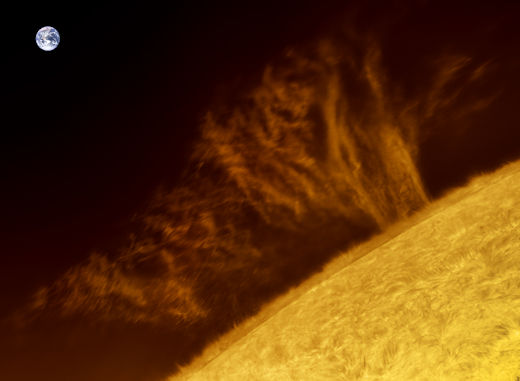
Photographer Philippe Tosi inserted a picture of Earth for scale; the 'trees' are ten times taller than our entire planet. "The seeing was only medium today in Nîmes, France, but the prominence is so large I was able to take a good picture anyway," says Tosi.
Got a solar telescope? Point it here. Solar flare alerts: SMS Text
Realtime Space Weather Photo Gallery
Free: Spaceweather.com Newsletter
AURORAS ON JUPITER: This week, NASA released the first James Webb Space Telescope (JWST) images of auroras on Jupiter. The red rings of light circling Jupiter's poles were big enough to swallow Earth:
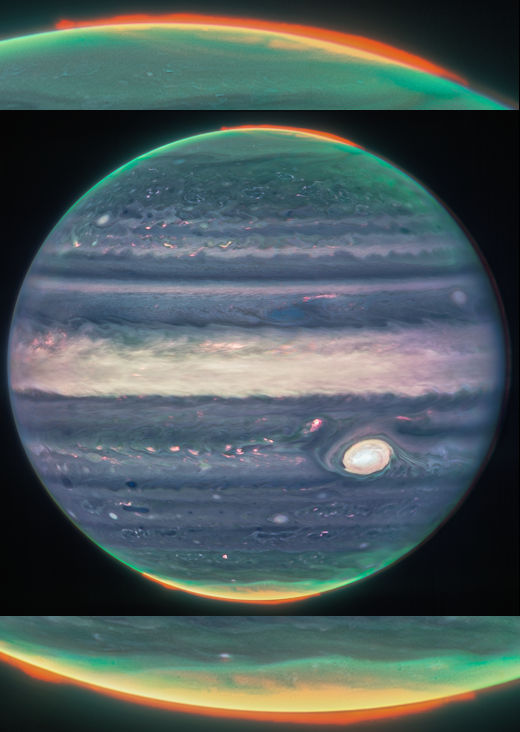
Image credit: JWST's Near-Infrared Camera (NIRCam). The camera's F360M filter picked up the 3.3 - 3.6 micron glow of excited H3+ in Jupiter's auroral zone.
But Jupiter's auroras are more then just oversized versions of our own. They are formed in a completely different way. One of the key ingredients is volcanoes, and--so much for space weather--solar activity is not required.
For the most part, Jupiter makes its own Northern and Southern Lights. It does this by spinning--like crazy. Jupiter turns on it axis once every 10 hours, dragging its giant planetary magnetic field around with it. Spinning a magnet is a great way to generate a few volts; kids do it all the time for science fair projects. Jupiter's spin produces 10 million volts around its poles.
These voltages set the stage for non-stop auroras. The fuel comes from Jupiter's volcanic moon Io, where active vents spew ions such as O+ and S+ into Jupiter's magnetosphere. Polar electric fields grab these ions and slam them into Jupiter's upper atmosphere. The resulting glow can be seen almost anytime JWST wants to look. Jupiter's volcano-powered auroras are usually "on."
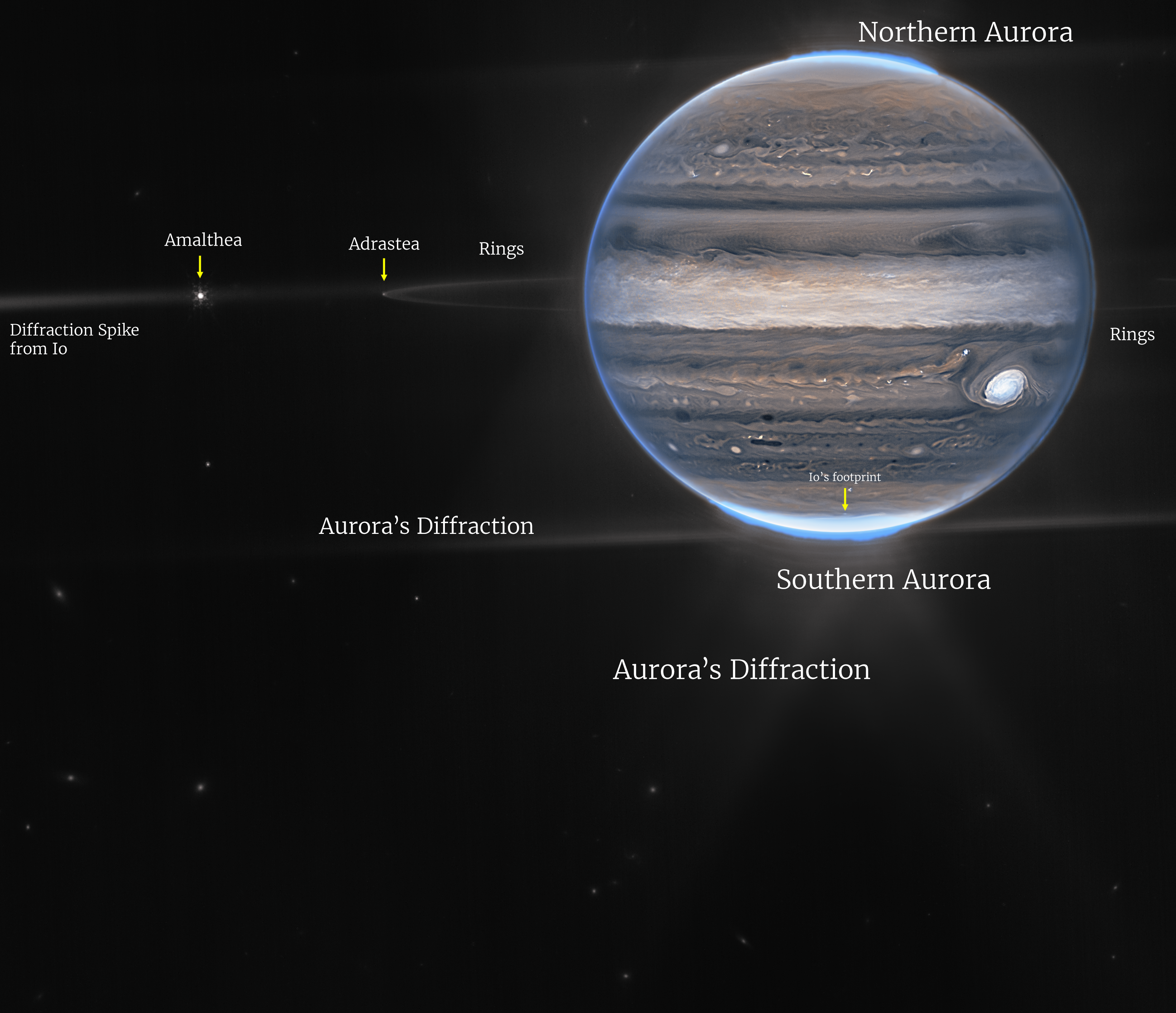
Above: This JWST image of Jupiter and its surroundings uses a different color table, so the auroras look blue. They are still infra-red.
Solar wind and CMEs can also help. However, solar storm clouds are naturally weakened by the time they travel all the way to Jupiter, five times farther from the sun than Earth. Also, Jupiter's powerful magnetic field forms a potent shield. Io is already inside Jupiter's "defenses," so it can be more effective.
Two distinct auroras coexist over the poles of Jupiter: Ultraviolet auroras created by atmospheric hydrogen in its molecular form (H2) and infrared auroras created by the hydrogen ion H3+. JWST saw the infrared variety. In fact, the telescope is well instrumented to monitor these auroras. Its Near-Infrared Camera (NIRCam) has a filter that nicely captures the 3.3 to 3.6 micron glow of H3+. NASA, we want more!

Realtime Aurora Photo Gallery
Free: Spaceweather.com Newsletter
STERLING SILVER RAINBOW DRAGONFLY: Are you looking for a far-out gift? Consider a rainbow dragonfly from the edge of space. On June 3, 2022, this sterling silver pendant hitched a ride onboard an Earth to Sky Calculus cosmic ray research balloon:
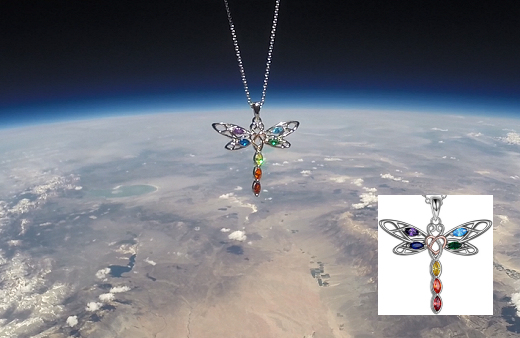
You can have it for $172.95. The dragonfly's heart is a golden Celtic love knot, and its wings are decorated with a spray of rainbow-colored crystals. The students are selling dragonfly pendants to support their cosmic ray ballooning program. Each one comes with a greeting card showing the pendant in flight and telling the story of its trip to the stratosphere and back again.
Far Out Gifts: Earth to Sky Store
All sales support hands-on STEM education
Realtime Noctilucent Cloud Photo Gallery
Free: Spaceweather.com Newsletter