A DANGEROUS SUNSPOT: Sunspot AR3089 has been quiet for days. Could it be the calm before the storm? The sunspot has developed a delta-class magnetic field that harbors energy for X-class solar flares. If there is such an eruption (NOAA estimates a 5% chance) it will be geoeffective because the sunspot is almost directly facing Earth. Solar flare alerts: SMS Text
DUNG BEETLES NAVIGATE USING THE MILKY WAY: When you hear the words "dung beetle" you probably think of poop. After you read this article, a different picture may come to mind: The Milky Way.
In 2009, entomologists made an astonishing discovery. Nocturnal dung beetles (Scarabaeus satyrus) can navigate using the Milky Way. Although the compound eyes of beetles cannot resolve individual stars, this species can see the Milky Way as a stripe across the sky and perhaps even sense features within it such as the galactic center and lanes of stardust.
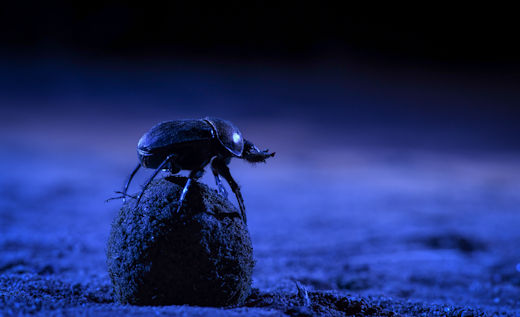
Above: A nocturnal dung beetle at work. Photo credit: Chris Collingridge © 2017
"Currently, dung beetles are the only animals we know of that use the Milky Way for reliable orientation," says James Foster of the University of Konstanz in Germany. "They are excellent little astronomers."
A quick review of dung beetles: They are nature's sanitation crew. Whenever a pile of brown material is dumped in the forest, dung beetles converge to clean up the mess. Each beetle sculpts a dung ball, which they roll away in a straight line. Far from the pile, the ball will be buried and eaten, and sometimes used as bedding for dung beetle eggs.
It sounds simple, but there's a problem. Dung beetles are combative. If two beetles leaving the pile bump into one other, they can get into a brutal wrestling match often ending with overhead judo-style full body throws. Wandering around in circles (like lost humans do) boosts the odds of a fight even more. Dung beetles have therefore evolved the ability to navigate to safety in quick straight lines.
During the day they steer by the sun. Dung beetles can see polarization patterns in the daytime sky, and use these patterns to hold course. A single patch of blue sky is sufficient. The trick works at night, too. Dung beetles are the only known creatures who can see the polarization of moonlight, which is 100 million times weaker than daylight polarization. Studies show that dung beetles walk straight as accurately at night as during the day, even when the Moon is a faint crescent.
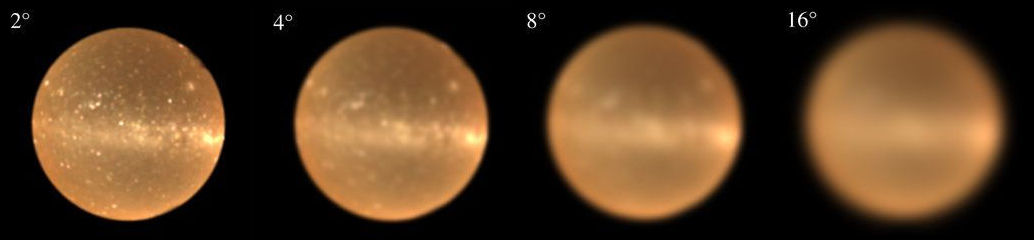
Above: Dung beetle vision blurs the Milky Way, but no one is certain how much. These are four models used in the experiments of James Foster.
But what happens when there's no sun or Moon? In the early 2000s, this question troubled two pioneers of dung beetle research, Eric Warrant and Marie Dacke of Lund University in Sweden. To find the answer, they took some beetles to the planetarium at the University of the Witwatersrand in Johannesburg, South Africa, and projected the Milky Way onto the domed ceiling. The beetles saw it, and navigated.
Their discovery prompted a veritable explosion in dung beetle research. James Foster is a leader in the field, publishing new results every few years.
Foster and colleagues have built a rudimentary planetarium just for dung beetles. It uses LED lights to mimic the Milky Way as beetles see it through their compound eyes. In 2017 they found that dung beetles were able to distinguish between north and south arms of the Milky Way, sensing intensity contrasts as low as 13%. This threshold puts features such as the galactic center in Sagittarius and the Great Rift in Cygnus theoretically within range of beetle senses.
Next they added city lights to their experiment--and the results were not good. "Light pollution may be forcing beetles to abandon the Milky Way as their compass," worries Foster.
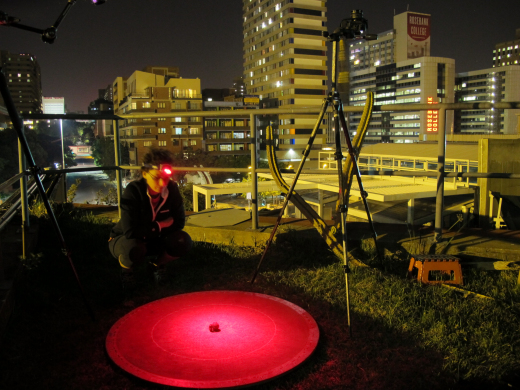
Above: Researcher Claudia Tocco observes the behavior of a dung beetle surrounded by urban lights. Photo credit Marcus Byrne.
In a paper published July 2021, Foster's team described how urban lights wipe out the Milky Way, reduce the polarization of moonlight by 60% to 70%, and "create anthropogenic celestial cues." The last item is worst of all. Spotlights and brightly lit buildings mesmerize beetles who suddenly ignore the sky and make a beeline for manmade bulbs.
"These beacons draw beetles towards the most hostile regions of their environments," says Foster. "After rolling their balls some distance, beetles need to find a patch of soft sand where they can dig in. They are unlikely to find that in the immediate vicinity of bright artificial lights, whether in cities or the countryside, since these are usually associated with concrete and tarmac."
Dung beetles aren't the only ones. Researchers believe they are only scratching the surface of this field with potentially thousands of species watching the stars. Everything from simple light bulbs to sophisticated satellite megaconstellations may be affecting these members of our ecosystem.
"Dung beetle!" What are you thinking of now?
Realtime Space Weather Photo Gallery
Free: Spaceweather.com Newsletter
OCEAN BLUE CRYSTAL DOLPHIN PENDANT: Are you looking for a far-out gift? Consider the Ocean Blue Crystal Dolphin Pendant. It flew to the stratosphere on April 8th onboard a cosmic ray research balloon:
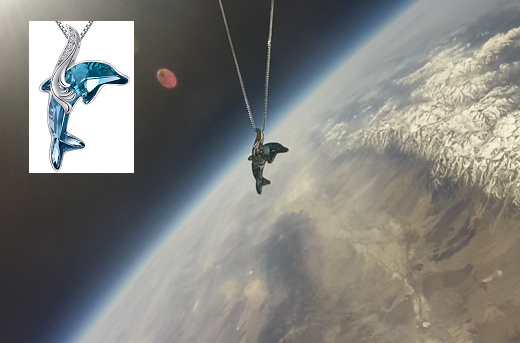
You can have it for $199.95. The students of Earth to Sky Calculus are selling these crystal cetaceans to support their cosmic ray monitoring program.
The dolphin is wrapped in a sterling silver wave and suspended from a matching 18-inch chain. It contains no nickel, no lead, no cadmium; the pendant is totally hypoallergenic. Each pendant comes with a greeting card showing the dolphin in flight, and telling the story of its trip to the edge of space and back again.
Far Out Gifts: Earth to Sky Store
All sales support hands-on STEM education
Realtime Noctilucent Cloud Photo Gallery
Free: Spaceweather.com Newsletter
Realtime Aurora Photo Gallery
Free: Spaceweather.com Newsletter