THE WORLD'S LARGEST SOLAR TELESCOPE: The US National Science Foundation has just released astonishing new images of the sun to celebrate the inauguration of the Daniel K. Inouye Solar Telescope on Maui, Hawai’i. With a four-meter diameter mirror, it is currently the largest solar telescope in the world able to resolve features on the sun as small as 18 km. Take a look.
A SUNSPOT WITH A TAIL: Sunspot AR3092 has a tail--a really long one. "It extends for about 390,000 km above the surface of the sun," says Eduardo Schaberger Poupeau who photographed the structure from Rafaela, Argentina:
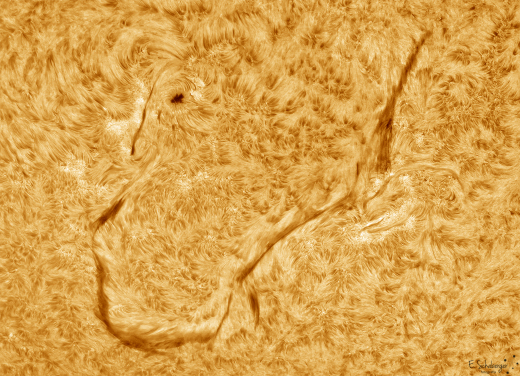
"To understand this size more visually, the dark core of sunspot AR3092, seen in the upper left, is about the size of planet Earth," notes Poupeau.
The sunspot's tail is a filament of magnetism emerging from the sunspot's core and curling away into the sun's atmosphere. Contained inside the filament is a long tube of relatively cool, dark pasma. Only one end of the filament is moored, so it could become unstable and begin to move around. A flick of this tail could send a CME toward Earth. Stay tuned.
more images: from Alan Friedman of Buffalo, NY; from Howard Eskildsen of Ocala, Florida; from Rossana Miani of Padova, Italy;
Realtime Space Weather Photo Gallery
Free: Spaceweather.com Newsletter
MAJOR FARSIDE CME AND RADIATION STORM (UPDATED): Something just exploded on the farside of the sun. NASA's STEREO-A spacecraft recorded a magnificent full-halo CME emerging during the late hours of Sept. 5th:
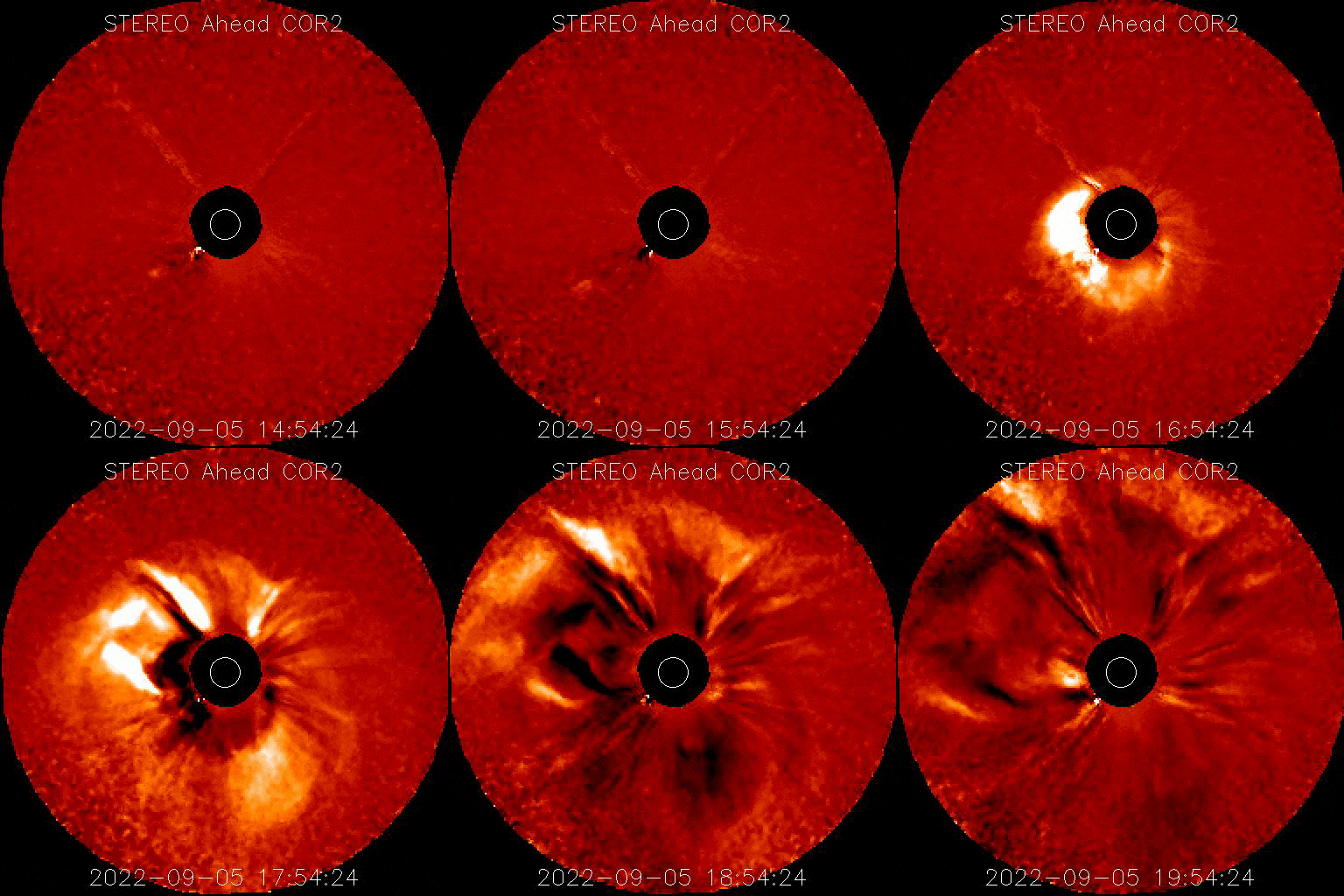
A NASA model of the CME shows it heading away from Earth and directly toward Venus. This will be the second time in a week that Venus has been hammered by a significant solar storm. An earlier CME struck on Sept. 1st, probably launched by the same farside sunspot.

"This is no run of the mill event," says George Ho of the Johns Hopkins Applied Physics Lab. "Many science papers will be studying this for years to come."
Ho is the principal investigator for an energetic particle detector onboard Europe's Solar Orbiter spacecraft--and he is getting a lot of data right now. Solar Orbiter just performed a close flyby of Venus (only 6420 km away) to adjust its orbit around the sun. It is in the perfect position to observe the storm.
This plot shows a wave of energetic particles washing over the spacecraft:
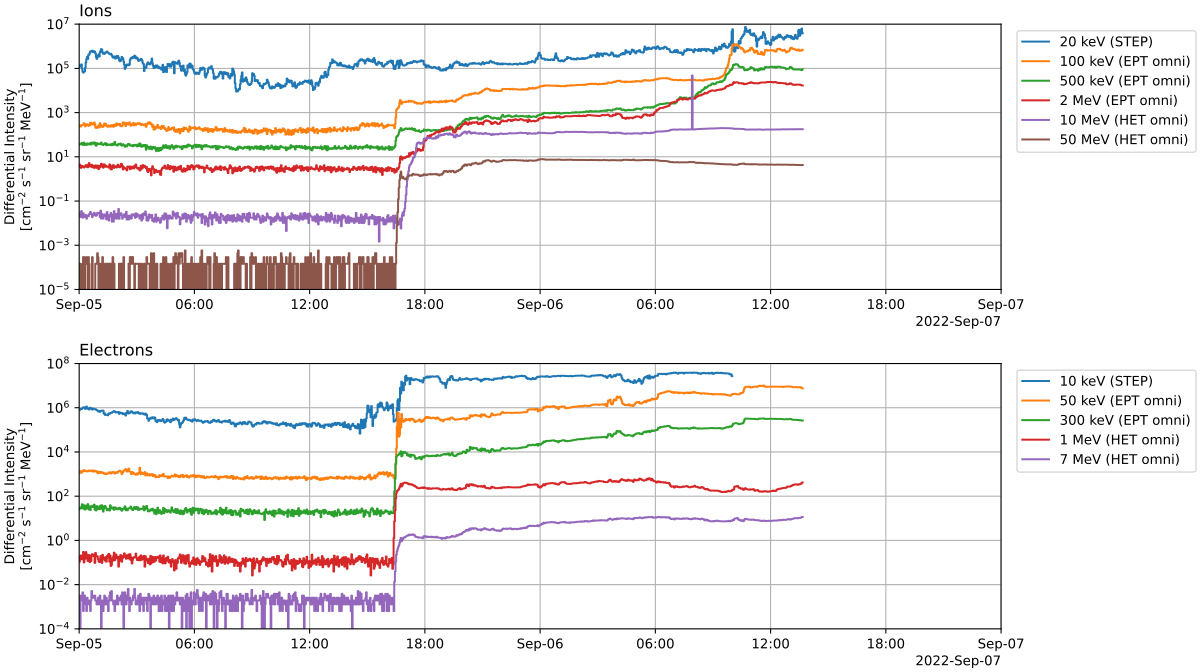
Above: Data from Solar Orbiter's EPD/Suprathermal Ion Spectrograph. These are quick-look data; they have not been checked for accuracy and are subject to revision
"I can safely say the Sept. 5th event is one of the largest (if not THE largest) Solar Energetic Particle (SEP) storms that we have seen so far since Solar Orbiter launched in 2020," says Ho. "It is at least an order of magnitude stronger than the radiation storm from last week's CME."
"In fact, the >10 MeV and >50 MeV particle intensity has not subsided since the beginning of the storm yesterday," adds Ho. "This is indicative of a very fast and powerful interplanetary shock, and the inner heliosphere may be filled with these high-energy particles for a long time. I think I've only seen couple of these in the last couple solar cycles."
Earth is not affected by the storm, which is happening on the opposite side of the sun. However, we may not be safe from its source. The underlying explosion almost certainly happened in the magnetic canopy of AR3088, an active sunspot that popped up on the Earthside of the sun in August. It is now transiting the farside, apparently bigger and angrier than before. The sun's rotation will turn AR3088 toward us again in little more than a week, putting Earth back in the line of fire. Stay tuned.Solar flare alerts: SMS Text
Realtime Aurora Photo Gallery
Free: Spaceweather.com Newsletter
"I LOVE YOU FOREVER" PENGUIN PENDANT: Does someone in your life love penguins? This may be the perfect gift. On Aug. 26, 2022, the students of Earth to Sky Calculus launched a sterling silver penguin pendant onboard a cosmic ray research balloon. The loving pair flew 107,400 feet high, above 99.5% of Earth's atmosphere:
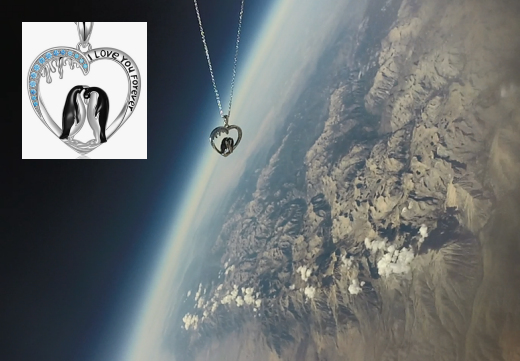
You can have it for $133.95. The two penguins are framed by a sterling silver heart inscribed with the words "I Love You Forever." It comes with a matching hypoallergenic 18-inch chain. Also included is a greeting card showing the pendant in flight and telling the story of its trip to the edge of space.
Far Out Gifts: Earth to Sky Store
All sales support hands-on STEM education
Realtime Noctilucent Cloud Photo Gallery
Free: Spaceweather.com Newsletter