CO-ROTATING INTERACTION REGION: NOAA forecasters say that a CIR (co-rotating interaction region) could hit Earth's magnetic field on Sept. 17th. CIRs are transition zones between slow- and fast-moving solar wind streams. Solar wind plasma piles up in these regions, producing shock-like structures that can mimic CMEs and spark bright Arctic auroras. Solar flare alerts: SMS Text.
THE STARLINK INCIDENT: A minor geomagnetic storm is supposed to be minor. That's why even experts were surprised on Feb. 4, 2022, when dozens of Starlink satellites started falling out of the sky. A weak CME had hit Earth's magnetic field, and the resulting G1-class (minor) storm was bringing them down:

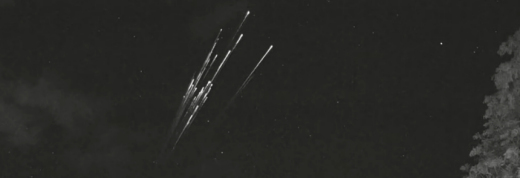
Above: A Starlink satellite breaks up over Puerto Rico on Feb. 7, 2022. Credit: The Sociedad de Astronomia del Caribe
How could this happen? A new paper published in the research journal Space Weather provides the answer.
"Although it was only 'minor,' the storm pumped almost 1200 gigawatts of energy into Earth's atmosphere," explains lead author Tong Dang of the University of Science and Technology of China. "This extra energy heated Earth's upper atmosphere and sharply increased aerodynamic drag on the satellites."
SpaceX launched the satellites from Cape Canaveral on Feb. 3, 2022. Forty-nine (49) Starlinks were crowded inside the Falcon 9 rocket; less than a quarter would survive.
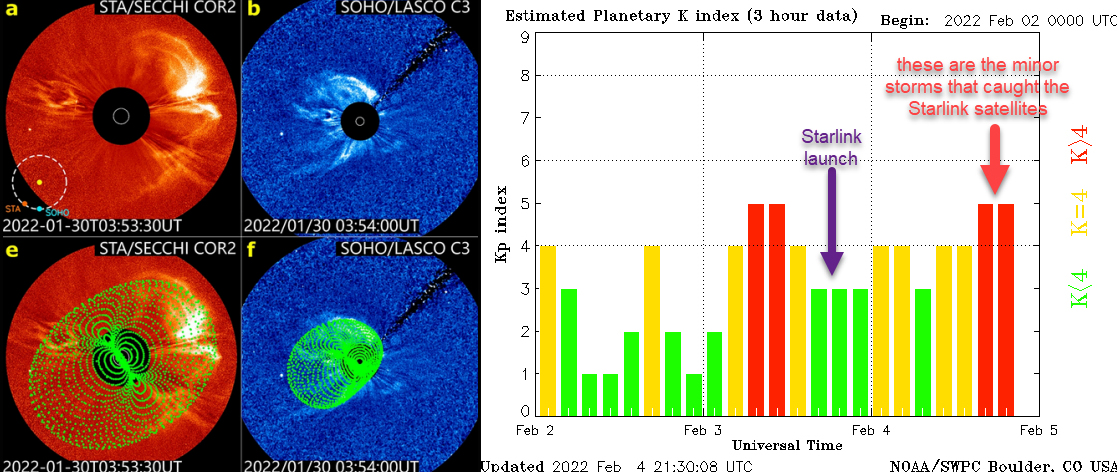
Above: The Starlink launch was sandwiched between two minor geomagnetic storms (right) possibly caused by an Earth-directed CME that left the sun on Jan. 30th (left)
As was SpaceX's practice at the time, the satellites were deployed at an altitude of 210 km--their first stop en route to an operational altitude near 600 km. In the satellite business, 210 km is considered to be low, barely above the atmosphere. SpaceX starts there in case any satellite malfunctions after launch. From 210 km, a "bad sat" can be easily de-orbited.
A little too easily, as it turns out.
Using a physics-based computer model named "TIEGCM," Dang and colleagues simulated conditions during the storm. As geomagnetic energy heated Earth's atmosphere, the air density at 210 km increased globally by 20% with "hot spots" as high as 60%. This movie shows what happened:
Starlink dodged the worst spots. "The satellites did not hit any of the 60% regions," says Dang. "But that didn't save them." The weaker 20% enhancements were enough to bring down 38 out of 49 satellites.
To prevent a repeat, SpaceX has started launching to 320 km instead of 210 km. Earth's atmosphere has to reach that much higher to drag the satellites back during a geomagnetic storm. Since the change, more than 1200 additional Starlink satellites have been launched on 24 rockets without incident.
There's still danger, though. "Air density at 320 km is an order of magnitude less (compared to 210 km), but it's not completely safe," cautions Dang's co-author Jiuhou Lei, also from the University of Science and Technology of China. "During an extreme geomagnetic storm, density could increase from 200% to 800% even at these higher altitudes."
Extreme storms may be in the offing. Young Solar Cycle 25 is just getting started. The profusion of minor storms we are observing today will intensify in the years ahead especially as we approach Solar Max around 2025.
Elon Musk's note to self: Check the space weather forecast.
Realtime Space Weather Photo Gallery
Free: Spaceweather.com Newsletter
THE SUNBURST X-PENDANT: It's the color of a sunburst: The Citrine X-Pendant. The students of Earth to Sky Calculus launched this one to the stratosphere onboard an cosmic ray research balloon. At the apex of the flight it floated 120,892 feet above Earth's surface--a record high for our 10-year ballooning program:
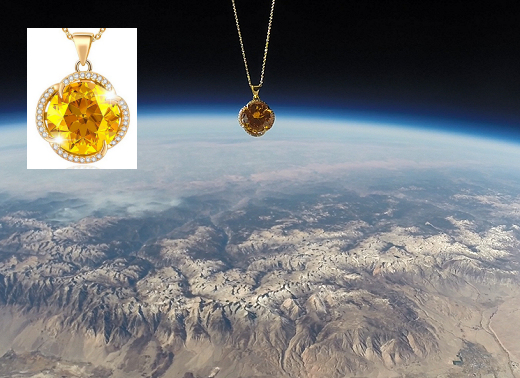
You can have it for $199.95. The citrine gemstone is framed in a 18K gold-plated swirl with a matching 16-inch chain. The students are selling these pendants to support their cosmic ray ballooning program. Each one comes with a greeting card showing the necklace in flight and telling the story of its journey to the edge of space.
Far Out Gifts: Earth to Sky Store
All sales support hands-on STEM education
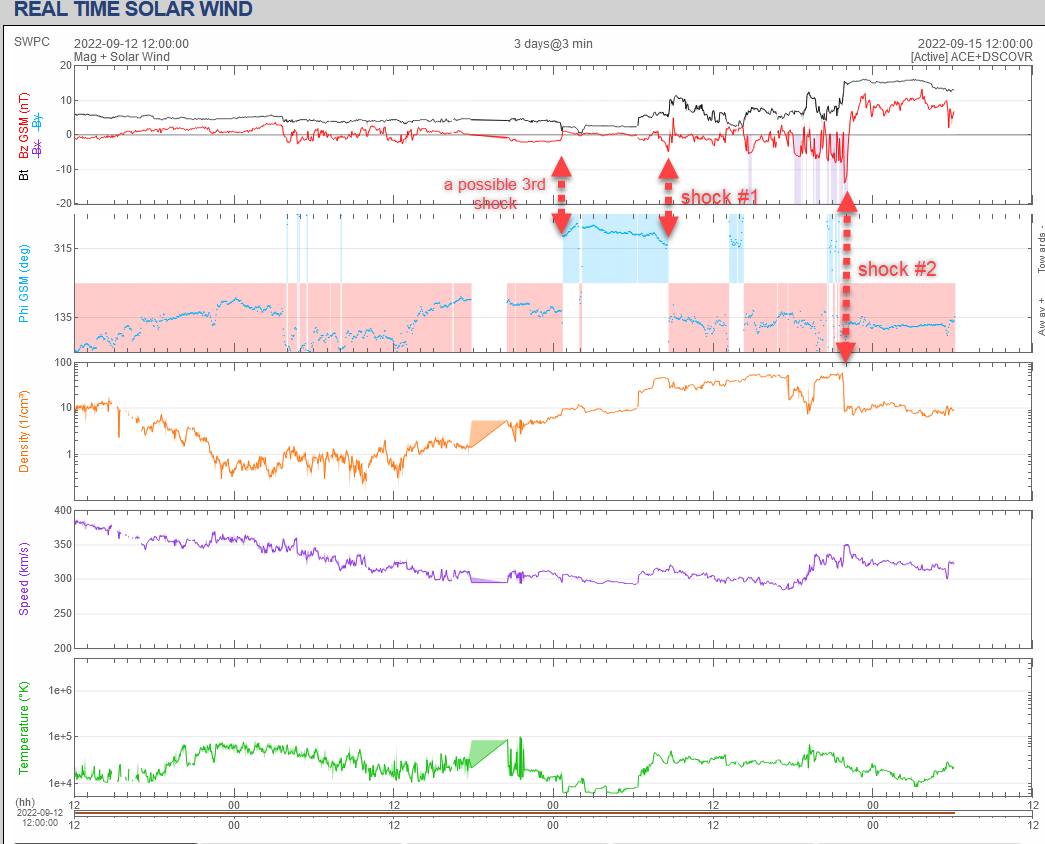
SOLAR WIND SHOCK WAVES SPARK AURORAS: Earth's magnetic field is reverberating from a double impact. Two solar wind shock waves hit our planet on Sept. 14th--one small (0630 UT) and one not-so-small (2313 UT). When the second shock arrived, magnetometers in Boulder, CO, registered a sudden impulse of 30 nanoTesla. The resulting light show stopped traffic in Iceland:
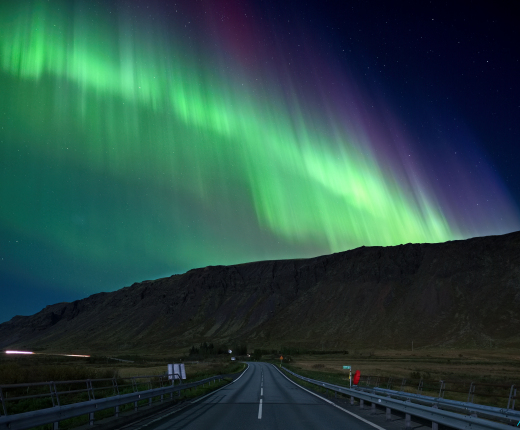
"The structure in the auroras was particularly striking, and the violet and red were some of the strongest I've ever seen!" says Christopher Mathews, who took the picture on Highway 35 north of Selfoss. "This happened despite a rather 'meh' aurora forecast."
Indeed, the shock waves were not in the forecast, and their origin is unknown. We have an idea, though. On Sept. 11th, sunspot AR3098 produced a series of seemingly minor C-class explosions while facing Earth. One or more of these may have embedded minor CMEs in the solar wind, creating the shocks that arrived on Sept. 14th.
more images: from Martijn Harleman of Borgarnes, Iceland; from Dave Higgins of Nairn, Scotland
Realtime Aurora Photo Gallery
Free: Spaceweather.com Newsletter