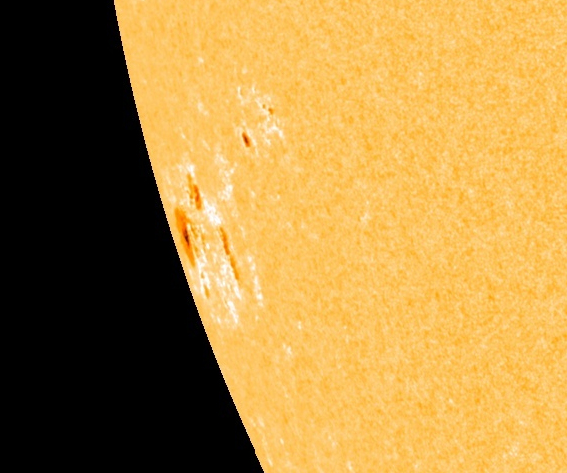
AN ACTIVE SUNSPOT RETURNS: It's back. Active sunspot AR3089 is emerging over the sun's southeastern limb following a 2-week trip around the farside of the sun. The last time we saw it in early September, AR3089 had a delta-class magnetic field that harbored energy for X-flares. And now? Stay tuned. Solar flare alerts: SMS Text.
SIMULTANEOUS EXPLOSIONS ON THE SUN: Yesterday, Sept. 18th, the sun's southern hemisphere convulsed all at once. NASA's Solar Dynamics Observatory (SDO) recorded three apparently simultaneous explosions more than a million kilometers apart:
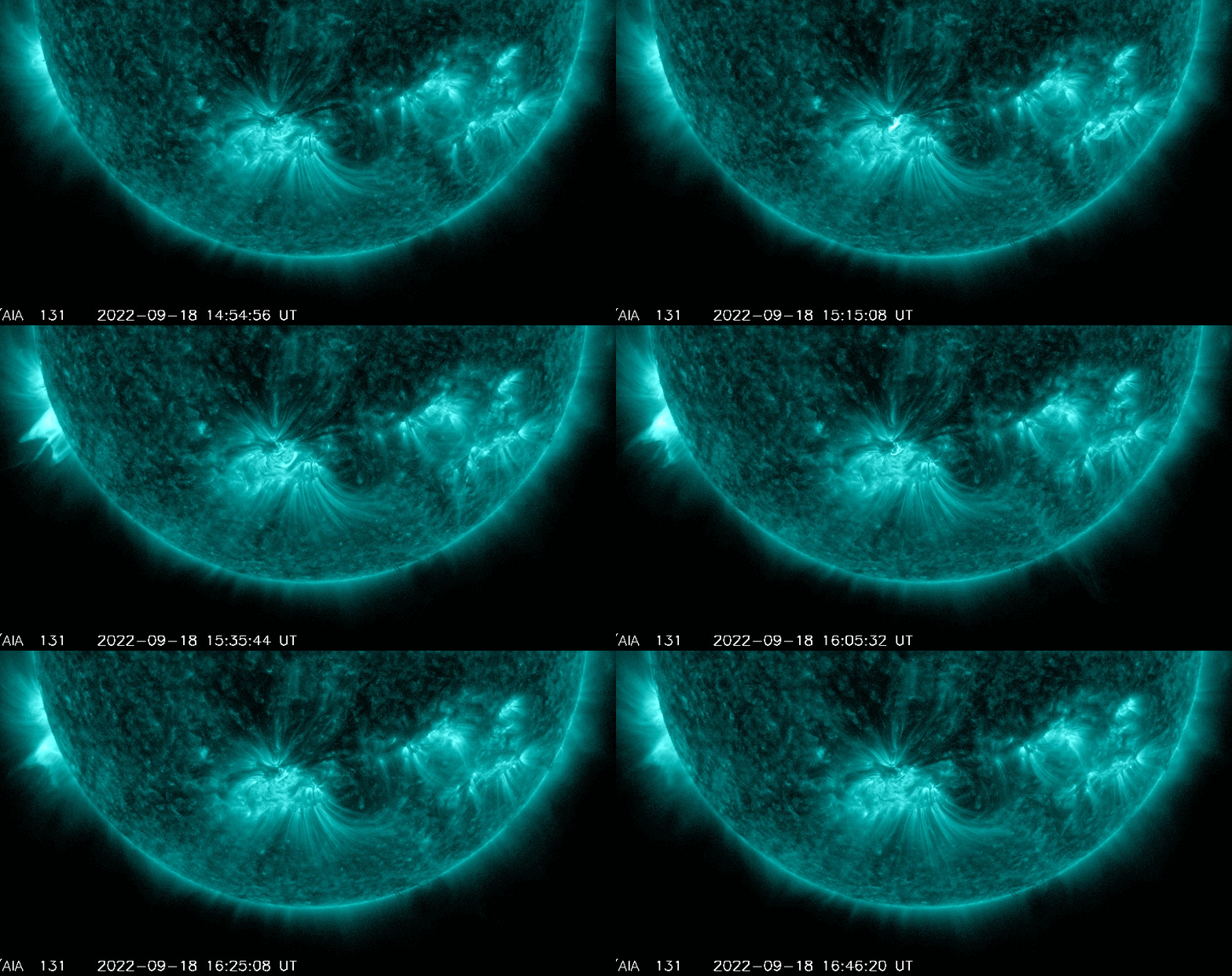
Coincidence? Maybe not. Twelve summers ago, SDO witnessed an even bigger eruption with a dozen significant shock waves, flares, filament eruptions, and CMEs spanning 180 degrees of solar longitude. Researchers studying the event realized that the blasts were a chain reaction connected by wide-ranging faults ("separatrices") in the sun's global magnetic field. Yesterday's event may have been the same.
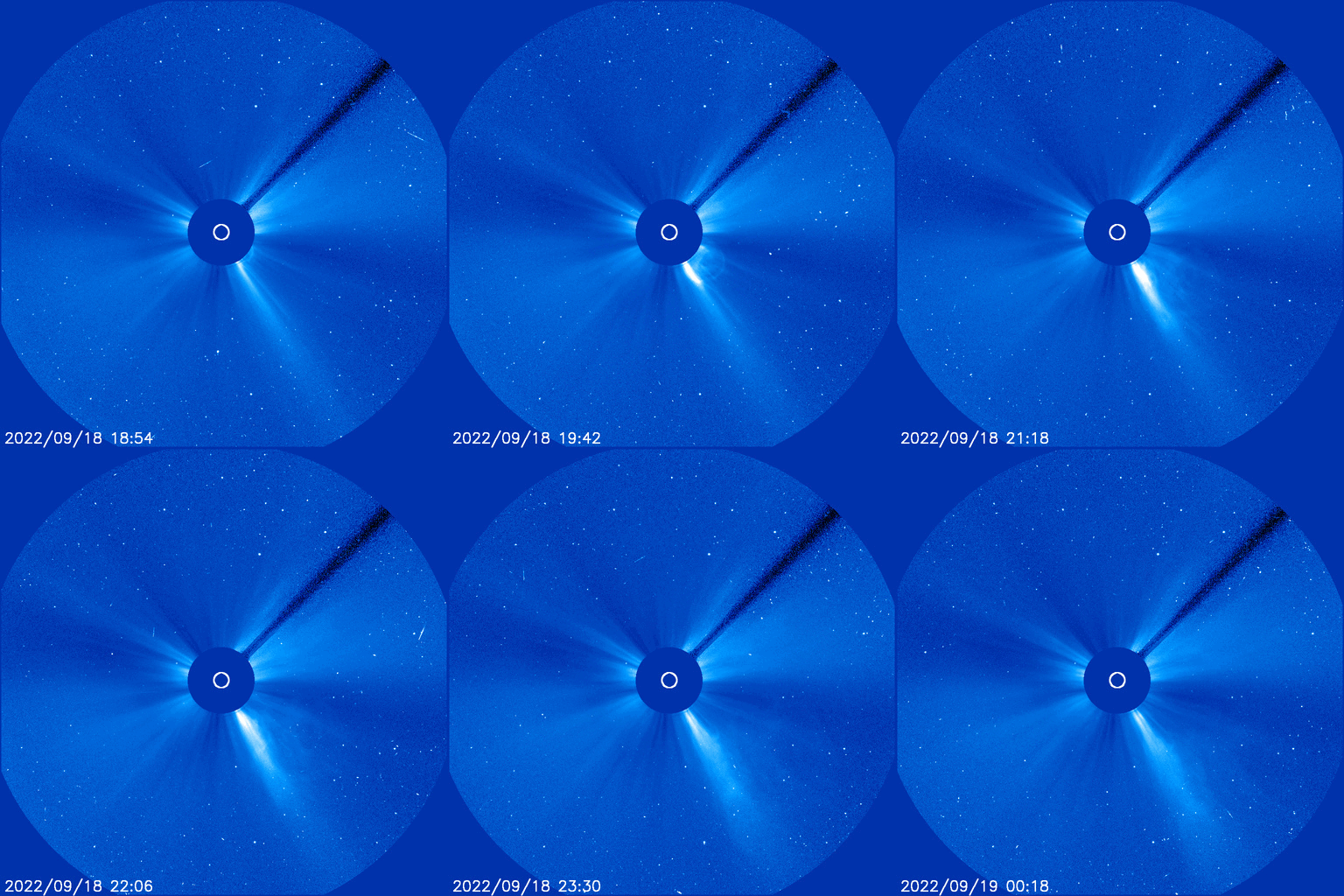
A CME left the sun following the triple explosion, but the jury's still out on whether it will hit Earth. NOAA analysts are modeling the cloud's trajectory now. Update: Subsequent modelling of the CME showed no Earth-directed component.
Realtime Space Weather Photo Gallery
Free: Spaceweather.com Newsletter
CATCH THE STARLINK TRAIN: Last night, Sept. 18th at 8:18 pm EDT, SpaceX launched another batch of Starlink satellites from Cape Canaveral. "Brent" photographed the Falcon 9 rocket from Orlando, FL:
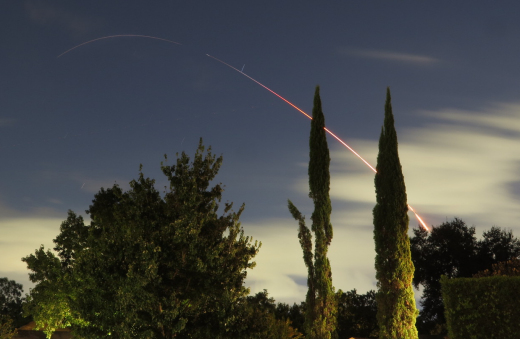
"After five weather delays, the rocket finally launched," says Brent. "There were no jellyfish this time, but it was still a beautiful view."
The launch means that there are now 54 new Starlink satellites in low Earth orbit. For the next few days, they will be very bright, flying in "train formation" across the night skies of Earth. Would you like to see it? Check Heavens Above for local flyby times; follow the link for "Starlink G4-43."
Realtime Space Weather Photo Gallery
Free: Spaceweather.com Newsletter
COSMIC RAY YIN-YANG PENDANT: To celebrate the yin-yang relationship between solar activity and galactic cosmic rays, the students of Earth to Sky Calculus just launched a yin-yang pendant to the stratosphere. Here it is, flying 104,265 ft high onboard a cosmic ray research balloon:
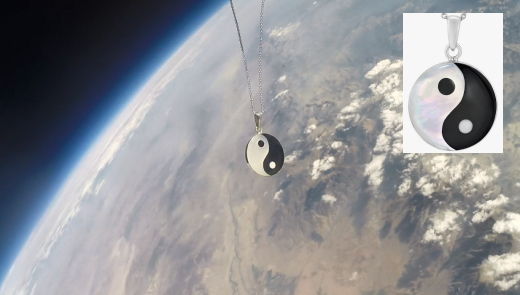
You can have it for $142.95. The pendant's sterling silver frame surrounds balancing swirls of black onyx and mother of pearl--all suspended from a matching 18-inch sterling silver chain. It makes a great anniversary, birthday or (never too early!) Christmas gift.
The students are selling yin-yang pendants to support their cosmic ray ballooning program. Each one comes with a greeting card showing the pendant in flight and telling the story of its journey to the edge of space and back again.
Far Out Gifts: Earth to Sky Store
All sales support hands-on STEM education
Realtime Aurora Photo Gallery
Free: Spaceweather.com Newsletter