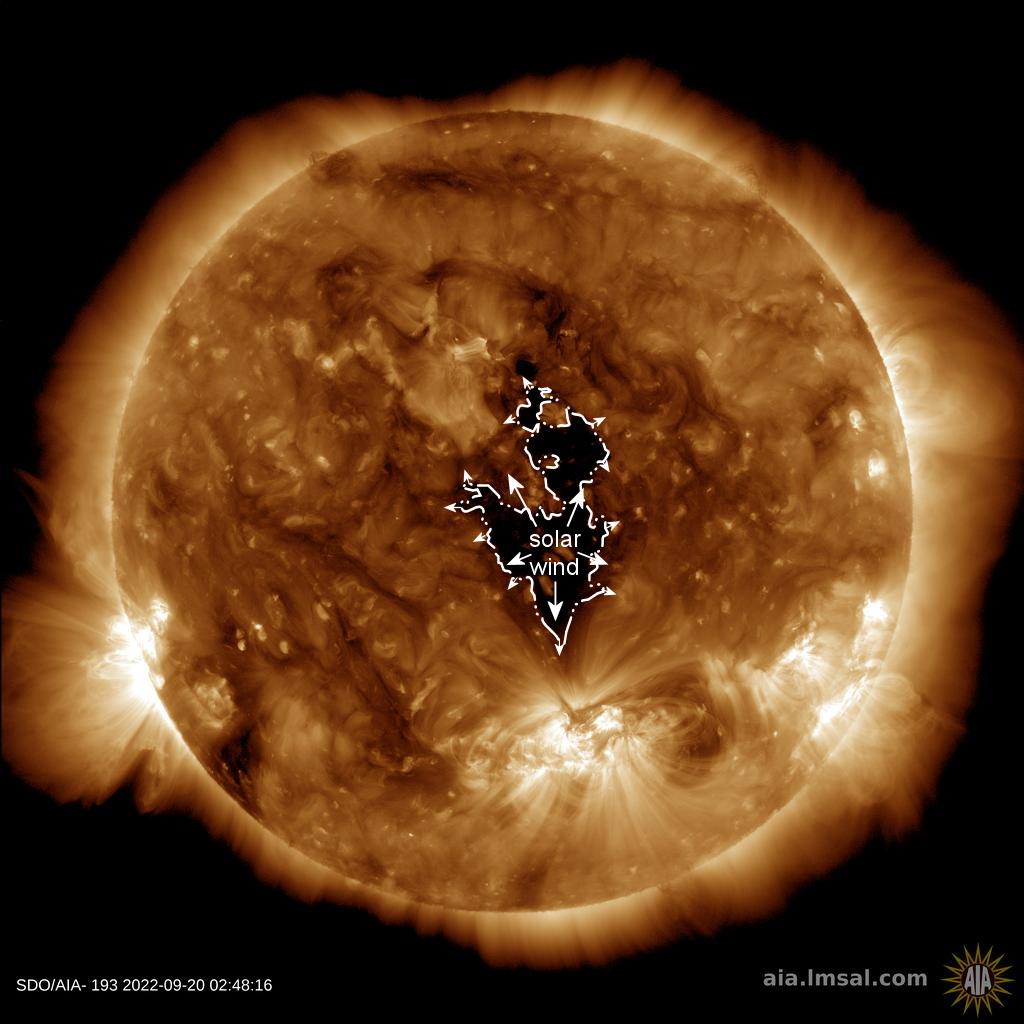
CHANCE OF MINOR STORMS: NOAA forecasters say that a minor G1-class geomagnetic storm is possible on Sept. 23rd when a high-speed stream of solar wind is expected to hit Earth's magnetic field. The gaseous material is flowing from an equatorial hole in the sun's atmosphere. High-latitude auroras are possible when the windy stream arrives. Aurora alerts: SMS Text.

CHINA'S GROWING SPACE STATION: China's Tiangong space station is in the big leagues now. In the past year alone, it has more than doubled in size, and it is starting to rival its older cousin the International Space Station (ISS). On Sept. 22nd, astrophotographer Philip Smith watched Tiangong fly over his backyard in New York. "It was bright!" he says. "I created this composite photo to show how much it has grown."
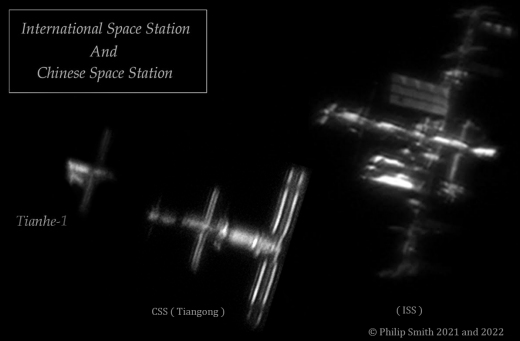
On the left is station's original core module, Tianhe-1, which Smith photographed in 2021. On the right is a recent photo of the International Space Station. Between the two is Tiangong as it appeared to Smith on Sept. 22nd.
"I scaled all of these images so they show the spacecraft as they would appear side-by-side at the same distance from my telescope," notes Smith.
With solar arrays, a robotic arm, multiple modules, and two spacecraft (Tianzhou 4 and Shenzhou 14) waiting at docking ports, Tiangong is starting to look a lot like the ISS. The ISS is still much larger, but China is catching up.

When it is completed in December 2023, Tiangong with be a Mir-class facility massing nearly 70 tons with living space for as many as 7 astronauts and even a Hubble-class telescope to view the cosmos.
Realtime Space Weather Photo Gallery
Free: Spaceweather.com Newsletter
BIG SUNSPOT ALERT: They're coming. Sunspots AR3105-3107 have rounded the sun's southeastern limb and now they are turning toward Earth. Maximilian Teodorescu photographed them today from his backyard observatory in Magurele, Romania:
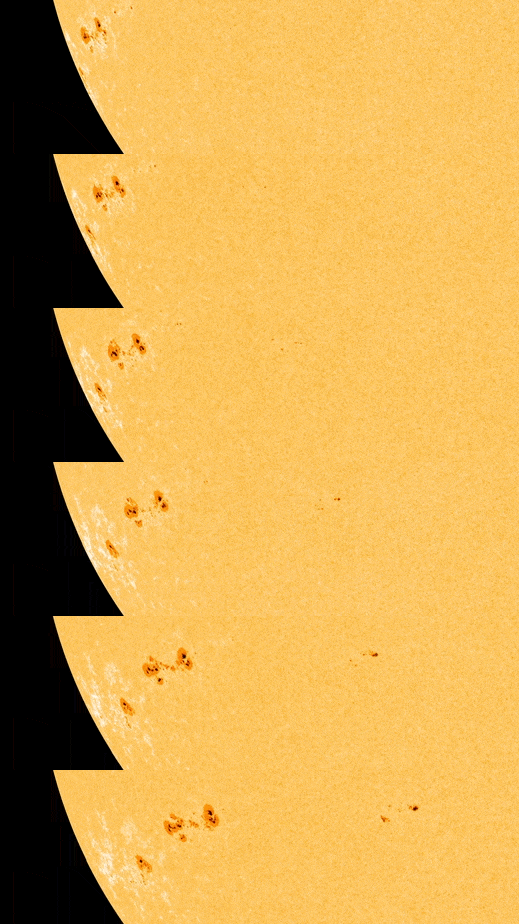
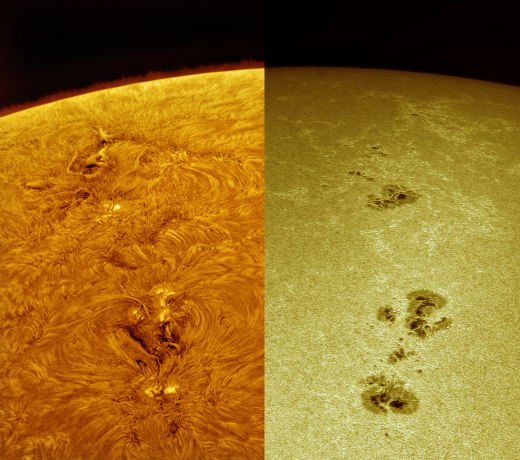
"These large sunspots are seething with activity," saysTeodorescu, "although they haven't produced any strong flares yet." Emphasis on yet. There is an increasing chance of geoeffective eruptions as they turn toward Earth this weekend.
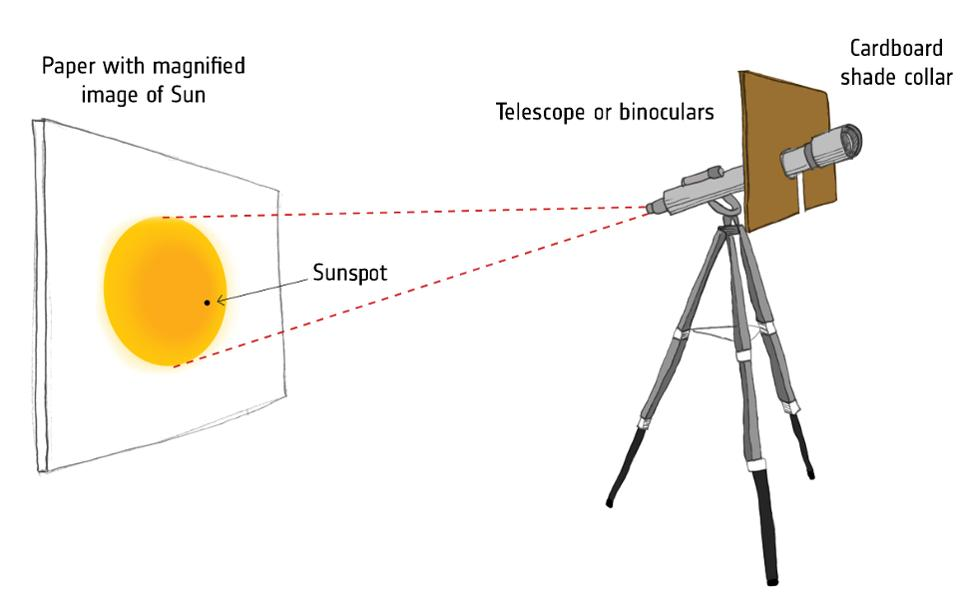
With three dark cores larger than Earth embedded in a vast field of bright magnetic froth, this sunspot complex is an easy target for backyard solar telescopes. No solar filter? No problem. Try the projection technique instead.
Realtime Space Weather Photo Gallery
Free: Spaceweather.com Newsletter
THE INFINITY PEARL: Nothing says "I love you forever" like the Infinity Pearl. Last January, the students of Earth to Sky Calculus launched this unique pendant to the stratosphere onboard a cosmic ray research balloon. For more than 2 hours it floated 101,378 feet above the Sierra Nevada mountains of central California:
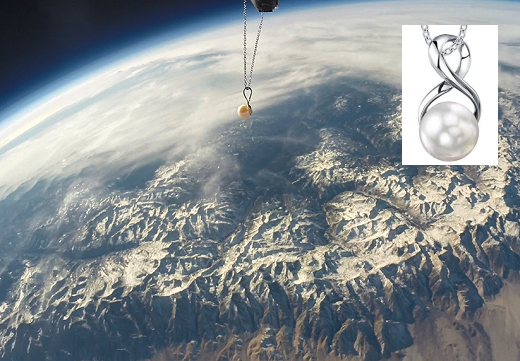
You can have it for $249.95. The students are selling space pearls to support their cosmic ray ballooning program. Measuring 9 mm in diameter, the Infinity Pearl is mounted on a sterling silver infinity twist and suspended from a matching 17 inch long sterling silver chain. It comes with a greeting card showing the pendant in flight and telling the story of its journey to the edge of space.
Far Out Gifts: Earth to Sky Store
All sales support hands-on STEM education
Realtime Aurora Photo Gallery
Free: Spaceweather.com Newsletter