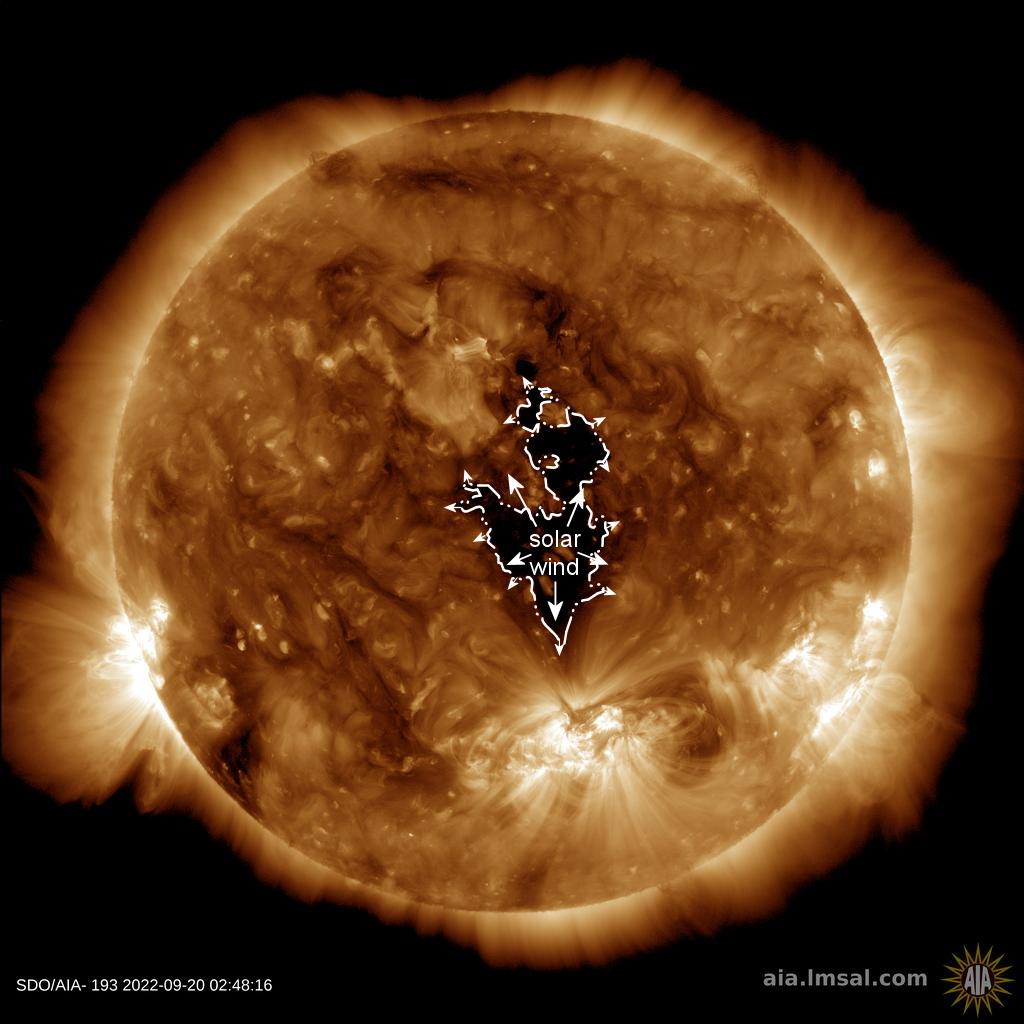
CHANCE OF STORMS TODAY: NOAA forecasters say that minor G1-class geomagnetic storms are possible later today and tomorrow, Sept. 23-24, when a high-speed stream of solar wind is expected to hit Earth's magnetic field. The gaseous material is flowing from an equatorial hole in the sun's atmosphere. Aurora alerts: SMS Text.

MAGNETIC FILAMENT ERUPTION: Today (Sept 23rd around 13:30 UT), a large filament of magnetism near the sun's southwestern limb became unstable and erupted. NASA's Solar Dynamics Observatory recorded the blast:
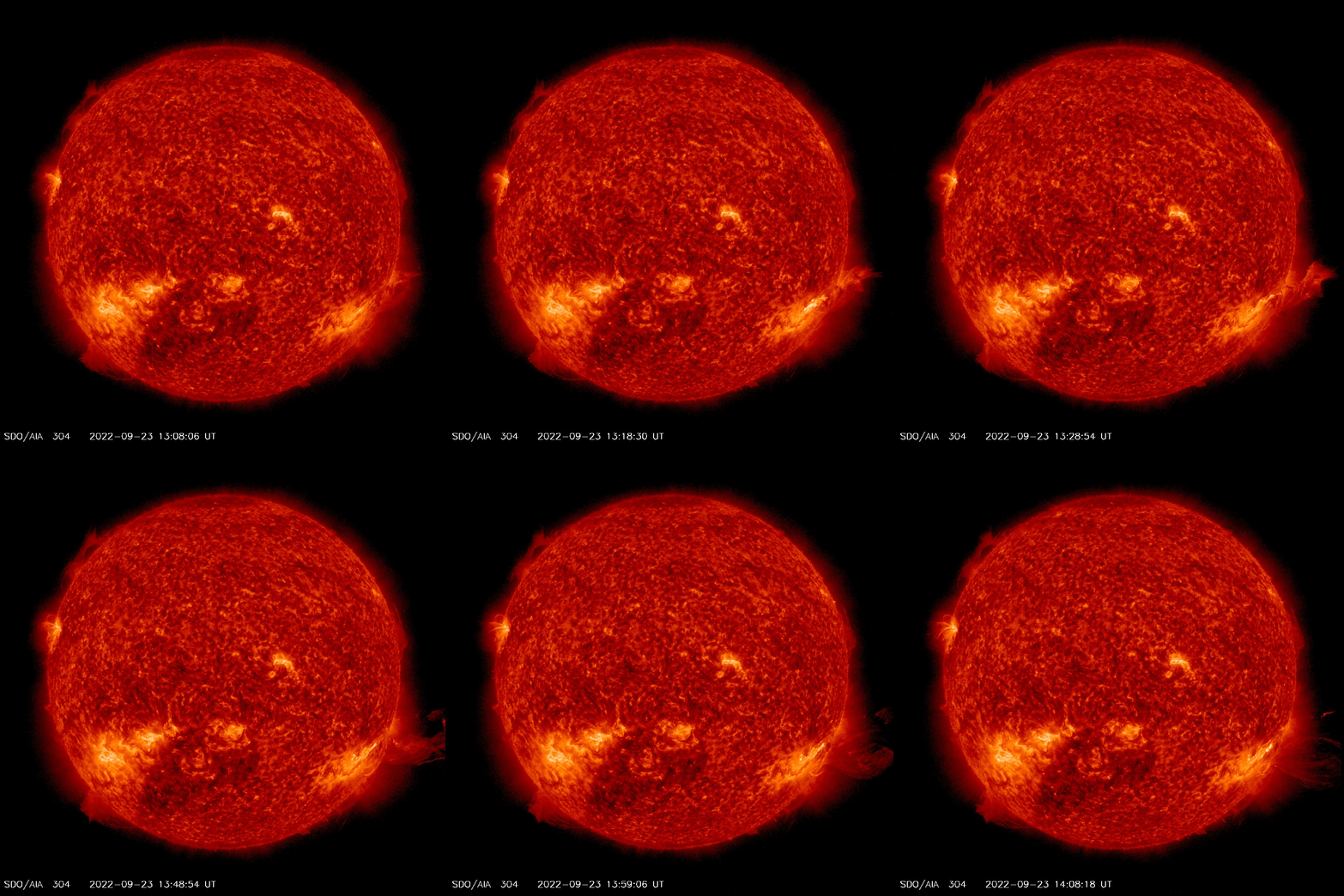
Shortly after the explosion, the US Air Force reported a Type II solar radio burst, a natural form of radio emission produced by shock waves moving through the sun's atmosphere. Characteristics of the burst suggest that a CME was being hurled into space at a speed of 820 km/s (1.8 million mph).
Will it hit Earth? Probably not. The explosion occured near the edge of the Earth strike zone. Fresh data from SOHO coronagraphs are required for confirmation. Stay tuned. Aurora alerts: SMS Text.
Realtime Space Weather Photo Gallery
Free: Spaceweather.com Newsletter
CHINA'S GROWING SPACE STATION: China's Tiangong space station is in the big leagues now. In the past year alone, it has more than doubled in size, and it is starting to rival its older cousin the International Space Station (ISS). On Sept. 22nd, astrophotographer Philip Smith watched Tiangong fly over his backyard in New York. "It was bright!" he says. "I created this composite photo to show how much it has grown."
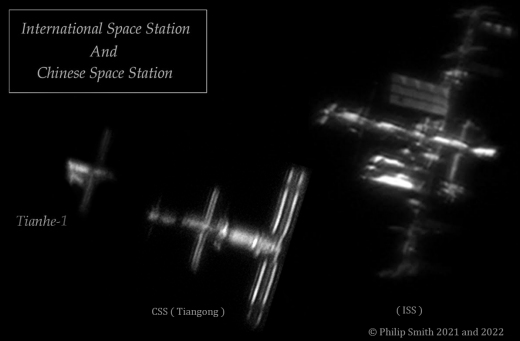
On the left is station's original core module, Tianhe-1, which Smith photographed in 2021. On the right is a recent photo of the International Space Station. Between the two is Tiangong as it appeared to Smith on Sept. 22nd.
"I scaled all of these images so they show the spacecraft as they would appear side-by-side at the same distance from my telescope," notes Smith.
With solar arrays, a robotic arm, multiple modules, and two spacecraft (Tianzhou 4 and Shenzhou 14) waiting at docking ports, Tiangong is starting to look a lot like the ISS. The ISS is still much larger, but China is catching up.

When it is completed in December 2023, Tiangong with be a Mir-class facility massing nearly 70 tons with living space for as many as 7 astronauts and even a Hubble-class telescope to view the cosmos.
Realtime Space Weather Photo Gallery
Free: Spaceweather.com Newsletter
A DRAGONFLY IN THE STRATOSPHERE: Are you looking for a far-out gift? Consider the Sterling Silver Space Dragonfly. This winged pendant has flown 113,451 feet above the Sierra Nevada mountains of California, hitching a ride onboard an Earth to Sky Calculus cosmic ray balloon:
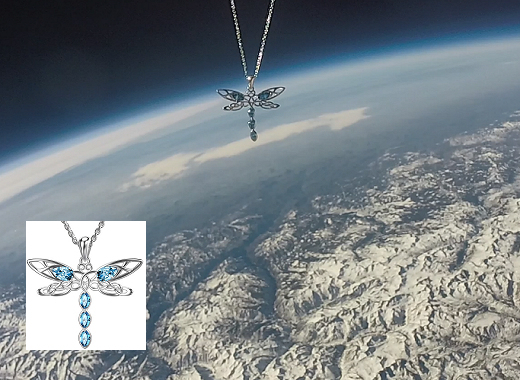
You can have it for $172.95. The dragonfly's heart is a Celtic love knot, and its wings are decorated with blue marquise crystals--all plated with 14k white gold. It's an exquisite ensemble for birthdays, anniversaries or any other romantic occasion.
The students are selling dragonfly pendants to support their cosmic ray ballooning program. Each one comes with a greeting card showing the pendant in flight and telling the story of its trip to the stratosphere and back again.
Far Out Gifts: Earth to Sky Store
All sales support hands-on STEM education
Realtime Aurora Photo Gallery
Free: Spaceweather.com Newsletter