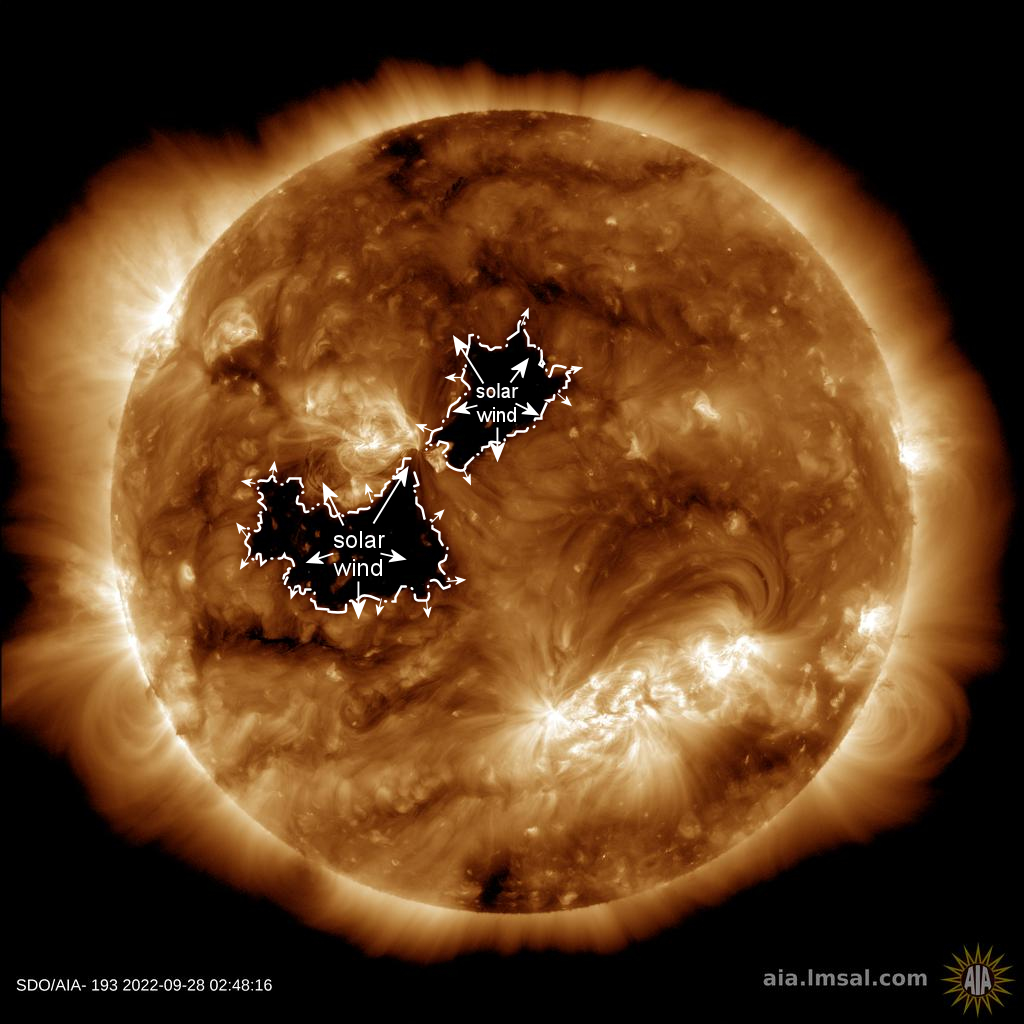
GEOMAGNETIC STORM WATCH (G2 CLASS): NOAA forecasters say that G2-class geomagnetic storms are possible on Oct. 1st in response to a double blow: (1) A solar wind stream is expected to hit Earth's magnetic field; it is flowing from an equatorial hole in the sun's atmosphere. (2) A CME will pass very close to Earth, potentially grazing our planet; it left the sun on Sept. 28th. Stay tuned! Aurora alerts: SMS Text
MID-LATITUDE AURORAS: With NOAA predicting a G2-class geomagnetic storm for Oct. 1st, it is worth reviewing what happened during the last G2-class storm. Auroras descended into the United States as far south as Missouri:
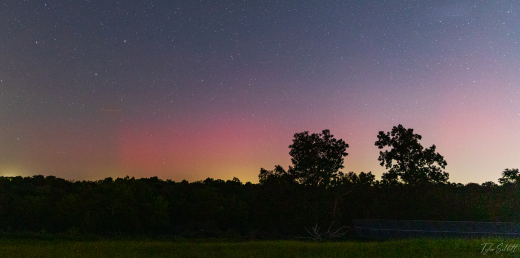
"I was out shooting deep space objects with my telescope on Sept. 27th when my little brother noticed something way up in the sky," says photographer Tyler Schlitt of Washington, MO. "It looked like Starlink satellites. So we rushed to grab the camera, which to my surprise revealed auroras here at latitude 38 degrees."
The circumstances were much the same as what NOAA is predicting for Oct. 1st: A nearby, grazing CME and some fast-moving solar wind. Although G2-class storms are merely moderate, not strong, they can produce mid-latitude auroras that are easy to catch using off-the-shelf digital cameras with night sky exposure settings.
More auroras in the USA were photographed by MaryBeth Kiczenski in Grand Portage, Minnesota; by Mark Brown in Alburnett, Iowa; from Josh Lopac in Wakefield, Michigan; by Matthew Merrell in central Minnesota;
Realtime Aurora Photo Gallery
Free: Spaceweather.com Newsletter
HUBBLE IMAGES OF ASTEROID IMPACT: When NASA's DART spacecraft slammed into asteroid Dimorphos on Sept. 26th, almost every telescope in the Solar System was watching. Here is what Hubble saw:

In these visible-light images, the asteroid tripled in brightness after DART struck. The glow remained steady for more than eight hours after impact. Some of the rays of ejecta appear to be curved, but astronomers need to take a closer look to confirm that the curvature is real and, if so, what it could mean.
Hubble plans to monitor the Didymos-Dimorphos binary system 10 more times over the next three weeks. These regular, relatively long-term observations as the ejecta cloud expands and fades will paint a more complete picture of DART's aftermath.
Oh, Webb saw it too.
Realtime Space Weather Photo Gallery
Free: Spaceweather.com Newsletter
STERLING SILVER HUMMINGBIRD PENDANT: This hummingbird has touched space. On Sept. 22, 2022, the students of Earth to Sky Calculus launched the sterling silver pendant to the stratosphere onboard a cosmic ray research balloon, more than 117,710 feet high:
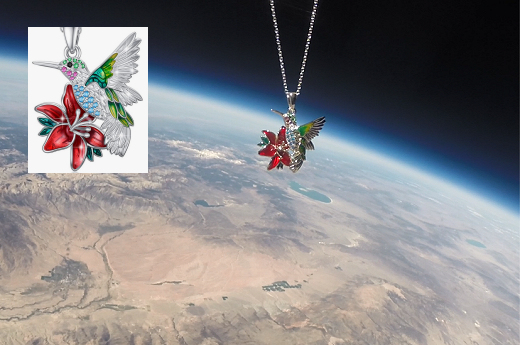
You can have it for $149.95. The students are selling hummingbird pendants to pay the helium bill for their cosmic ray ballooning program. Each one comes with a greeting card showing the bird and red lily in flight, and telling the story of their trip to the stratosphere and back again.
Far Out Gifts: Earth to Sky Store
All sales support hands-on STEM education
JUNO JUST BUZZED EUROPA: NASA's Juno spacecraft just made the closest flyby of Jupiter's moon Europa in more than 20 years. On Thursday, Sept. 29th, at 5:36 a.m. EDT, Juno came within 222 miles of Europa's icy surface, taking pictures with a resolution of only 0.6 miles per pixel. Juno couldn't actually see life in Europa's oceans, but the flyby could help NASA decide where future missions should look.

Above: An example of chaos terrain on Europa, photographed by NASA's Galileo spacecraft in the late 1990s.
Europa is one of the most interesting places in the solar system. Since Voyager 2 flew past the moon in 1979, evidence has mounted that Europa's icy surface overlies an enormous saltwater ocean--twice the volume of Earth's oceans combined. In 1989, NASA dispatched the Galileo spacecraft to investigate. Galileo buzzed Europa repeatedly, seeing "chaos terrain" where rafts of ice had seemingly broken free and re-frozen. Researchers suspected that water from beneath the surface must be breaking through from time to time. Indeed, in 2012 the Hubble Space Telescope found evidence (later confirmed by Keck) that Europa may be venting plumes of water vapor into space. Such plumes could lead back to a habitat for life.
During the flyby "Juno imaged an area of chaos terrain called 'Annwn Regio,'" says Candice Hansen, lead scientist for JunoCam at the Planetary Science Institute. "We will be on the lookout for anything different [since Galileo visited in the 90s] because such a find would be very exciting!"
Juno's instruments can sense plumes of water vapor if the spacecraft is lucky enough to fly through one. "We would have to be at the right place at just the right time, but if we are so fortunate, it’s a home run for sure," says Scott Bolton, Juno's Principal Investigator at the Southwest Research Institute.
Depending on the availability of the Deep Space Network, first images from the flyby could be available before the weekend. Stay tuned!
Raw Images from JunoCam
See the flyby photos as they arrive!
Realtime Aurora Photo Gallery
Free: Spaceweather.com Newsletter