POSSIBLE CANNIBAL CME EVENT: According to NOAA forecasters, multiple CMEs are heading for Earth. ETA: Oct. 4th. This could be a "Cannibal CME" event. Cannibal CMEs form when a fast-moving CME devours one or more slower CMEs ahead of it. The combined cloud contains tangled magnetic fields that can do a good job sparking auroras. Storm levels could reach category G2 if/when the Cannibal arrives. Aurora alerts: SMS Text

PINK PULSATING AURORAS--A "GLITCH IN THE MATRIX": Pink auroras are rare. Pulsating auroras are rare, too. Last night in Abisko, Sweden, sky watchers witnessed both rarities at the same time. Hit PLAY to make the sky pulse:
"One of our tour guides, Miquel Such, photographed the display and created this time lapse," says Chad Blakley, the owner of Lights over Lapland. "All of our guides were talking about it the next morning. One of them described it as 'a glitch in the Matrix.'"
Blakley has seen pulsating auroras before: "The best way to describe it is to imagine the sky as a large checker board," he says. "As the pulsating begins, black squares on the board would illuminate as a green aurora. Then, in an instant, all the black squares lose their illumination and the red squares on the imaginary checkerboard immediately glow green."
In this case, however, the green was pink. Pink auroras appear when solar wind particles penetrate unusually deep in Earth's atmosphere, striking nitrogen molecules less than 100 km above our planet's surface. A crack in Earth's magnetic field on Oct. 3rd let the particles reach that level.
Pulsating auroras are so mysterious, NASA keeps launching rockets into them to learn what makes them tick. In 2018, researchers led by S. Kasahara of the University of Tokyo conclusively linked pulsating auroras to "chorus waves" in Earth's magnetosphere. Their findings explain everything -- except the shape of the 'squares' and why they blink so quickly. Keep launching rockets, NASA.
Realtime Aurora Photo Gallery
Free: Spaceweather.com Newsletter
RARE MR. SPOCK ORNAMENT: It's the logical way to decorate your Christmas tree--with a rare Mr. Spock ornament. This one has been to the edge of space. On Sept. 22, 2022, the students of Earth to Sky Calculus launched Spock to the stratosphere on board a cosmic ray research balloon:
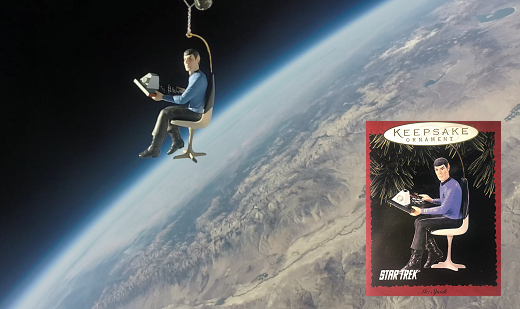
You can have it for $129.95. The students are selling Spock ornaments to pay the helium bill for their cosmic ray ballooning program. Made by Hallmark in the 1990s, the ornament comes with a greeting card showing the science officer in flight and telling the story of its trip to the stratosphere and back again.
Far Out Gifts: Earth to Sky Store
All sales support hands-on STEM education
Realtime Space Weather Photo Gallery
Free: Spaceweather.com Newsletter