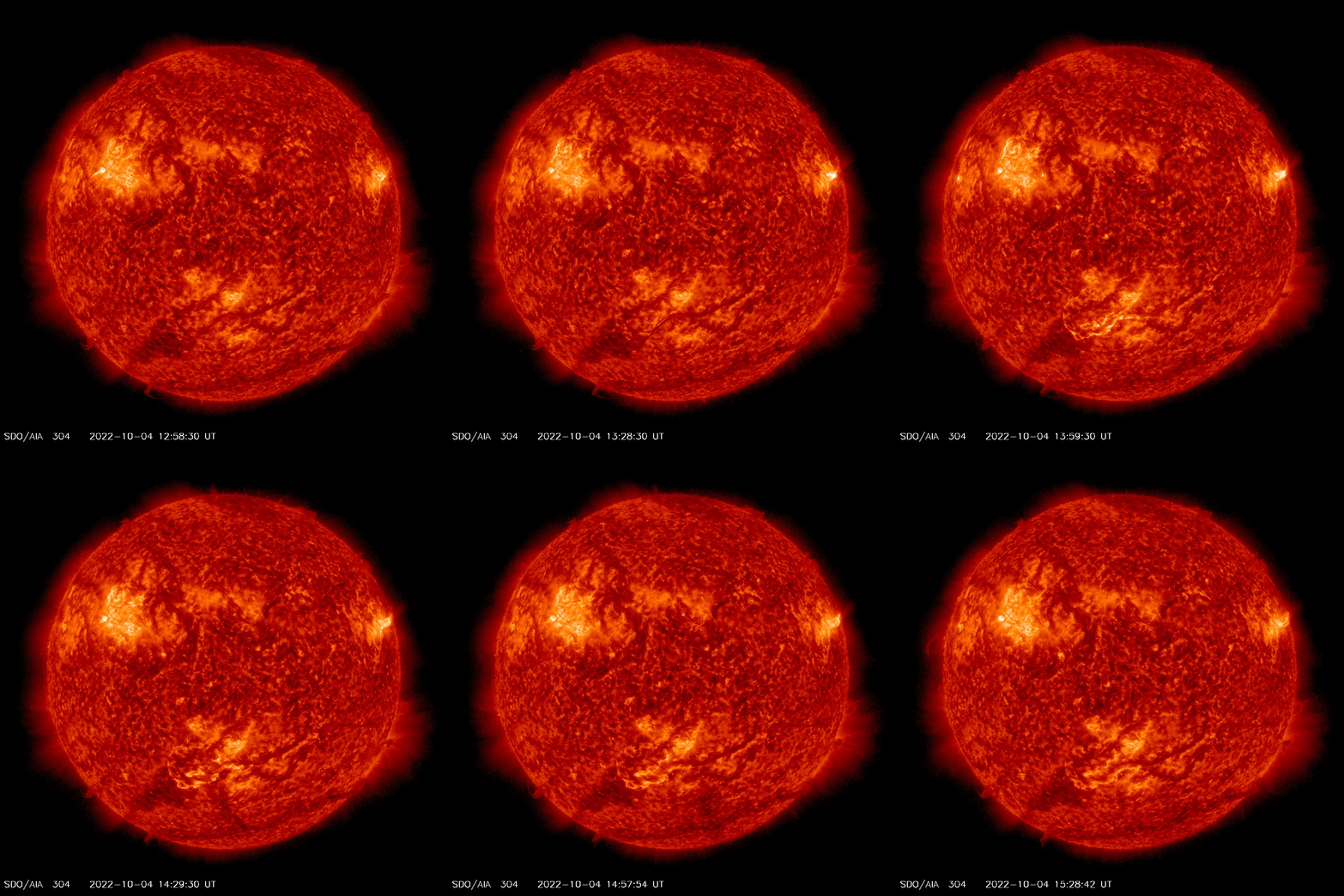
THIS FORECAST MIGHT BE WRONG: A CME is heading for Earth and it could graze our planet's magnetic field on Oct. 7th or 8th. The storm cloud was hurled into space on Oct. 4th by an erupting filament of magnetism in the sun's southern hemisphere. Gaps in coronagraph data and possible confusion with other nearby-in-time CMEs make it hard to know for sure where this CME is heading. If a glancing blow does occur, it could spark a G1-class geomagnetic storm. Aurora alerts: SMS Text
IS SOMETHING OOZING OUT OF EUROPA? NASA has just released a new image from Juno's Sept. 29th flyby of Europa, and it looks like something is oozing out of Jupiter's ocean moon:
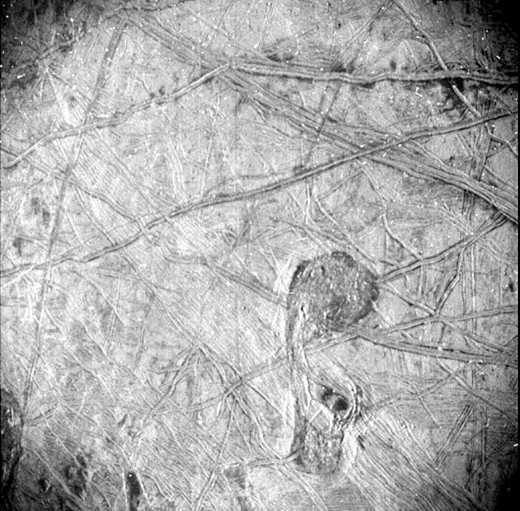
This image covers 150 km by 200 km of Europa’s surface, revealing a region crisscrossed with a network of fine grooves and double ridges. Researchers think that dark stains in this terrain may linked to something erupting onto the surface from below. Of particular interest is the feature that looks a bit like a musical quarter note.
Since Voyager 2 flew past the moon in 1979, evidence has mounted that Europa's icy crust overlies an enormous saltwater ocean--twice the volume of Earth's ocean's combined. Because of the ocean's chemistry and tidal heating, astrobiologists consider it to be one of the best places in the Solar System to look for extraterrestial life. Whatever's down there may be percolating to the top.
Remarkably, Juno took the picture at night. Illumination in the photo comes from "Jupitershine" (sunlight reflected from Jupiter's cloudtops). Juno’s Stellar Reference Unit (SRU) – a star camera used to orient the spacecraft – is specifically designed for such low-light conditions, so mission controllers commanded it to take the shot. The resulting image is as clear as day, with a resolution that ranges from 256 to 340 meters per pixel.
Realtime Space Weather Photo Gallery
Free: Spaceweather.com Newsletter
SUNSPOT SUNSET: You know a sunspot is big when you can see it in the sunset. At the end of the day on Oct. 5th, Radu Anghel photographed AR3112 from Bacau, Romania:
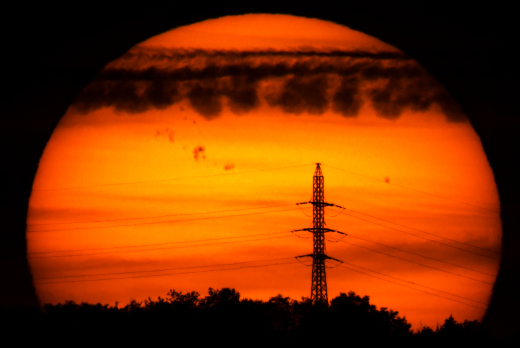
"What a wonderful view," says Anghel. "Clouds crossing the solar disk made it look like a big Jupiter with sunspots! :)"
AR3112 is one of the biggest sunspots in years. With more than a dozen dark cores scattered across 300,000 km of solar terrain, it is an easy target for safely-filtered backyard telescopes and cameras. When the sun is dimmed by low clouds and haze, it may even be photographed without a filter. Be careful, though. Sunlight viewed through unfiltered optics can damage your eyes--even at the end of the day.
Realtime Space Weather Photo Gallery
Free: Spaceweather.com Newsletter
RARE MR. SPOCK ORNAMENT: It's the logical way to decorate your Christmas tree--with a rare Mr. Spock ornament. This one has been to the edge of space. On Sept. 22, 2022, the students of Earth to Sky Calculus launched Spock to the stratosphere on board a cosmic ray research balloon:
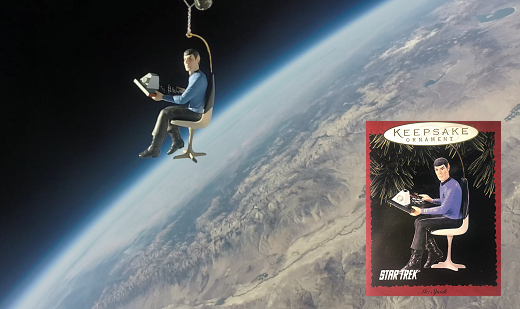
You can have it for $129.95. The students are selling Spock ornaments to pay the helium bill for their cosmic ray ballooning program. Made by Hallmark in the 1990s, the ornament comes with a greeting card showing the science officer in flight and telling the story of its trip to the stratosphere and back again.
Far Out Gifts: Earth to Sky Store
All sales support hands-on STEM education
Realtime Aurora Photo Gallery
Free: Spaceweather.com Newsletter