POSSIBLE CLOSE ENCOUNTER WITH A CME: NOAA forecasters say that a slow-moving CME might pass close to Earth today (Oct. 12th). It left the sun five days ago. The near miss could shove solar wind plasma onto Earth's magnetic field, sparking auroras around the Arctic Circle. Aurora alerts: SMS Text
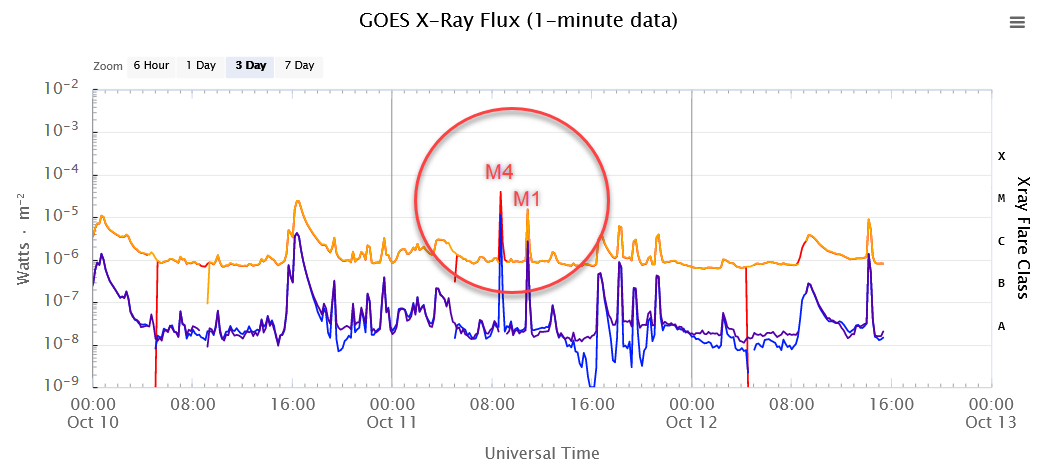
DARK JETS FROM THE SUN: Yesterday, two jets of dark plasma shot out of sunspot AR3116. NASA's Solar Dynamics Observtory recorded the M-class eruptions:

The jets are dark because they are relatively cool--emphasis on "relatively." The temperature was only a little less 50,000 degrees K. It is the sun, after all. Often such eruptions produce coronal mass ejections (CMEs), but not this time. SOHO coronagraphs show no CMEs emerging from the blast site. Aurora alerts: SMS Text
Realtime Aurora Photo Gallery
Free: Spaceweather.com Newsletter
THE DEEP IMPACT OF DART: For the first time ever, human tech has altered the orbit of a planetary body. In a media briefing yesterday, NASA reported that DART's plunge into Dimorphos changed the orbital period of the asteroid moon by a whopping 32 minutes. NASA would have declared the mission a success with only a 73 second change, so this is a huge acomplishment. One of the revelations at the briefing was this new image from the Hubble Space Telescope:

It shows a long comet-like tail of debris behind the battered asteroid. The tail is made of fine dust blasted into space by DART's impact. The dust is so fine that individual dust grains can be pushed away from the asteroid by the gossamer pressure of sunlight. This is how comet tails are formed, too.
The Hubble image reveals for the first time that the tail of Dimorphos is splitting in two. Researchers don't yet know why.
In another surprise, NASA announced that recoil of ejecta from the asteroid's surface contributed significantly to the asteroid's orbit change. Previously, mission planners expected the mass of DART alone to play a role.

Above: This image from Italy's LICIACube spacecraft shows plumes of ejecta streaming from Dimorphos immediately after the impact on Sept. 26th.
Dimorphos is only 170 meters across, but its tail stretches 10,000 kilometers into space. These dimensions mean the tail can be seen by large amateur telescopes on Earth. Backyard astronomers can potentially monitor changes such as the continued splitting of the tail and interactions with the solar wind. Right now, Dimorphos is located south of the celestial equator, but it is moving north and will be within range of northern-hemisphere telescopes later this month.
More images: NASA DART Imagery Shows Changed Orbit of Target Asteroid
Realtime Space Weather Photo Gallery
Free: Spaceweather.com Newsletter
ROSE QUARTZ HEART PENDANT: Take a heart shaped piece of rose quartz; wrap it in a sterling silver sunflower filigree; then launch it to space. That's how you make an Earth to Sky Rose Quartz Heart Pendant. Here's one flying 107,400 feet above Earth on Aug. 26th:
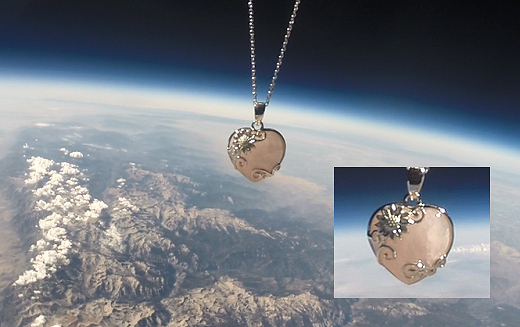
You can have it for $169.95. The students of Earth to Sky Calculus are selling space pendants to support their cosmic ray ballooning program. Each comes with a greeting card showing the pendant in flight and telling the story of its trip to the edge of space. All sales support STEM science.
Far Out Gifts: Earth to Sky Store
All sales support hands-on STEM education
Realtime Aurora Photo Gallery
Free: Spaceweather.com Newsletter