CHANCE OF FLARES TODAY: Departing sunspot AR3112 poses a continued threat for solar flares. NOAA forecasters estimate a 45% chance of M-class flares and a 10% chance of X-flares on Oct. 13th. Solar flare alerts: SMS Text
TRITON PASSES IN FRONT A STAR: Neptune's moon Triton is a mystery. The only spacecraft to ever visit it was NASA's Voyager 2 in 1989. The brief flyby revealed a world bigger than Pluto with cryogenic volcanoes spewing plumes of vaporizing liquid nitrogen into space. Almost 2/3rds of Triton has never been photographed.
Last week Triton did something rare. "It passed in front of a star," says amateur astronomer Filipp Romanov, who photographed the occultation with Yiming Mao, Renhao Ye, Qianyi Zou, Yongkang Sun, Yueyue Shen and Jingyuan Zhao from the Yanqi Lake Observatory in Beijing, China:

The brightest object in their video is Neptune. The lesser light is a merger of Triton and the 12th magnitude star TYC 5254-00839-1. They dim when Triton blocks the star.
"This was a rare opportunity to study Triton's atmosphere from Earth," explains Romanov. "The light curve shows that the beginning and end of the occultation occur gradually due to Triton's atmosphere."
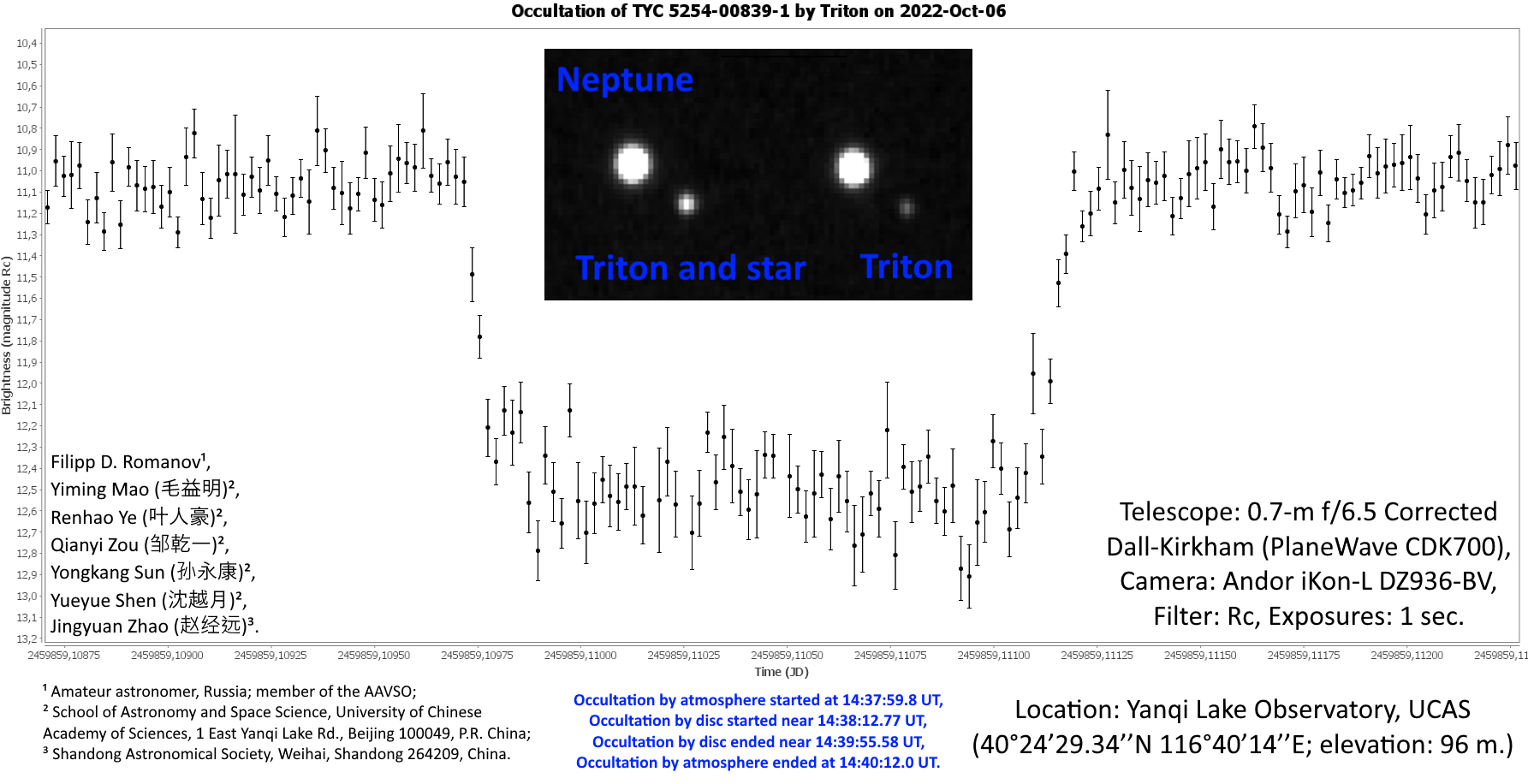
Triton's thin atmosphere is composed mainly of nitrogen with small amounts of methane. It originates almost entirely from volcanic activity. Stellar occultations, which happen every 5 to 10 years, are one of the only ways astronomers have of monitoring Triton's atmosphere and volcanic outgassing.
Triton, Io and Venus are the only bodies in the solar system besides Earth that are known to be volcanically active at the present time. One volcanic feature on Triton, Leviathan Patera, is a caldera roughly 100 km in diameter surrounded by a volcanic dome 2,000 km wide. These dimensions make Leviathan the second largest volcano in the solar system by area, after extinct Alba Mons on Mars.
Realtime Space Weather Photo Gallery
Free: Spaceweather.com Newsletter
STORM TROOPER WHISKEY DECANTER: It's the perfect gift for a Star Wars fan--a Storm Trooper Whiskey Decanter from the edge of space. On Oct. 10th, it hitched a ride onboard a cosmic ray research balloon floating 106,066 feet above the Sierra Nevada mountains of central California:
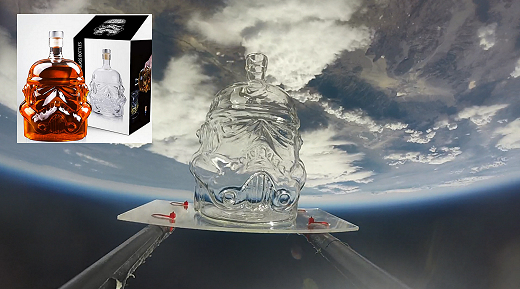
You can have it for $166.95. The 750 ml decanter comes with a greeting card showing the item in flight, and telling the story of its journey to the stratosphere and back again. All purchases from the Earth to Sky Store help pay the helium bill for our student ballooning program.
Far Out Gifts: Earth to Sky Store
All sales support hands-on STEM education
Realtime Aurora Photo Gallery
Free: Spaceweather.com Newsletter