RING OF FIRE SOLAR ECLIPSE: Mark your calendars. One year from today, Oct. 14, 2023, the Moon will pass in front of the sun, producing a 'ring of fire' annular eclipse over the USA. Maps, time tables, and eclipse glasses are available from GreatAmericanEclipse.com.
LUCY'S SUPER-CLOSE FLYBY OF EARTH: Most spacecraft try to avoid hitting the atmosphere. Lucy is about to do it on purpose. On Oct. 16th, NASA's Lucy spacecraft will skim Earth's atmosphere, passing only 220 miles (350 kilometers) above our planet's surface. Near closest approach over Australia it will be visible to the naked eye glowing almost as brightly as a 1st magnitude star.

This is a gravity assist maneuver--the first of three required for Lucy's complicated mission to visit 8 different asteroids. The slingshot will give Lucy the energy it needs to fly towards the asteroid belt and, its ultimate destination, the orbit of Jupiter.
Named for a hominid fossil found in 1974 in Africa, Lucy is on a mission to study a completely different kind of relic: the Trojan asteroids. These are primitive leftovers from the formation of our solar system, collected into swarms around two of Jupiter's Lagrange points. Sensors onboard the spacecraft will examine their appearance and composition, putting competing theories of planetary genesis to the test.
To reach the Trojans, Lucy must first return to Earth. Launched on Oct. 16, 2021, the spacecraft is coming home after exactly one year in space. Lucy's trajectory will bring it deep into near Earth orbit, passing through a region full of Earth-orbiting satellites and debris. NASA will be ready to make last-minute adjustments to avoid collisions. The altitude is so low, the mission team had to include the effect of atmospheric drag when designing the flyby. Passing so close allows Lucy to extract maximum energy from Earth's gravitational field.
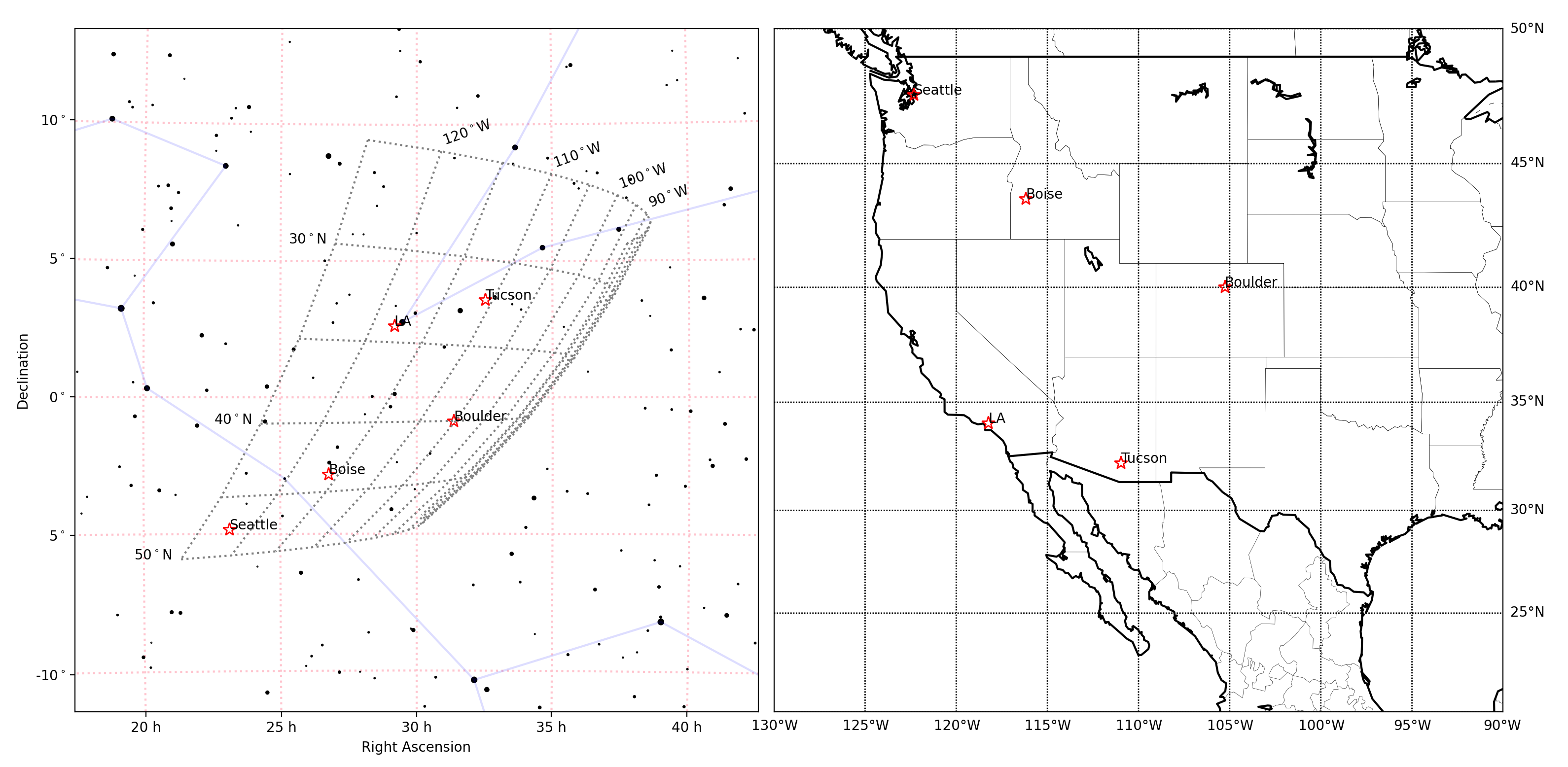
On the left, the location in the sky where Lucy will first appear when it emerges from the Earth's shadow for the Western United States. Red stars correspond to cities on the right.
Observers in western Australia will be the first to see Lucy. At around 10:55 UTC (6:55 p.m. local time) on Oct. 16th, the spacecraft will race overhead shining like a 1st or 2nd magnitude star. At the apex of its brightness, it will suddenly disappear into Earth's shadow, vanishing at 11:02 UTC (7:02 p.m. local time).
Lucy will continue over the Pacific Ocean in darkness and emerge from the Earth's shadow at 4:26 a.m. PDT (11:26 UTC). By that time it will have dimmed to 6th or 7th magnitude. Amateur astronomers in the western United States should be able to see Lucy using binoculars or a small telescope.
After the gravity assist, Lucy will recede from Earth, passing by the Moon and taking a few pictures before continuing out into interplanetary space. It might remain bright enough to see using backyard telescopes for more than 24 hours.
Want to see Lucy? You can spot the spacecraft using observing tips from the Southwest Research Institute. Ephemerides from JPL are recommended, too.
Realtime Space Weather Photo Gallery
Free: Spaceweather.com Newsletter
IMPERIAL STORM TROOPER WHISKEY DECANTER: It's the perfect gift for a Star Wars fan--a Storm Trooper Whiskey Decanter from the edge of space. On Oct. 10th, it hitched a ride onboard a cosmic ray research balloon floating 106,066 feet above the Sierra Nevada mountains of central California:
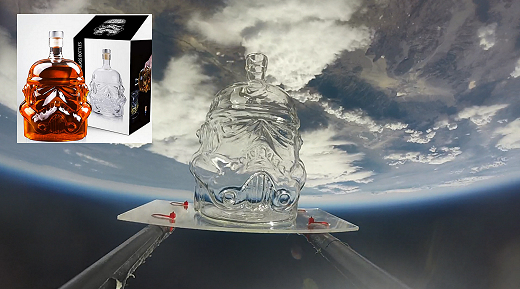
You can have it for $166.95. The 750 ml decanter comes with a greeting card showing the item in flight, and telling the story of its journey to the stratosphere and back again. All purchases from the Earth to Sky Store help pay the helium bill for our student ballooning program.
Far Out Gifts: Earth to Sky Store
All sales support hands-on STEM education
Realtime Aurora Photo Gallery
Free: Spaceweather.com Newsletter