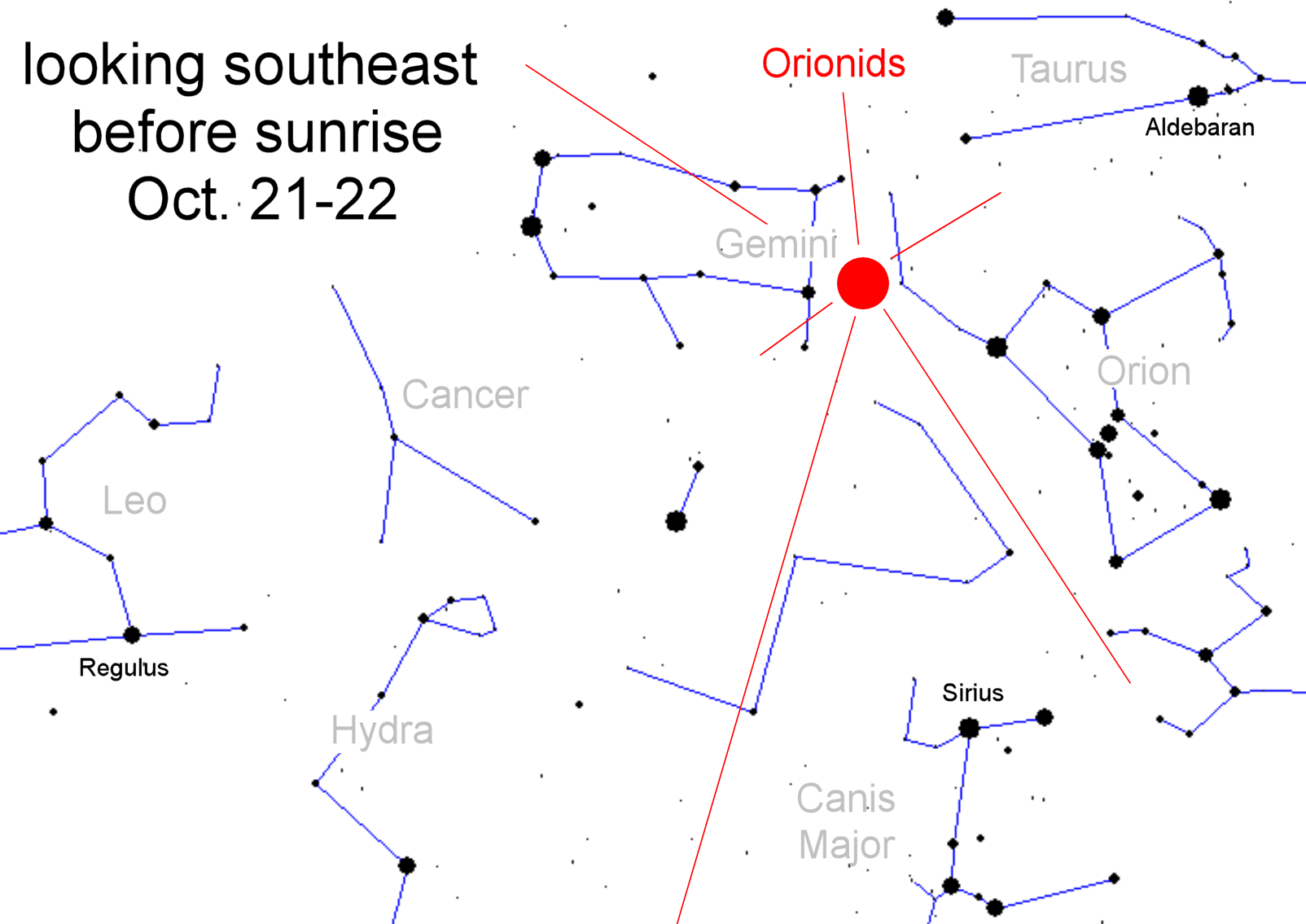
ORIONID METEOR SHOWER: Earth is entering a stream of debris from Halley's Comet, source of the annual Orionid meteor shower. Forecasters expect the shower to peak on Oct. 21st with as many as 20 meteors/hr. Orionids strike Earth's atmosphere traveling 148,000 mph. At that speed, they often leave glowing "trains" (incandescent bits of debris) that linger for minutes, swirling among the glittering stars of Orion, Gemini, and Taurus. The best time to look is between 1:00 am and sunrise. More: sky map, photo gallery, observing tips.
VENUS AND THE POLAR STREAMER: Venus is passing by the sun this week as it heads for superior solar conjunction on Oct. 22nd. Today it is less than an arcminute away from a bright polar streamer:
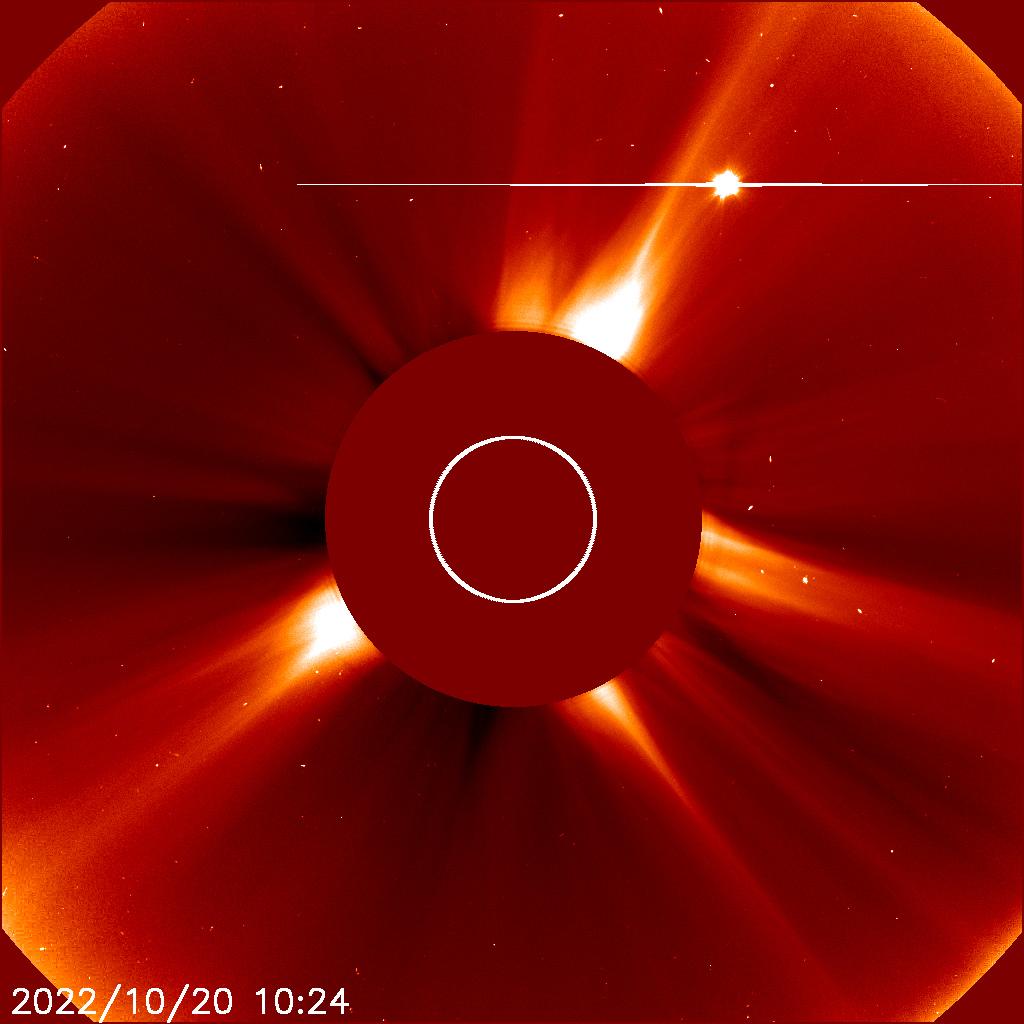
This coronagraph image comes from the Solar and Heliospheric Observatory (SOHO)
Streamers are magnetic loops emerging from the surface of the sun. The solar wind stretches them into long narrow structures with pointy tips. There are four streamers in today's coronagraph image. Streamer #1, pointing almost directly toward Venus, has roots near the sun's north pole.
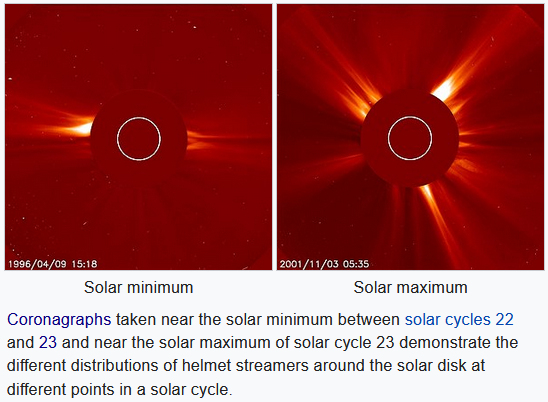
This image tells us something interesting about the solar cycle. During Solar Minimum, streamers emerge primarily from the sun's equator, giving the sun a Saturn-like appearance. At Solar Maximum, however, streamers can pop up anywhere, turning the solar disk into a porcupine of plasma quills. Today's sun looks more like a porcupine, signalling that Solar Max is on its way. Solar flare alerts: SMS Text
Realtime Space Weather Photo Gallery
Free: Spaceweather.com Newsletter
A SUDDEN CHANGE IN CHINA'S SPACE STATION: China's new space station, Tiangong, is only a year and a half old, yet astrophotographer Philip Smith has seen it many times flying over his backyard in Manorville, New York. On Oct. 15th he looked at it again--and something was not right. "The space station was in a new configuration," he says. "Suddenly, it looks like a letter 'L'."
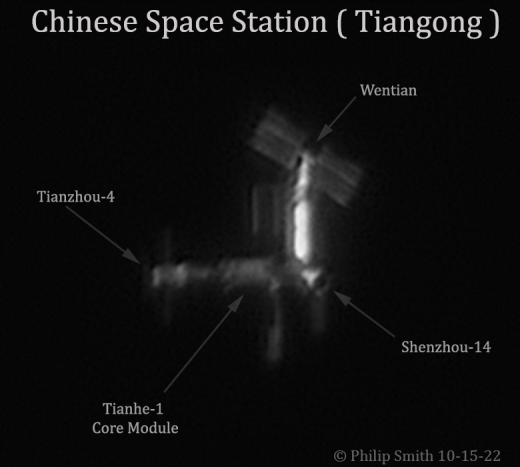
What happened? The Wentian science laboratory was recently moved to the side port of the space station's core module. The space station is now in an L shape as a result. The move makes room for another module, Mengtian, which is scheduled to be launched around the end of this year.
Smith has created a composite of recent observations showing how the shape of Tiangong has changed. With solar arrays, a robotic arm, multiple modules, and two spacecraft (Tianzhou 4 and Shenzhou 14) waiting at docking ports, Tiangong is starting to resemble the ISS. The ISS is still much larger, but China is catching up.

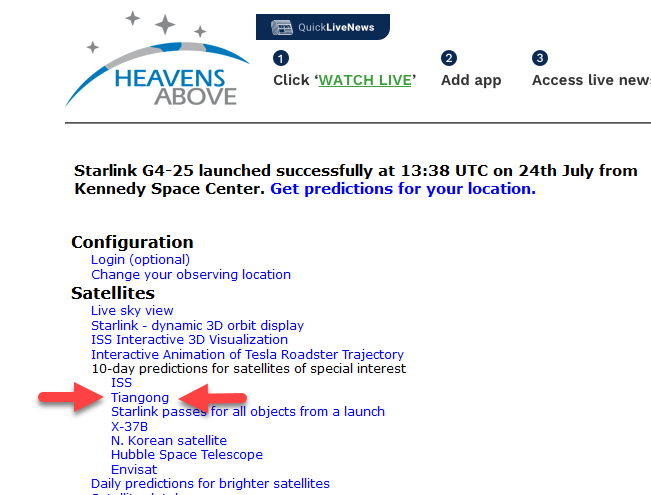
When it is completed in December 2023, Tiangong with be a Mir-class facility massing nearly 70 tons with living space for as many as 7 astronauts and even a Hubble-class telescope to view the cosmos. The growing space station is now about as bright as a 1st magnitude star when it flies overhead in the night sky.To see it, visit Heavens Above and select Tiangong for local flyby predictions.
Realtime Space Weather Photo Gallery
Free: Spaceweather.com Newsletter
VOYAGER GOLDEN RECORD ORNAMENT: This is a must-have Christmas ornament for space fans: The Voyager Golden Record. On Oct. 15th, the students of Earth to Sky Calculus launched it to the stratosphere onboard a cosmic ray research balloon:
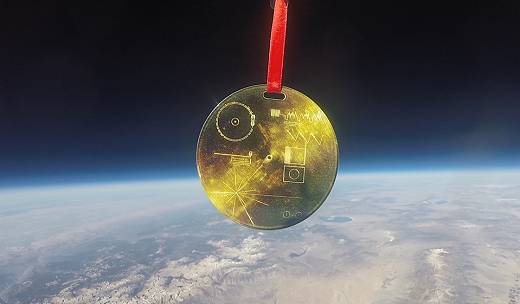
You can have it for $129.95. The 4-inch aluminum disk is imprinted with instructions intended for extraterrestrials, telling them how to play the phonographs now sailing through interstellar space onboard NASA's Voyager probes. Having touched the edge of space, it's the closest thing on Earth to an actual Golden Record.
The students are selling these unique ornaments to support their cosmic ray ballooning program. Each one comes with a greeting card showing the ornament in flight and extra materials decoding the markings on the disk.
Far Out Gifts: Earth to Sky Store
All sales support hands-on STEM education
Realtime Aurora Photo Gallery
Free: Spaceweather.com Newsletter