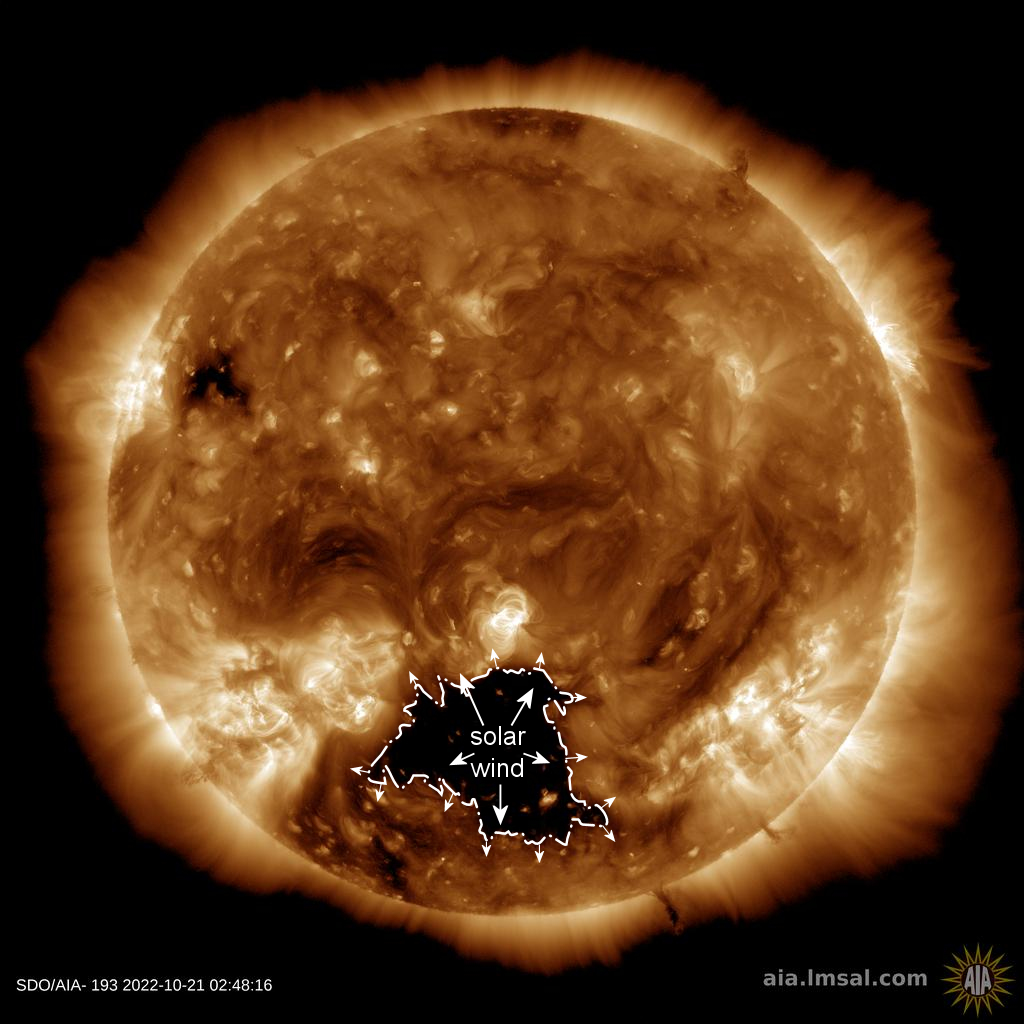
INCOMING SOLAR WIND STREAM: Minor G1-class geomagnetic storms are possible on Oct. 24th when a fast moving stream of solar wind is expected to hit Earth's magnetic field. The gaseous material is flowing from a southern hole in the sun's atmosphere. High-latitude sky watchers should be alert for auroras early next week. Aurora alerts: SMS Text

THE ASTEROID THAT WASN'T AN ASTEROID: Last week on Oct. 16th, NASA's Lucy spacecraft made an atmosphere-skimming flyby of our planet. It didn't come alone. Hours before Lucy arrived, another object buzzed Earth only a few hundred km above our planet's surface. Astronomers thought it was an asteroid and named it 2022 UQ1.

Flyby trajectories of Lucy and 2022 UQ1. Credit: Tom Ruen [more]
On second thought, it wasn't an asteroid at all. Amateur astronomer Bill Gray and NASA engineer Davide Farnocchia took a closer look at 2022 UQ1's orbit and realized it matched Lucy's old Centaur booster rocket. They've been traveling through space in tandem since Lucy launched a year ago. The Minor Planet Center at Harvard University quickly retracted the asteroid designation.
Although Lucy and the Centaur flew past Earth at similar distances, the flybys were on opposite sides of the planet, so their orbits were bent in different directions. Lucy gained momentum and hurtled out toward Jupiter. (Lucy is on a mission to study Jupiter's Trojan asteroids.) The Centaur, on the other hand, turned toward the inner solar system for a perihelion between Mercury and Venus. It will be near Earth again on Nov. 8, 2024. Stay tuned for space junk.
Realtime Space Weather Photo Gallery
Free: Spaceweather.com Newsletter
VENUS AND THE STREAMERS: Venus is passing by the sun this week as it heads for superior solar conjunction on Oct. 22nd. Today it is arcseconds away from a bright polar streamer:

This coronagraph image comes from the Solar and Heliospheric Observatory (SOHO)
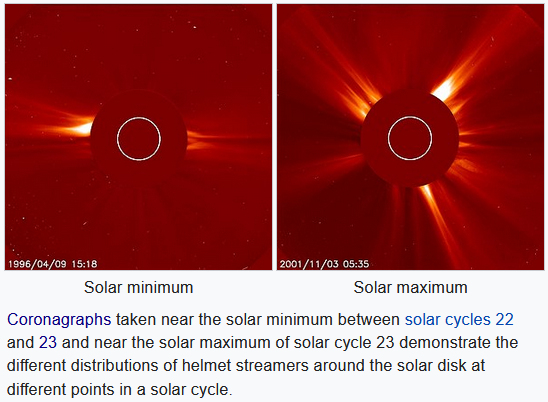
Streamers are magnetic loops emerging from the surface of the sun. The solar wind stretches them into long narrow structures with pointy tips. There are five streamers in today's coronagraph image. Streamer #1, pointing almost directly toward Venus, has roots near the sun's north pole.
This image tells us something interesting about the solar cycle. During Solar Minimum, streamers emerge primarily from the sun's equator, giving the sun a Saturn-like appearance. At Solar Maximum, however, streamers can pop up anywhere, turning the solar disk into a porcupine of plasma quills. Today's sun looks more like a porcupine, signalling that Solar Max is on its way. Solar flare alerts: SMS Text
Realtime Space Weather Photo Gallery
Free: Spaceweather.com Newsletter
VOYAGER GOLDEN RECORD ORNAMENT: This is a must-have Christmas ornament for space fans: The Voyager Golden Record. On Oct. 15th, the students of Earth to Sky Calculus launched it to the stratosphere onboard a cosmic ray research balloon:
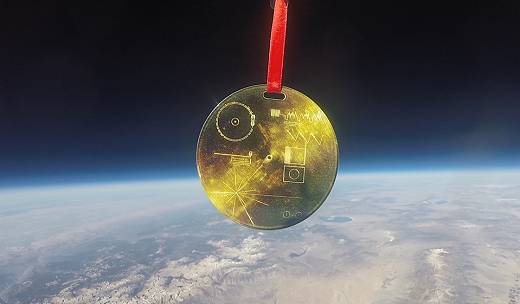
You can have it for $129.95. The 4-inch aluminum disk is imprinted with instructions intended for extraterrestrials, telling them how to play the phonographs now sailing through interstellar space onboard NASA's Voyager probes. Having touched the edge of space, it's the closest thing on Earth to an actual Golden Record.
The students are selling these unique ornaments to support their cosmic ray ballooning program. Each one comes with a greeting card showing the ornament in flight and extra materials decoding the markings on the disk.
Far Out Gifts: Earth to Sky Store
All sales support hands-on STEM education
Realtime Aurora Photo Gallery
Free: Spaceweather.com Newsletter