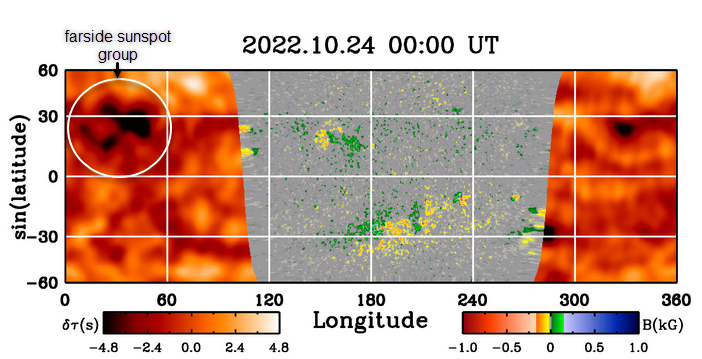
FARSIDE SUNSPOT: There is a sunspot on the farside of the sun so big it is changing the way the sun vibrates. Helioseismic maps reveal its acoustic echo a few days behind the sun's northeastern limb. The sunspot will rotate onto the Earthside of the sun later this week. Solar flare alerts: SMS Text
PARTIAL SOLAR ECLIPSE: Today, the Moon passed in front of the sun, producing a partial eclipse widely visible from Europe to India. Pictures are pouring in to our solar eclipse gallery. Here's one from Munich, Germany -- and it's not what it appears to be:

It's not a painting of an eclipse. It's a painting with an eclipse. "I projected an image of the eclipsed sun onto an oil painting," explains photographer Rex Kramer. "I call it 'augmented reality.'"
At the edge of the eclipse zone in India, the sun was no more than 10% covered. Nevertheless,, the event was visible because it occured at sunset when the solar disk was dimmed by low-hanging clouds and haze. Arun Radhakrishnan sends this picture from Thrissur:

"What a beautiful way to end the day," says Radhakrishnan. "I tracked the eclipse all the way down to the horizon."



Got a picture of the eclipse? Submit it here.
Realtime Solar Eclipse Photo Gallery
Free: Spaceweather.com Newsletter
AMBER BUMBLEBEE SPACE PENDANT: Bumblebees don't usually fly so high. On Oct 15, 2022, the students of Earth to Sky Calculus launched this one to the stratosphere onboard a cosmic ray research balloon. Here it is floating 115,158 feet above California's Sierra Nevada:
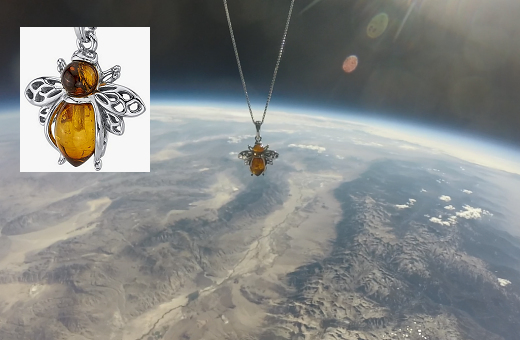
You can have it for $159.95. This bee is made of genuine Baltic Amber with a sterling silver exoskeleton. The rich Cognac-colored pendant measures 3/4 inch and comes with a matching 18-inch sterling silver chain.
The students are selling these unique pendants to support their cosmic ray ballooning program. Each one comes with a greeting card showing the bumblebee in flight and telling the story of its trip to the stratosphere and back again.
Far Out Gifts: Earth to Sky Store
All sales support hands-on STEM education
WATCH TWO COMETS DIVE INTO THE SUN: Over the weekend, the sun swallowed a comet. Correction: Make that two. Karl Battams of the US Naval Research Lab took a closer look at SOHO coronagraph images, and this is what he found:
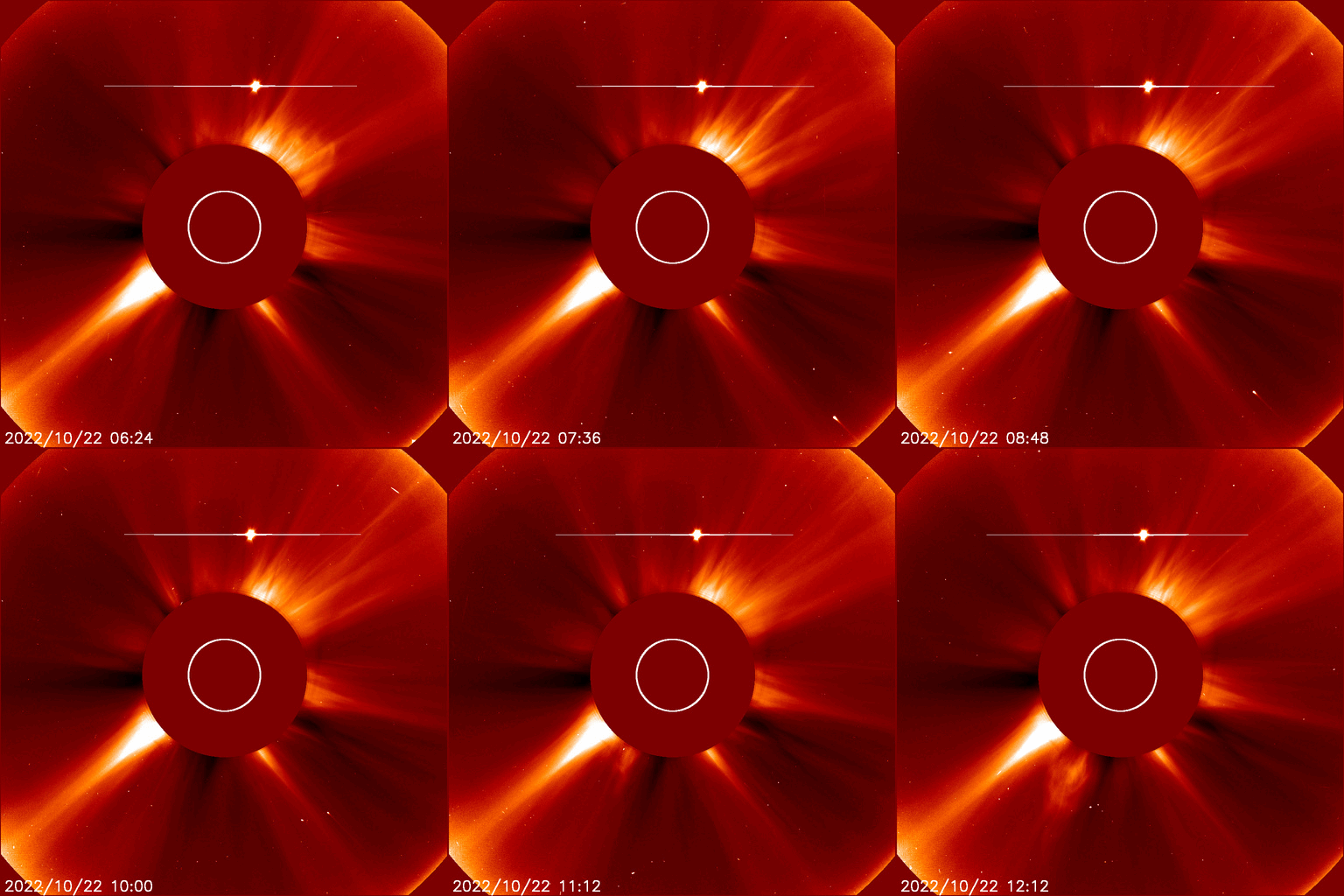
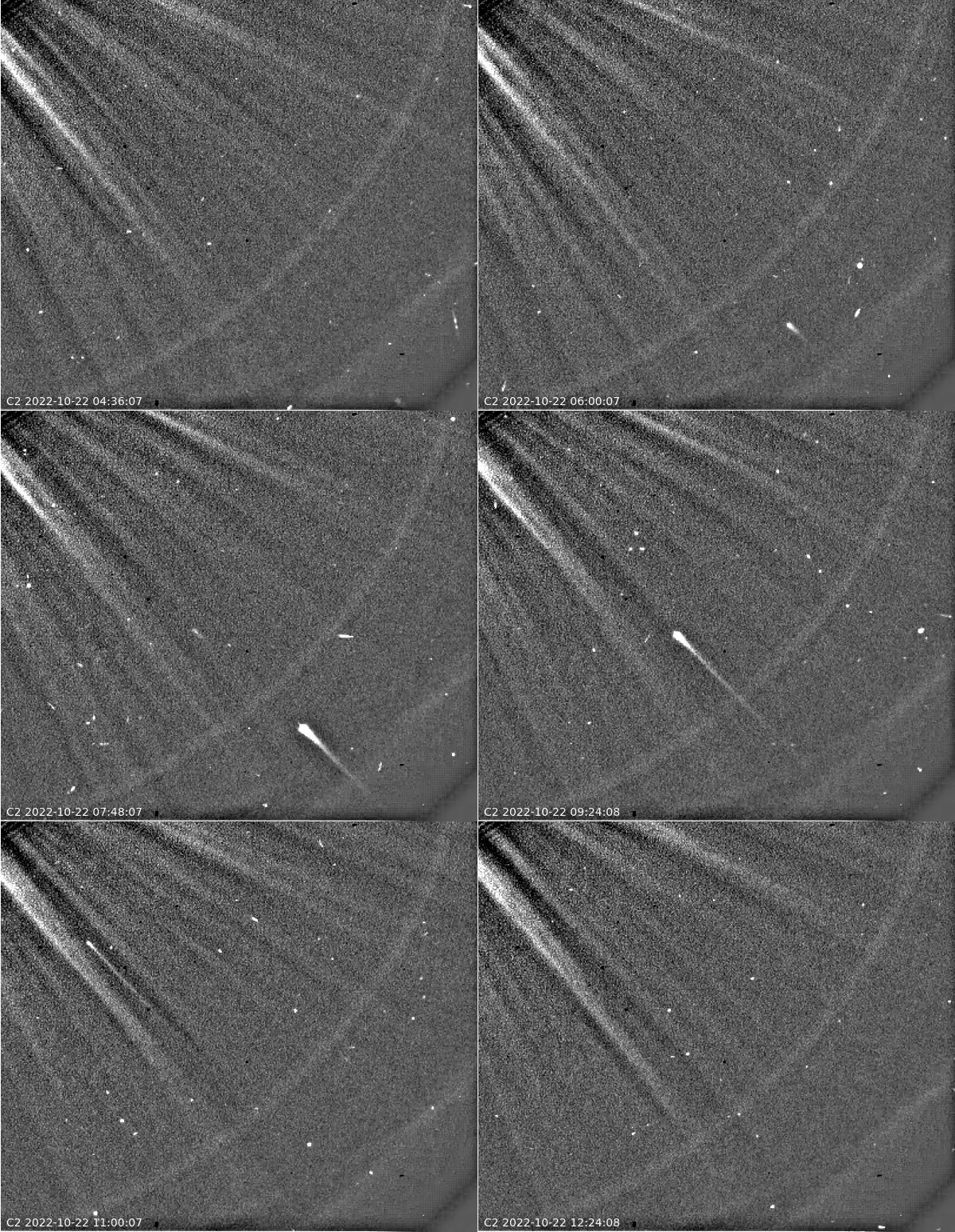
"Saturday's bright comet turned out to have a smaller, leading companion," says Battams. "This isn't particularly uncommon. I'd estimate that at least 30% of the really bright sungrazers we see in SOHO coronagraph images end up having a small leading or trailing companion."
Both comets in Battams' movie are Kreutz sungrazers. These are fragments from the breakup of a single giant comet many centuries ago. Since SOHO was launched in 1995, the observatory has watched more than 4000 Kreutz fragments fall into the sun. None have survived.
Astronomers have long wondered if one day a whole cluster of Kreutz fragments might appear--a veritable squadron of comets dive-bombing the sun. Such a swarm could be concentrated around the location of the progenitor comet. However, no one knows if or when it would happen.
"We have absolutely no idea what the actual distribution of Kreutz comets looks like around their orbit," notes Battams. "Undoubtedly there are clusters, but it’s a several-century long path they're following and we've only been blessed with a ~25-yr window into that. So all we can do is just keep watching and counting."
Realtime Aurora Photo Gallery
Free: Spaceweather.com Newsletter