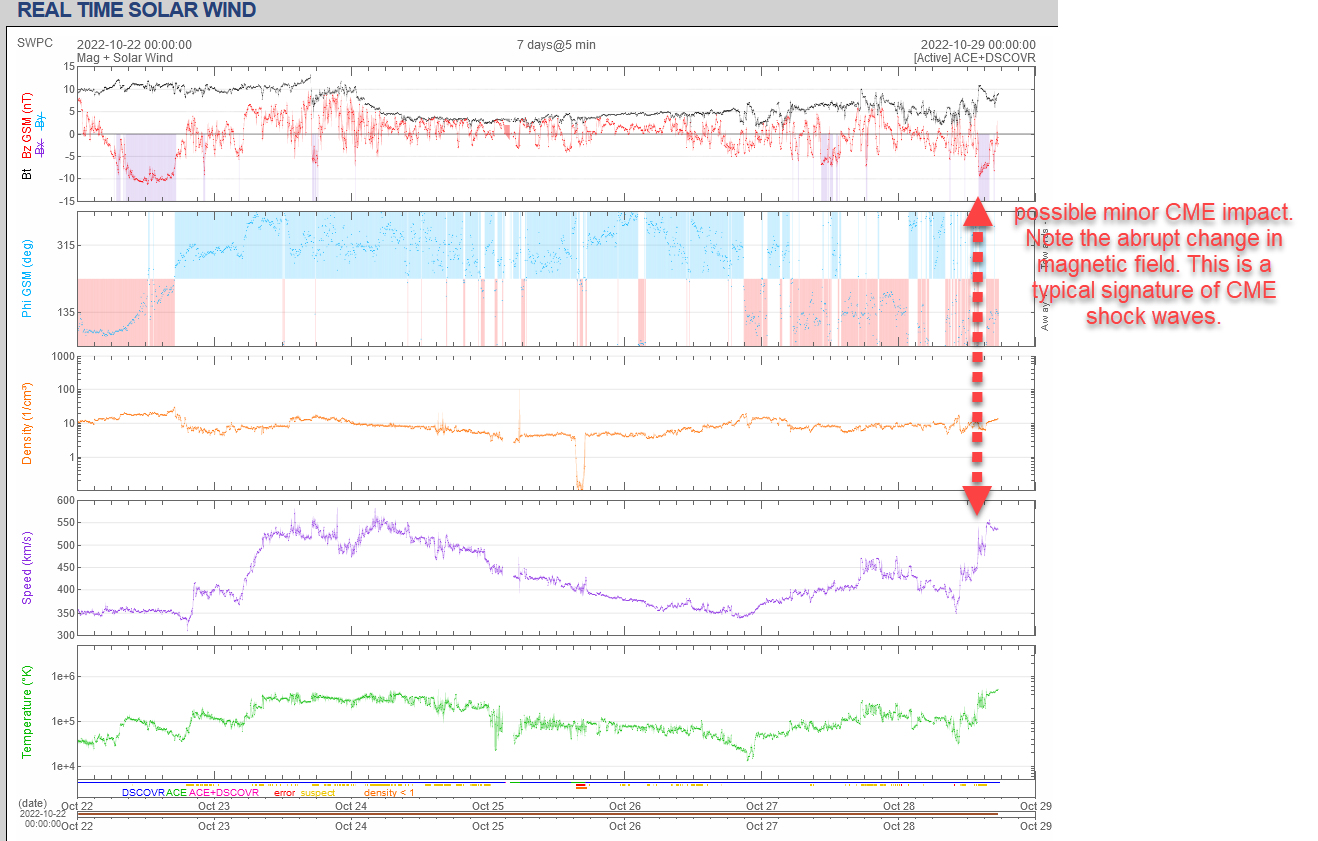
POSSIBLE MINOR CME IMPACT: Solar wind data from NOAA's DSCOVR spacecraft suggest that a minor unanticipated CME might have struck Earth's magnetic field on Oct. 28th around 1400 UT. The weak impact sets the stage for possible G1-class geomagnetic storms in the hours ahead. Aurora alerts: SMS Text

STARLINK SATELLITE LAUNCH: Earth just got 53 more satellites. They blasted into space Thursday evening (Oct. 27th) onboard a Falcon 9 rocket launched from Vandenberg Space Force Base in California. Gary Palmer photographed the contrail 500 miles away in Sedona, Arizona:
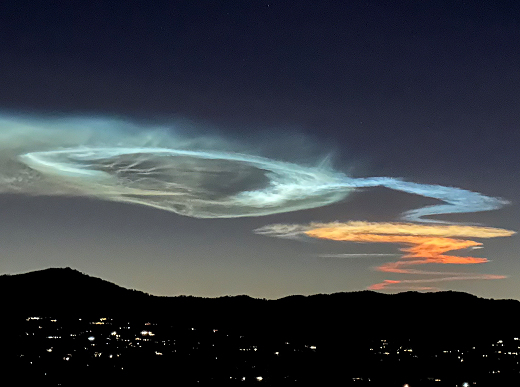
"Falcon 9 propellant is truly somewhere over the rainbow," says Palmer. "I took the picture using my iPhone 14PRO."
Streaking through the western sunset, the rocket carried 53 Starlink satellites to low Earth orbit. It was SpaceX's 49th launch of the year, bringing the total number of Starlinks in orbit to more than 3550. The growing megaconstellation is already providing internet service to customers around the world; in fact, today's edition of Spaceweather.com was uploaded via Starlink.
more images: from Marcus Prazniak of Tonopah, Nevada; from Doug Backlund of Ajo, Arizona; from Dan Gibbons of St. George Utah; from Andrew N of Glendale, Arizona; from John Dwyer of Green Valley, Arizona; from Thom Peck of Poway, California; from Richard Sears of Atwater, California;
Realtime Space Weather Photo Gallery
Free: Spaceweather.com Newsletter
ASTEROID DIMORPHOS ONE MONTH LATER: On Sept. 26th, NASA slammed the DART spacecaft into asteroid Dimorphos--a test of planetary defense technology that successfully altered the asteroid's orbit. Exactly one month later, amateur astronomer Eliot Herman photographed the aftermath:
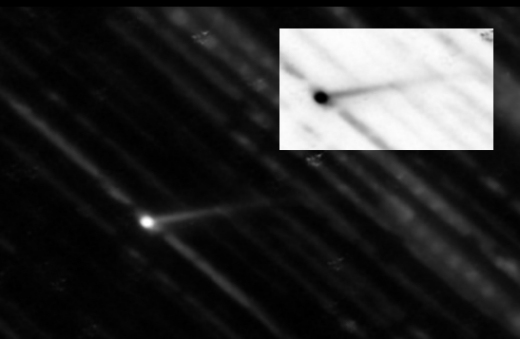
"The debris tail still extends thousands of kilometers from the asteroid," says Herman. "The tail is much diminished from its maximum two weeks after impact, but it is still streaming away from the asteroid moonlet even 30 days later. The man-made mini-comet continues to amaze."
To take this picture, Herman used a remote-controlled telescope in Rio Hurtado Valley, Chile. Southern hemisphere telescopes have had the best view of the battered asteroid since the impact one month ago. That's about to change. On Oct. 22nd, Dimorphos crossed the celestial equator heading north. Northern astronomers can now use their own telescopes to monitor developments.
more images: from Bill Williams of the Chiefland Astro Village, Florida; from Andrea Aletti of Campo dei Fiori Mount, Varese, Italy
Realtime Space Weather Photo Gallery
Free: Spaceweather.com Newsletter
AMBER BUMBLEBEE SPACE PENDANT: Bumblebees don't usually fly so high. On Oct 15, 2022, the students of Earth to Sky Calculus launched this one to the stratosphere onboard a cosmic ray research balloon. Here it is floating 115,158 feet above California's Sierra Nevada:
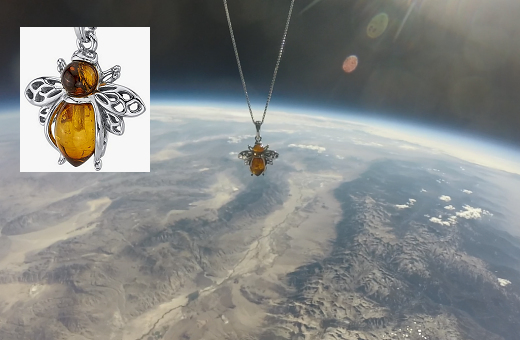
You can have it for $159.95. This bee is made of genuine Baltic Amber with a sterling silver exoskeleton. The rich Cognac-colored pendant measures 3/4 inch and comes with a matching 18-inch sterling silver chain.
The students are selling these unique pendants to support their cosmic ray ballooning program. Each one comes with a greeting card showing the bumblebee in flight and telling the story of its trip to the stratosphere and back again.
Far Out Gifts: Earth to Sky Store
All sales support hands-on STEM education
Realtime Aurora Photo Gallery
Free: Spaceweather.com Newsletter